
In Khula cases in Bahrain, the wife has the right to request Khula, while the husband is entitled to receive fair compensation for any harm that may result from the dissolution of the marriage contract.
Understanding Husband’s Rights in Khula in Bahrain is essential to ensure that the rights of both parties are protected in accordance with Bahraini law.
This article will review all legal aspects related to this subject, while explaining the role of a lawyer in defending the husband’s rights.
Contact us now by clicking the WhatsApp button at the bottom of the screen.
Table of Content
Husband’s Rights in Khula in Bahrain
Khula is the dissolution of a marriage contract based on the wife’s request in exchange for compensation paid to the husband. Bahraini law aims to maintain balance between both parties, requiring the wife to pay compensation known as “Khula consideration,” which is determined either through an agreement between the parties or by a judge’s decision.
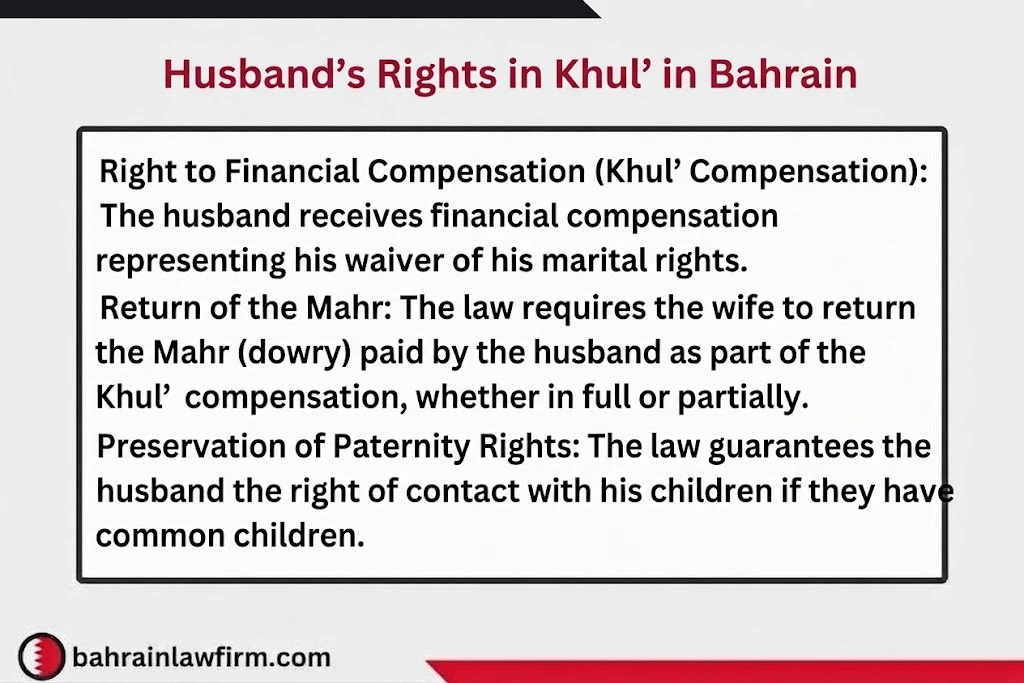
Under Bahraini law, the husband has the following rights in Khula:
- Right to financial compensation (Khula consideration): The husband receives financial compensation in return for giving up his marital rights. The amount is determined based on an agreement or a court decision.
- Return of the dowry: The law requires the wife to return the dowry paid by the husband as part of the Khula consideration, whether in full or partially.
- Preservation of parental rights: The law guarantees the husband’s right to communicate with his children if they have children together, with custody and visitation rights determined by agreement.
Khula Procedures and Protection of the Husband’s Rights
Khula procedures are carried out before the Bahraini Sharia Court by following these steps:
- Submitting a Khula request: The wife submits the request and explains the reasons for seeking Khula.
- Determining the Khula consideration: The appropriate compensation amount is decided by the judge based on the financial details of the case.
- Protecting the husband’s rights: The court ensures that the husband’s financial and moral rights are preserved throughout the process.
The Role of a Lawyer in Khula Cases
A lawyer plays an essential role in protecting Husband’s Rights in Khula in Bahrain. A lawyer assists with:
- Providing legal consultations: Explaining the husband’s rights and ensuring that no legitimate rights are overlooked.
- Representing the husband before the court: Preparing legal documents and presenting arguments before the judge.
- Negotiating the Khula consideration: Reaching the best possible financial compensation and ensuring the return of the dowry.
Get a professional legal consultation now from one of the leading law firms in Bahrain by clicking the WhatsApp button at the bottom of the screen.
Frequently Asked Questions
What Is the Minimum Khula Compensation in Bahrain?
There is no legally specified minimum amount for khula compensation. It is determined based on the agreement between the parties or by the court’s decision according to the financial and social circumstances.
Can the Husband Refuse a Khula Request?
Yes, the husband can refuse a khula request if the parties do not agree on the compensation or if there is a dispute regarding other rights. However, the final decision rests with the court.
Husband’s Rights in Khula in Bahrain is an important matter that helps achieve fairness between both parties. By understanding the law and appointing a specialized lawyer, the husband can protect his financial and legal rights.
Read more about: A list of the leading custody case lawyers in Bahrain.

A Bahraini lawyer and the founder of a legal consultancy firm established in February 2019. He holds a Higher Degree in Sharia and Law from Al-Azhar University. He has extensive experience in court representation and providing legal advice in criminal, personal status, civil, and commercial matters. He is known for delivering clear, practical, and effective legal advice aimed at protecting his clients’ rights and interests, and has achieved tangible results in notable cases, including commercial litigation and inheritance matters
