
A common legal situation occurs when a person suffers a physical injury or financial loss because of another party’s wrongful act and keeps medical reports, repair invoices, or other supporting documents. This raises an important question: is proving the damage alone enough to succeed in a Damages Claim in Bahrain?
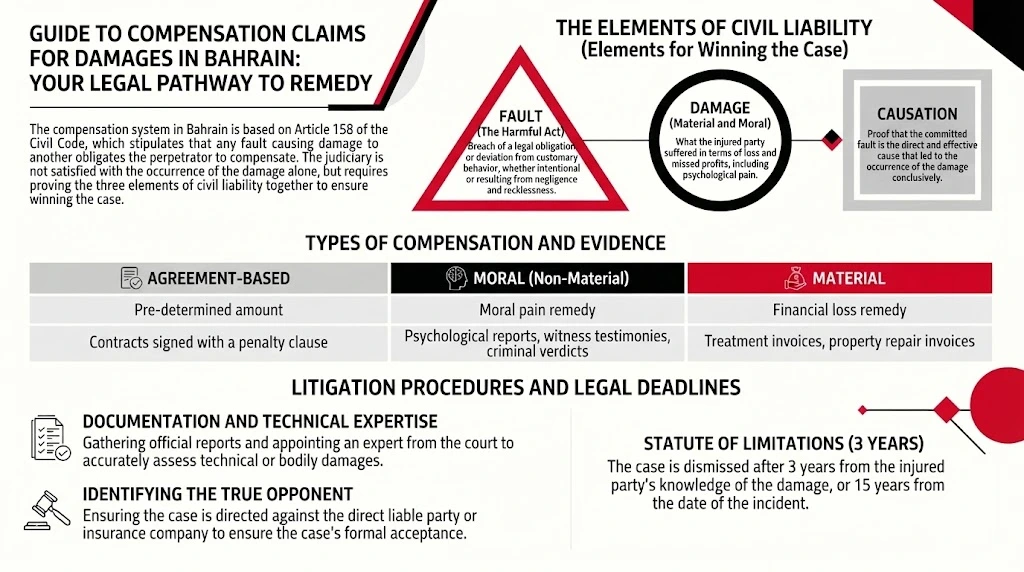
In practice, the answer is no. Proving the damage is only the first step. The court generally requires all three elements of civil liability to be established together: fault, damage, and a causal link between them before compensation can be awarded.
This guide explains the requirements for a damages claim, the procedures involved, and how to prepare a well-supported legal case.
Have you suffered financial or non-material damage and want to claim compensation?
Do not risk losing your rights because of insufficient evidence or missed legal time limits.
Request an Assessment of Your Compensation Case NowIf you would first like to understand the elements of civil liability and how courts assess compensation, continue reading below.
Table of Content
Damages Claim Under Bahraini Law
A damages claim in Bahrain is based on the general rule governing civil, or tortious, liability under Article 158 of the Bahraini Civil Code (Legislative Decree No. 19 of 2001). It establishes a clear principle: “Every fault that causes damage to another person obliges the person who committed it to compensate for that damage.“
The court therefore does not consider the extent of the damage alone. It also examines whether that damage resulted from a clear and proven fault. Whether the dispute is purely civil or involves decisions issued by government authorities that may require filing a Compensation Claim in Administrative Disputes in Bahrain, the basic rules of liability remain applicable.
How Are Damages Claims Accepted by the Court?
For the court to award compensation, the statement of claim must establish the following three elements:
1. Fault: Wrongful Act or Negligence
Fault means departing from the conduct normally expected in the circumstances or breaching a legal or contractual obligation. Bahraini law does not require the wrongful act to be intentional. Establishing negligence or reckless conduct may be sufficient. Examples of fault include:
- Driving recklessly and causing bodily injury, which may give rise to a Compensation Claim for Injuries Caused by a Car Accident.
- Fabricating malicious accusations, which may require filing a defense memorandum in a compensation claim arising from a false report.
- Physical assault, which may lead to filing a compensation claim arising from an assault offense.
- A landlord acting abusively or breaching contractual terms, which may cause a rental dispute and could result in the rejection of a Rental Compensation Claim if the fault is not properly proven.
2. Damage: Financial or Non-Material Loss
There can be no compensation without damage. Under Articles 161 and 162 of the Civil Code, compensation is assessed according to the loss suffered by the injured party and the profit or benefit they were deprived of. This may include:
- Financial damage: medical expenses, property repair costs, or loss of income.
- Non-material damage: emotional suffering, bodily disfigurement, or harm to honour and reputation, as may arise in defamation cases or Compensation Claims for Indecent Assault in Bahrain.
3. Causal Link
The fault must be the direct and effective cause of the damage. Article 165 provides that where the damage is proven to have resulted from an external cause, such as force majeure, the fault of a third party, or the injured party’s own fault, liability for compensation may not arise.
Types of Damage That May Be Compensated
The following table explains the main forms of compensation that may arise in a damages claim:
| Type of Compensation | Practical Meaning | Examples of Evidence |
|---|---|---|
| Financial Compensation | Compensation for financial loss or loss of expected income | Medical bills, repair reports, proof of income |
| Compensation for Non-Material Damage | Compensation for emotional suffering or harm to reputation or dignity | Reports, witnesses, supporting evidence, related criminal judgment |
| Compensation for Breach of Contract | Compensation for damage caused by failure or delay in performing a contractual obligation | Contract, notices, correspondence, invoices |
| Agreed Compensation | An amount agreed in advance as a contractual penalty | Contract, compensation clause, evidence that damage occurred |
Where compensation is not predetermined by contract or law, the court may assess it according to the proven damage and the circumstances of the case. The Civil Code also allows compensation to be awarded in money, restoration of the position that existed before the damage where possible, or another appropriate method of redress.
In contractual liability, the court generally considers the damage that could ordinarily have been foreseen when the contract was concluded, unless fraud or gross fault is involved. Contractual penalty clauses are also subject to specific rules, including the possibility of reducing the agreed amount where it is excessive or where the obligation has been partly performed.
Procedures for Filing a Damages Claim
Filing a damages claim in Bahrain requires following the proper procedural steps to reduce the risk of the case being dismissed on procedural or substantive grounds.
Sample Damages Claim in Bahrain
When filing a Damages Claim in Bahrain, it is important to prepare a statement of claim containing the necessary information and supporting documents. The following is a general sample that may be adapted to the circumstances of each case:
Court: …………….
Circuit: …………….
Claimant: ……………. ID No.: ………. Address: ………
Defendant: ……………. ID No.: …….. Address: …………
Subject: Damages Claim in Bahrain
Honourable President of the Court,
I respectfully file this claim seeking compensation for the damage I suffered as a result of the defendant’s act of (describe the harmful act, such as a traffic accident, medical error, commercial damage, etc.), which caused me (describe the damage, such as physical injuries, financial losses, or non-material damage).
First: Facts
On …./…./…., the defendant (describe the incident in detail), causing me serious damage as established by the attached reports and documents.
Second: Legal Basis of the Claim
Pursuant to Article (insert the appropriate legal provision) of the Bahraini Civil Code, any person who commits a fault that causes damage to another person is required to compensate for that damage.
Third: Requests
Based on the above, I respectfully request that the Court:
- Order the defendant to pay compensation in the amount of (specify amount) for the financial and non-material damage I suffered.
- Order the defendant to bear the court costs and legal fees.
- Award any additional compensation the Court considers appropriate in light of the proven damage.
Respectfully submitted,
Attachments: (medical reports, invoices, documents proving the damage, witness statements)
Applicant: (name and signature)
This sample is provided for general guidance only. It is preferable to consult a qualified lawyer to prepare a complete statement of claim that reflects the particular circumstances and legal basis of your case.
Common Reasons Damages Claims Are Rejected
Courts may reject compensation claims for reasons that could sometimes have been avoided when preparing the case. Common reasons include:
- Limitation period: Article 180 of the Civil Code provides that a compensation claim will not be heard after three years from the date on which the injured party became aware of the damage and the person responsible for it, or after fifteen years from the date of the unlawful act.
- Break in the chain of causation: This may arise where the defendant establishes that the damage resulted from force majeure or from the injured party’s own fault. This issue is explained further in our article on Defenses Available to a Defendant in a Compensation Claim in Bahrain.
- Unsupported or excessive claim: Seeking a large amount of compensation without supporting invoices, financial evidence, or expert reports may weaken the claim.
The Lawyer’s Role in a Damages Claim
Engaging an experienced Lawyer in Bahrain can assist with a damages claim in Bahrain by providing legal services such as:
- Explaining the claimant’s legal rights and the available methods for seeking compensation.
- Preparing and filing the legal documents required to support the claim.
- Representing the claimant before the courts and presenting the legal arguments supporting the claim.
Working with an experienced lawyer can help ensure that the claim is properly prepared, supported by the relevant evidence, and presented in accordance with the applicable legal procedures.
Frequently Asked Questions About Damages Claim in Bahrain
What Is the Time Limit for Filing a Compensation Claim for Damages?
Under Bahraini law, a compensation claim for damages must generally be filed within three years from the date the injured party becomes aware of both the damage and the person responsible for it.
Can Compensation Be Claimed for Psychological Harm?
Yes. Compensation may be claimed for psychological harm, as Bahraini law allows compensation for moral damage, including pain and suffering or damage to reputation.
What Documents Are Required to File a Compensation Claim?
The documents required to file a compensation claim may include:
1. Medical reports proving the injuries.
2. Witness statements.
3. Evidence of financial losses, such as medical bills or property repair invoices.
A Damages Claim in Bahrain provides a legal means for an injured party to seek compensation for proven damage caused by another person’s fault. If you believe you are entitled to compensation for damage you have suffered, obtaining legal advice can help you understand the basis of your claim, the available evidence, and the procedures that apply to your case.

A Bahraini lawyer and the founder of a legal consultancy firm established in February 2019. He holds a Higher Degree in Sharia and Law from Al-Azhar University. He has extensive experience in court representation and providing legal advice in criminal, personal status, civil, and commercial matters. He is known for delivering clear, practical, and effective legal advice aimed at protecting his clients’ rights and interests, and has achieved tangible results in notable cases, including commercial litigation and inheritance matters
