
At a company in Bahrain, an employer found out that one of his employees had submitted forged certificates when he applied for the job. Relying on Article 107 of the Bahraini Labour Law, the employer ended the employment contract without notice or compensation.
This case shows why it pays to understand the article. It spells out the rights and duties of both employers and workers, as Bahraini law sets them. So read on closely.
Have you been accused of serious violations to justify firing you and cutting off your end-of-service gratuity under Article 107?
Table of Content
Article 107 of the Bahraini Labour Law: Detailed Explanation
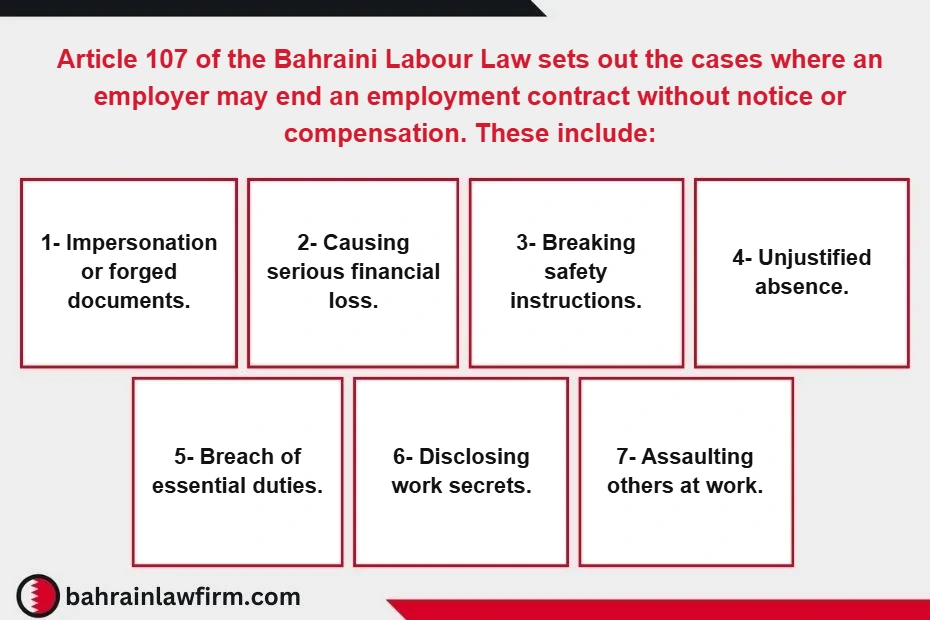
Article 107 of the Bahraini Labour Law lists the cases where an employer may end an employment contract without notice or compensation. They include the following:
- Impersonation or forged documents: If a worker gives false information about his identity, or submits forged certificates or recommendation letters, the employer may end the contract right away.
- Causing serious financial loss: If a worker makes a mistake that costs the employer a large sum, the contract can be ended. The employer must report the incident to the competent authorities within two working days of learning about the loss.
- Breaking safety instructions: A worker who ignores the safety rules set to protect workers and the establishment, even after a written warning, gives the employer grounds to end the contract. These rules must be written, clear, and posted in the workplace.
- Unjustified absence: If a worker stays away without a lawful reason for more than twenty days in total (not consecutive) or ten consecutive days within one year, the employer may end the contract. A written warning must come first: after ten days of absence in the first case, and after five days in the second.
- Breach of essential duties: When a worker fails to perform the basic duties agreed in the employment contract, the employer has a lawful reason to end it without notice or compensation.
- Disclosing work secrets: This applies if a worker reveals business secrets without written permission from the employer, and the disclosure harms the business or the employer’s interests.
- Conviction for a crime against honour: A final court judgment against the worker for a felony or misdemeanour involving dishonour, breach of trust, or public morals justifies ending the contract without compensation.
- Drug use or drunkenness at work: A worker who is clearly drunk or under the influence of drugs during working hours, or who commits indecent acts at the workplace, can be dismissed immediately.
- Assaulting others at work: If a worker assaults the employer or the manager in charge, or seriously assaults a colleague or a customer during work or because of it, the employer may end the contract without notice.
- Breaking the rules on strikes: A worker who does not follow the legal rules for exercising the right to strike may lose the contract without compensation.
- Losing the qualifications needed for the job: If a worker becomes unfit for the agreed work for a reason that comes from him, such as a revoked licence to practise or the loss of required qualifications, the employer may end the contract.
Read more: employee rights in case of arbitrary dismissal in Bahrain.
Our Firm’s Role in Providing Legal Consultations
At the office of lawyer Abdulrahman Khalifa, we value understanding and applying labour laws in a way that brings justice and protects every party. We offer our clients the following services:
- Specialised legal consultations: We give precise advice on how Article 107 and other articles of the Bahraini Labour Law apply.
- Drafting and reviewing employment contracts: We help write contracts that follow current laws and protect the rights of everyone involved.
- Resolving labour disputes: We represent our clients in labour disputes and work to settle them, amicably or through the courts, in the way that best serves their interests.
Don’t hesitate to ask for a consultation with a corporate labour lawyer from our firm whenever you need one. We’re ready to give you legal advice with full honesty and transparency.
Frequently Asked Questions
Our article on Article 111 of the Bahraini Labour Law also covers its provisions in detail.
When can an employer end an employment contract without notice or compensation?
An employer can end the contract without notice or compensation if the worker breaks one of the conditions set out in Article 107. Examples include submitting forged documents, causing serious losses, staying away from work without a reason, or assaulting others at the workplace.
Can a worker object if his contract is ended under Article 107?
Yes. The worker can go to the Ministry of Labour or the courts to challenge the dismissal if he believes it was arbitrary or had no valid legal grounds.
Must the employer give a warning before ending the contract under Article 107?
In some cases, such as unjustified absence or ignoring safety instructions, the employer must send a written warning first. In others, such as forgery or assault, the contract can be ended right away.
What steps must an employer follow when dismissing a worker under Article 107?
The employer must document the reason for the dismissal, notify the competent authorities where required, and prove that the worker committed the violation. This matters most in cases that may call for a formal investigation.
In short, Article 107 of the Bahraini Labour Law sets out the cases where an employer can end an employment contract without notice or compensation, which helps keep the workplace safe and fair. When employers and workers understand these cases and meet their duties, the working relationship grows stronger and the workplace becomes more stable.
For specialised legal advice, please contact a lawyer in Bahrain by clicking the WhatsApp button at the bottom of the screen.

A Bahraini lawyer and the founder of a legal consultancy firm established in February 2019. He holds a Higher Degree in Sharia and Law from Al-Azhar University. He has extensive experience in court representation and providing legal advice in criminal, personal status, civil, and commercial matters. He is known for delivering clear, practical, and effective legal advice aimed at protecting his clients’ rights and interests, and has achieved tangible results in notable cases, including commercial litigation and inheritance matters
