

Legal Review: This content was written and reviewed by the legal team at Abdulrahman Khalifa Law Firm.
Last Updated: August 30, 2026.
Category: Bahraini Family Law.
One case began with what appeared to be a simple request: “I want to file for divorce.” However, when the lawyer reviewed the documents, other issues emerged that the client had not initially considered.
There were two children, school expenses, a dispute over housing, and a previous visitation agreement that had not been implemented.
Reviewing the file changed the way the dispute was approached. The question was no longer simply: How do we file for divorce? Instead, it became: How can the marriage be brought to an end while protecting financial rights, regulating the children’s arrangements, and avoiding a new dispute at the enforcement stage?
For this reason, choosing the best Divorce Lawyer in Bahrain should not be based on an attractive advertisement or a promise of a quick result. It should be based on selecting a licensed lawyer who understands Bahraini family law and reviews the details before recommending a course of action.
Are you feeling overwhelmed by the hidden complexities of filing for divorce in Bahrain? Don’t let uncertainty about child custody, financial rights, and changing family laws put your future at risk.
Table of Content
How Do You Choose the Best Divorce Lawyer in Bahrain?
Begin with clear criteria that you can verify yourself. Do not rely on the word “best” alone, because it is neither an official government ranking nor a guarantee of a particular outcome.
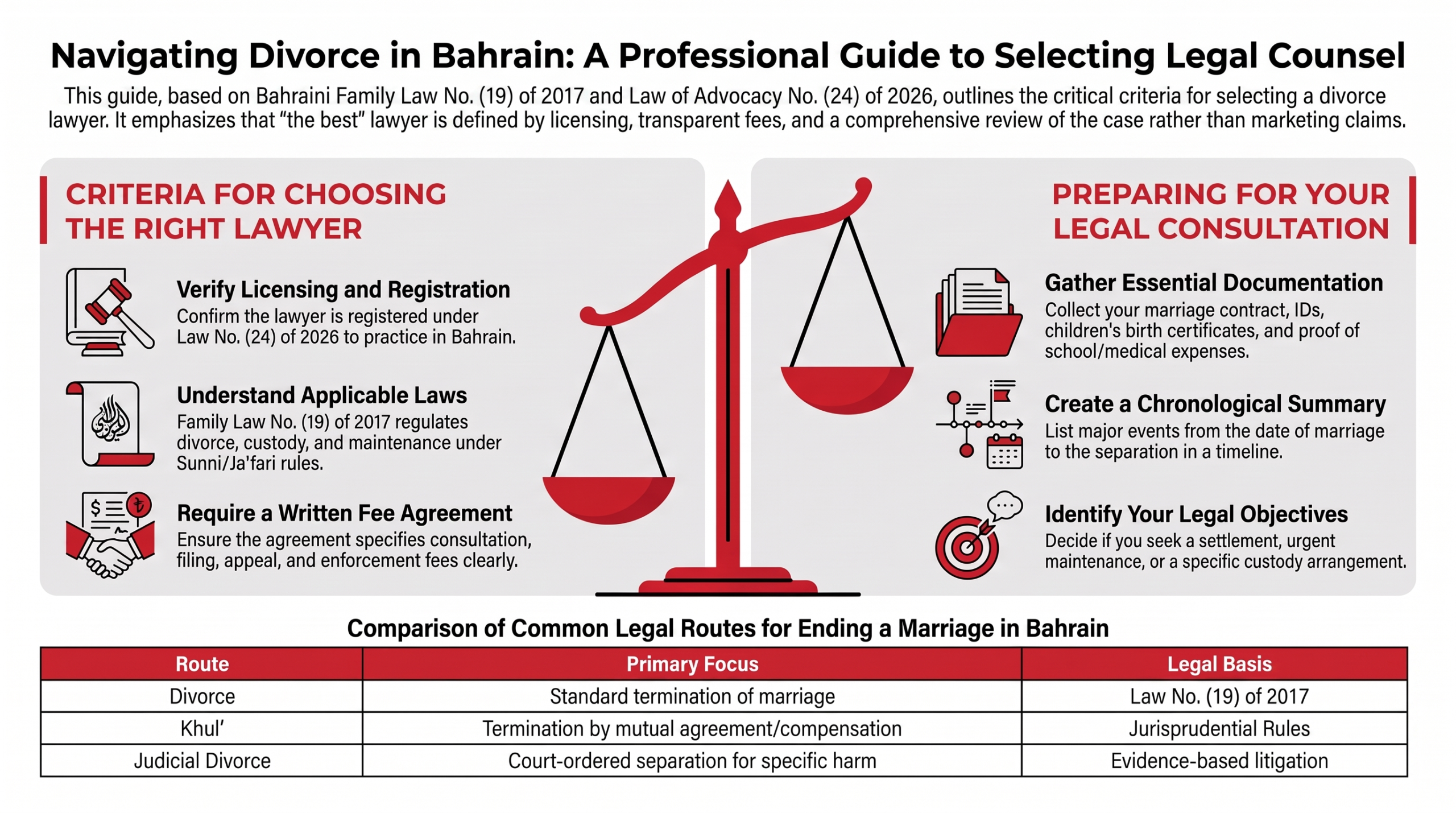
Family Law No. (19) of 2017 regulates divorce, khul’, judicial divorce, maintenance, custody, parentage, and other family matters.
The Law also takes into account the rules applicable under Sunni and Ja’fari jurisprudence, according to the marriage contract and the provisions set out in the Law. The legal answer may therefore differ from one case to another even where the facts initially appear similar.
Verify Licensing and Professional Registration
First, confirm that the lawyer is licensed and registered to practise in Bahrain. Then ask which Divorce Lawyer in Bahrain will actually handle your case rather than relying solely on the name of the law firm.
The current Law of Advocacy was issued as Law No. (24) of 2026 and published in the Official Gazette on June 18, 2026. The Law regulates the requirements for professional registration, legal practice, and the obligations imposed on lawyers.
When choosing a lawyer, review the following points:
- The name of the lawyer responsible for your case.
- The lawyer’s professional status and level of registration.
- The lawyer’s ability to appear before the competent court.
- How communication will be managed during the case.
- Who will prepare the statement of claim and legal memoranda.
- How documents will be delivered and retained.
The appearance of a firm’s name in search results is not enough. Ask who will study the file, who will attend hearings, and who will respond to your questions.
Experience in Family Law Cases
Ask about practical experience in divorce, judicial divorce, khul’, khul’ divorce, maintenance, custody, visitation, and enforcement matters. Several of these issues may arise within the same file, and each claim may require different documents and procedures.
You can assess experience by considering the questions the lawyer asks, including:
- What type of marriage contract applies?
- Does the contract contain any special conditions?
- Has there been a previous divorce?
- Are there previous cases or judgments?
- Are there children, and what are their ages?
- Is there a dispute concerning custody or visitation?
- Is there a claim for maintenance or housing?
- What evidence is available to prove the relevant facts?
The Family Law distinguishes between divorce, khul’, and judicial divorce or judicial separation. Each route has different conditions and legal consequences. A lawyer should therefore identify the appropriate course after reviewing the facts rather than merely acting on one party’s stated preference.
Assess How the Case Is Reviewed
Observe the lawyer’s approach from the first meeting. A professional Divorce Lawyer in Bahrain should begin by gathering information, organising it, and only then giving legal advice.
Look for clear steps such as:
- Requesting a chronological summary of events.
- Reviewing the marriage contract.
- Examining previous judgments and agreements.
- Reviewing documents relating to both parties’ income.
- Identifying the needs of the children.
- Separating strong evidence from weak evidence.
- Identifying urgent applications.
- Comparing settlement with litigation.
- Explaining risks before proceedings begin.
A review of the documents may reveal that the immediate priority is not limited to filing a divorce case. A wife may need to seek temporary maintenance, one parent may need formal visitation arrangements, or the appropriate step may be to enforce an existing judgment rather than commence a new case.
Clear Fees and Scope of Services
Ask for a clear agreement before the lawyer begins work. The agreement should explain the services provided in return for the agreed fees.
Depending on your circumstances, ask for clarification regarding:
- The fee for the initial consultation.
- The cost of reviewing documents.
- Fees for filing the case.
- Fees for preparing legal memoranda.
- The number of hearings or stages included.
- Fees for urgent applications.
- Appeal fees.
- Enforcement fees.
- Court fees and expenses excluded from the lawyer’s fees.
- Payment or instalment arrangements.
- Procedures for terminating the engagement and returning the file.
Always distinguish between the fees charged by a Divorce Lawyer in Bahrain and government fees or expenses relating to translation, notarisation, expert reports, or service of process.
Avoid Guarantees of Results
Avoid anyone who guarantees a judgment before reviewing the file. A lawyer does not issue the judgment and cannot control the evidence presented by the opposing party or the court’s assessment of the case.
A lawyer should instead provide an explanation covering:
- The strengths of the case.
- Potential weaknesses.
- Missing documents.
- Claims that can be supported by evidence.
- Procedural risks.
- Settlement opportunities.
- Expected stages.
- Available alternatives if circumstances change.
According to the firm’s identity guide, Abdulrahman Khalifa Law Firm follows an approach based on realistic expectations, clear communication, and avoiding exaggerated promises.
What Does a Divorce Lawyer in Bahrain Provide?
The work of a Divorce Lawyer in Bahrain may begin before a case is filed and continue until the divorce documentation is obtained and the judgment is enforced, depending on the scope of representation and the agreed legal fees.
Assessing the Legal Position
The lawyer reviews the case from several perspectives rather than focusing only on the reason for seeking divorce.
The assessment usually includes:
- Details of the marriage contract.
- The applicable jurisprudential rules.
- The method sought for ending the marriage.
- The history of the dispute and separation.
- The circumstances of the children.
- Current and past maintenance.
- Housing arrangements and expenses.
- Existing judgments or agreements.
- Evidence and correspondence.
- Court jurisdiction.
- Urgent applications.
- Prospects of settlement.
This assessment helps determine whether the matter requires a single case or several connected procedures.
Providing Legal Advice
The lawyer explains the available options clearly and discusses how each option may affect financial rights, children, time, and cost.
The consultation should answer questions such as:
- What type of case is appropriate?
- What documents are required?
- What needs to be proven?
- Can temporary maintenance be requested?
- Can custody and visitation arrangements be agreed?
- Is settlement appropriate at this stage?
- Is there a previous judgment that should be enforced?
- What risks may arise later?
Seeking advice does not mean encouraging the client to proceed with divorce. A consultation may reveal that a written agreement would protect the parties’ rights more effectively or that an urgent application should be made before negotiations begin.
Preparing the Statement of Claim and Legal Memoranda
The lawyer organises the facts chronologically and connects them to the supporting documents and legal relief sought.
A properly prepared statement of claim should contain clear elements, including:
- Correct information about the parties.
- A concise explanation of the marriage and dispute.
- Facts directly relevant to the claim.
- Verifiable dates.
- Documents supporting each important fact.
- Specific and consistent requests for relief.
- A legal basis appropriate to the type of case.
The lawyer avoids unnecessary emotional statements that add no evidential value and instead focuses on what happened, when it happened, how it can be proven, and what relief is sought from the court.
Representation Before the Court
The lawyer attends hearings within the scope of the power of attorney, submits applications and legal memoranda, and responds to the opposing party’s defence.
Depending on the agreement, representation may include:
- Registering the case.
- Following up on service of process.
- Attending hearings.
- Submitting documents.
- Responding to legal memoranda.
- Requesting witness testimony when required.
- Following court decisions.
- Explaining the outcome of each hearing to the client.
- Identifying the next step.
The court may require the husband or wife to attend personally when it wishes to hear that person’s statements or attempt reconciliation. Appointing a lawyer therefore does not necessarily mean that the client will never be required to attend in person.
Following Up on the Judgment and Enforcement
Not every case ends once a judgment is issued. A client may need to appeal, enforce the judgment, or obtain the official divorce document.
Follow-up may include:
- Obtaining a copy of the judgment.
- Explaining the operative part of the judgment and its effects.
- Reviewing grounds for appeal.
- Monitoring the appeal deadline.
- Obtaining the required documentation.
- Opening an enforcement file.
- Claiming maintenance awarded by the court.
- Enforcing custody or visitation arrangements.
- Submitting enforcement-related applications.
The Ministry of Justice provides an official guide for electronically filing divorce cases, while Bahrain’s national portal also provides a service allowing parties or their representatives to file cases.
What Cases Does a Family Lawyer Handle?
A Divorce Lawyer in Bahrain handles the legal termination of marriage as well as rights and obligations that arise during the case or continue after it.
Divorce and Judicial Divorce Cases
The lawyer determines the appropriate type of proceeding after reviewing the marriage contract and the facts.
Cases may include:
- Establishing a divorce.
- Officially documenting a divorce.
- Judicial divorce claims.
- Judicial separation claims.
- Disputes concerning the consequences of divorce.
- Enforcement of a previous separation agreement.
- Obtaining the divorce document after completion of the required procedures.
Divorce, khul’, and judicial divorce should not be treated as interchangeable legal terms. Their requirements, evidence, and legal consequences differ, and certain details also vary depending on the applicable jurisprudential rules.
What Should You Prepare Before Consulting a Divorce Lawyer in Bahrain?
Prepare a simple file before the consultation. Complex organisation is not necessary. Gather the documents, write down the facts, and identify what you want to understand.
Summary of the Facts
Write the events chronologically, beginning with the date of marriage.
The summary may include:
- Date of marriage.
- Date the dispute began.
- The most significant events.
- Attempts at reconciliation.
- Date of actual separation.
- Current circumstances of the children.
- Date of the last maintenance payment.
- Any previous case or judgment.
- The outcome you are seeking.
Use one short sentence for each event and leave lengthy details for discussion during the consultation.
Marriage Contract and Identification
Bring clear copies of the main documents.
The initial documents should include:
- Marriage contract.
- Identity card.
- Passport where required.
- Address of the other party.
- Any annex or condition connected with the marriage contract.
- Previous divorce document, if applicable.
The marriage contract contains information that may affect the legal analysis, including the date of the contract, contractual conditions, dowry, and information relevant to the jurisprudential rules applicable to the marriage.
Documents Relating to Children and Income
Collect documents showing the children’s needs and the parties’ financial circumstances.
These may include:
- Children’s birth certificates.
- Proof of school enrolment.
- School invoices.
- Medical reports.
- Medical bills.
- Tenancy agreement.
- Receipts for essential expenses.
- Salary certificate.
- Evidence of income where lawfully available.
- Previous maintenance judgments.
Obtain evidence through lawful means. Do not access the other party’s phone, accounts, or email without permission.
Previous Judgments or Agreements
Provide every document relating to an earlier dispute between the parties.
Important documents may include:
- Maintenance judgment.
- Custody judgment.
- Visitation judgment.
- Settlement record.
- Written agreement.
- Formal legal notice.
- Statement of claim in a pending case.
- Decision issued during previous proceedings.
- Enforcement documents.
The appropriate step may be to enforce or seek amendment of an existing judgment rather than filing a completely new case.
Identify Your Objectives Before the Consultation
Decide what you want to achieve before the meeting.
Your objective may be to:
- Understand your rights before deciding on divorce.
- Attempt to reach a settlement.
- File a judicial divorce claim.
- Seek urgent maintenance.
- Regulate custody or visitation.
- Enforce an existing judgment.
- Understand the effect of an agreement you have been asked to sign.
- Estimate the likely time, cost, and procedural steps.
A clear objective helps a Divorce Lawyer in Bahrain organise priorities, although reviewing the documents may reveal that another option would be more appropriate.
How Much Does a Divorce Lawyer in Bahrain Cost?
There is no single fee applicable to every case. The cost varies according to the amount of work required, the number of claims, and the stages of litigation involved.
The following explanation represents a general professional opinion and does not constitute fixed pricing for any particular case.
Type of Case
The type of proceedings directly affects the amount of legal work required. Fees may differ between:
- Pre-divorce consultation.
- Establishing a divorce.
- Judicial divorce proceedings.
- Khul’ proceedings.
- Maintenance proceedings.
- Custody or visitation proceedings.
- A case involving several claims.
- Appeal proceedings.
- Enforcement of a previous judgment.
A limited matter may require relatively few documents, while another case may involve witnesses, legal memoranda, and multiple applications.
Number of Court Applications
The work increases when several applications are required. A matter may involve:
- Divorce or judicial divorce proceedings.
- An application for temporary maintenance.
- Child maintenance proceedings.
- A custody application.
- A visitation application.
- An appeal.
- An enforcement file.
Ask whether these services are included in one fee or whether separate fees apply to each stage.
Complexity of the Case and Documents
Fees generally increase where the file requires more time and extensive review.
Factors that may increase complexity include:
- A large volume of documents.
- Conflicting accounts of events.
- Existing judgments.
- A party residing outside Bahrain.
- Translation or authentication requirements.
- Difficulties with service of process.
- Disputes concerning a party’s income.
- Claims relating to more than one child.
- The need for witnesses or specialist reports.
Litigation Stages Included in the Fees
Ask about each stage separately.
The fee agreement should clarify whether it includes:
- Initial case assessment.
- Court of First Instance proceedings.
- Appeal proceedings.
- Cassation where applicable.
- Urgent applications.
- Obtaining official documents.
- Opening an enforcement file.
- Enforcement follow-up.
- Additional meetings.
- Legal memoranda outside the original scope.
Do not assume that fees for first-instance proceedings automatically include appeals and enforcement.
What Should the Fee Agreement Include?
Request a written and understandable fee agreement.
It should preferably include:
- The client’s and lawyer’s names.
- Description of the legal service.
- Scope of representation.
- Amount of legal fees.
- Payment dates.
- Instalment arrangements where agreed.
- Fees and expenses not included.
- Stages of work.
- Communication arrangements.
- Procedure for terminating the engagement.
- Method for returning documents.
The firm follows an approach based on fee transparency and may offer instalment arrangements depending on the nature of the matter and the agreement. According to the firm’s identity guide, focused consultations start from BHD 30.
Are you worried that a rushed decision in your divorce proceedings could jeopardize your financial rights or your children’s future? Don’t leave your family’s well-being to chance.
Not ready to talk yet? Continue reading below to learn how to prepare your documents and avoid common procedural mistakes.
How Do You Appoint the Best Divorce Lawyer in Bahrain?
Follow clear steps before issuing a power of attorney. This helps ensure that you understand the scope of services and what will happen at each stage.
Present the Details of the Case
Explain all relevant facts, including facts you believe may weaken your position.
Tell the lawyer about:
- The reason for the dispute.
- The other party’s position.
- The circumstances of the children.
- Financial claims.
- Previous judgments.
- Settlement attempts.
- Available evidence.
- Any document you have been asked to sign.
- Any upcoming date or existing hearing.
A lawyer needs the complete picture before developing a legal strategy.
Review the Documents
Send clear copies and arrange them chronologically where possible.
Begin with:
- Marriage contract.
- Identification.
- Children’s documents.
- Previous judgments.
- Settlement agreements.
- Evidence of income and expenses.
- Important correspondence.
- Statement of claim in any pending proceedings.
Keep the original documents until the Divorce Lawyer in Bahrain or the court requests them.
Agree on the Scope of Work
Define the required service before issuing the power of attorney.
The scope may include:
- Written or oral legal advice.
- Review of the file.
- Negotiations with the other party.
- Drafting an agreement.
- Filing a case.
- Defending an existing case.
- Submitting an urgent application.
- Appeal.
- Enforcement.
Record the scope in the fee agreement rather than relying on a general verbal understanding.
Issue the Power of Attorney
Read the power of attorney before approving it and ensure that it gives the Divorce Lawyer in Bahrain the authority required to perform the agreed work.
Pay particular attention to:
- Name of the lawyer or firm.
- Type of case.
- Authority to file proceedings.
- Authority to submit legal memoranda and applications.
- Authority to appear before courts.
- Authority to settle or waive rights, if included.
- Duration of the power of attorney.
- Method of revocation where necessary.
Law No. (24) of 2026 regulates the legal profession and a lawyer’s representation of clients.
Commencing Legal Proceedings
The lawyer begins work after the documents, power of attorney, and fee agreement have been completed.
The process may begin with one of the following:
- Sending legal correspondence.
- Starting structured negotiations.
- Drafting a settlement agreement.
- Filing a case electronically.
- Submitting an urgent application.
- Responding to existing proceedings.
- Opening an enforcement file.
The Ministry of Justice provides guides for filing cases electronically, while Bahrain’s national portal also allows parties or their representatives to submit court cases.
Why Is It Advisable to Consult a Divorce Lawyer in Bahrain From the Beginning of the Dispute?
Early advice from a Divorce Lawyer in Bahrain can help protect rights before the dispute develops into steps that may be difficult to reverse.
Protect Rights From the Beginning
Review every agreement or waiver before signing it.
From the outset:
- Preserve the marriage contract and official documents.
- Collect documents relating to the children.
- Keep records of expenses.
- Preserve previous judgments.
- Read agreements before signing them.
- Avoid giving waivers that you do not understand.
- Avoid angry messages.
- Do not publish details of the dispute.
- Use lawful methods when collecting evidence.
A written statement or poorly considered waiver may affect later stages of the case.
Avoid Procedural Errors
A lawyer can help reduce errors that may delay the case or weaken a claim.
Common mistakes include:
- Choosing the wrong type of proceeding.
- Submitting inconsistent claims.
- Omitting an important document.
- Relying on unclear evidence.
- Missing an appeal deadline.
- Failing to follow up on service of process.
- Filing a new case despite the existence of an enforceable judgment.
- Signing an agreement without understanding its consequences.
Build an Appropriate Legal Strategy
The lawyer compares settlement and litigation and explains the advantages and risks of each approach.
The strategy is usually based on:
- The desired outcome.
- Strength of the evidence.
- Circumstances of the children.
- Whether urgent action is required.
- The other party’s position.
- Expected time.
- Cost.
- Ability to enforce the outcome.
- Effect of the dispute on the family.
Settlement may be preferable where it protects rights and reduces the effect of the dispute on the children. Court proceedings may become necessary where negotiations fail or urgent protection is required.
Legal Representation Throughout the Case
A lawyer can maintain a consistent presentation of the case from beginning to end.
Comprehensive representation assists with:
- Consistency of the facts presented.
- Clarity of the legal claims.
- Organisation of documents.
- Attendance at hearings.
- Timely responses.
- Review of the judgment.
- Decisions concerning appeal.
- Enforcement follow-up.
Why Do Clients Choose Our Firm for Divorce Cases?
Clients may choose a firm where they receive a clear plan, transparent fees, and a team that follows the case without exaggeration.
The expression “best Divorce Lawyer in Bahrain” does not refer to an official government ranking and does not guarantee an outcome. It refers to identifying the lawyer or legal team most suitable for the facts of the case and the communication needs of the client.
Experience in Family Law Matters
Lawyer Abdulrahman Abdullah Khalifa founded and manages the firm. The firm’s website states that he holds a Higher Degree in Sharia and Law from Al-Azhar University and that his areas of work include family cases alongside civil, commercial, employment, criminal, contractual, arbitration, and enforcement matters.
The published approach to legal work is based on clear steps:
- Understanding the facts.
- Collecting the documents.
- Identifying the disputed issues.
- Developing a legal plan.
- Explaining realistic options.
- Following up on the case.
Updating the client when an important development occurs.
Follow-Up Throughout All Stages of the Case
The firm includes a legal team with experience across different areas of practice. Work is allocated according to the type and stage of each matter without describing every team member as exclusively specialising in divorce.
The team listed on the firm’s “About Us” page includes:
- Lawyer Abdulrahman Khalifa: Founder and Managing Director of the firm, working in areas including family law, litigation, contracts, and enforcement.
- Lawyer Fatima Al-Shirawi: Works on drafting legal memoranda, legal research, and structured communication with clients.
- Lawyer Mohammed Al-Kooheji: Focuses on civil, employment, and commercial matters and the drafting of legal memoranda and pleadings.
- Lawyer Noura Ahmed Mousa: Works on drafting legal memoranda and pleadings and has practical training experience with the Military Prosecution and courts.
- Lawyer Abdullah Al-Faihani: A licensed lawyer who supports the team in Sharia, civil, and criminal matters, attends hearings, and follows up on the filing of cases.
The allocation of responsibilities assists with different aspects of the file, including:
- Reviewing documents.
- Preparing the statement of claim.
- Drafting legal memoranda.
- Attending hearings.
- Communicating with the client.
- Following up on applications.
- Moving to enforcement where agreed.
Transparency in Legal Fees
The firm explains the scope of work and expected cost before work begins.
Financial clarity includes:
- Identifying the consultation fee.
- Explaining case fees.
- Specifying the stages included.
- Separating official fees from legal fees.
- Explaining the payment plan.
- Clarifying appeal and enforcement fees.
- Providing instalment arrangements where agreed.
These steps help clients understand what they will pay and what services they will receive in return.
Confidentiality of Information
The firm handles case information within a professional framework. Divorce cases require particular care because they contain information relating to the family, children, income, health, and private life.
Privacy protection includes:
- Secure retention of documents.
- Limiting circulation of case information.
- Using information for the purpose of handling the legal matter.
- Avoiding publication of client details.
- Organising communications and correspondence.
- Sharing information only where necessary for legal work.
Confidentiality and privacy are among the core values stated in the firm’s identity guide, and the firm’s website also presents confidentiality as part of the professional relationship.
Communication and Follow-Up
According to its published working approach, the firm follows cases and provides concise updates after significant developments.
Practical follow-up includes:
- Confirming receipt of documents.
- Identifying missing documents.
- Explaining the next step.
- Providing hearing dates.
- Summarising what occurred after hearings.
- Clarifying any decision required from the client.
- Updating the strategy when new facts emerge.
Prompt communication does not guarantee that a judgment will be issued quickly. It means that the client should understand the status of the case and the next step without unnecessary uncertainty.
Frequently Asked Questions About the Best Divorce Lawyer in Bahrain
How Do I Choose the Best Divorce Lawyer in Bahrain?
Check the lawyer’s licence and experience in family cases, then consider how the file is reviewed and whether the fees are explained clearly. Choose a lawyer who explains the available options and risks rather than promising a particular result.
Is There an Official Standard for Identifying the Best Divorce Lawyer in Bahrain?
No. There is no published government ranking called the “best Divorce Lawyer in Bahrain.” Official authorities regulate licensing and professional registration, while clients select a lawyer based on experience, working approach, and the needs of the case.
Do I Need a Lawyer to File for Divorce?
Appointing a lawyer is not mandatory in every situation, but legal representation can be valuable where there are multiple claims, disputes over maintenance or custody, or complicated documents and procedures.
How Much Does a Divorce Lawyer in Bahrain Cost?
The cost of a Divorce Lawyer in Bahrain varies according to the type of case, number of claims, volume of documents, and the litigation stages included in the fee agreement.
Are Legal Fees Fixed for All Divorce Cases?
No. Some cases require limited procedures, while others involve legal memoranda, witnesses, appeals, and enforcement.
What Should I Bring to My First Consultation?
Bring the marriage contract, identification, a summary of the facts, documents relating to the children and income, and any previous judgments or agreements.
Can I Appoint a Female Divorce Lawyer in Bahrain?
Yes. You may appoint a licensed female Divorce Lawyer in Bahrain. The choice should be based on licensing, experience, and the approach taken to the case rather than the lawyer’s gender.
Can I Obtain Legal Advice Before Deciding Whether to Divorce?
Yes. A consultation can help you understand your rights, available alternatives, and the potential consequences before making a decision or signing an agreement.
Can a Divorce Case Be Filed Electronically?
Yes. The Ministry of Justice provides guidance for electronically filing Sharia cases, while Bahrain’s national portal also provides a case-filing service for parties and their legal representatives.
Choosing the best Divorce Lawyer in Bahrain begins with understanding the case rather than comparing advertising claims. Verify licensing, review relevant experience, prepare your documents, request a clear legal plan, and agree on fees in writing.
Then choose the lawyer or legal team that explains the process accurately, respects the privacy of the family, and follows the case from assessment through enforcement according to the agreed scope of work.
Abdulrahman Khalifa Law Firm includes Lawyer Abdulrahman Khalifa, Lawyer Fatima Al-Shirawi, Lawyer Mohammed Al-Kooheji, Lawyer Noura Ahmed Mousa, and Lawyer Abdullah Al-Faihani. The firm allocates work according to the nature and stage of each matter.
You can use the WhatsApp button at the bottom of the screen to request a legal consultation.

A Bahraini lawyer and the founder of a legal consultancy firm established in February 2019. He holds a Higher Degree in Sharia and Law from Al-Azhar University. He has extensive experience in court representation and providing legal advice in criminal, personal status, civil, and commercial matters. He is known for delivering clear, practical, and effective legal advice aimed at protecting his clients’ rights and interests, and has achieved tangible results in notable cases, including commercial litigation and inheritance matters
