

Bahrain’s Arbitration Law, issued under Law No. (9) of 2015, regulates this process and is based on the UNCITRAL Model Law on International Commercial Arbitration.
For this reason, handling any dispute properly should begin with reviewing the arbitration agreement, the underlying contract, the applicable law, and the seat of arbitration before taking any formal step.
This review becomes even more important when the contract involves several parties, is performed in another country, or contains a clause referring disputes to a specific arbitration institution.
At that point, the question is not simply whether arbitration should be used, but which legal path should be followed under the existing agreement.
Are you involved in a commercial dispute and unsure whether the arbitration clause in your contract protects your position or makes the process more complicated?
Request a Review of the Arbitration Clause and Dispute
Prefer to understand the situation first? Continue reading to learn about the main stages and available options.
Table of Content
What Is International Commercial Arbitration in Bahrain?
Arbitration allows the parties to refer a specific dispute to a sole arbitrator or an arbitral tribunal under an agreement made either before or after the dispute arises.
It differs from court litigation because the parties’ agreement plays a central role in determining the procedural rules, the seat and language of arbitration, and the method used to appoint the arbitrators, within the limits permitted by law.
The international nature of arbitration usually appears when the commercial relationship extends across more than one country. This may include a contract between a Bahraini company and a foreign company, performance of contractual obligations outside one party’s country, or a dispute connected with an international commercial transaction.
Simply describing a contract as “international,” however, is not enough. The facts of the transaction and the agreement governing the relationship must be examined.
If the dispute concerns a commercial relationship within Bahrain without a clear international element, it may be useful to review the information available on Commercial Arbitration in Bahrain to understand the broader arbitration framework before considering the international aspects of the dispute.
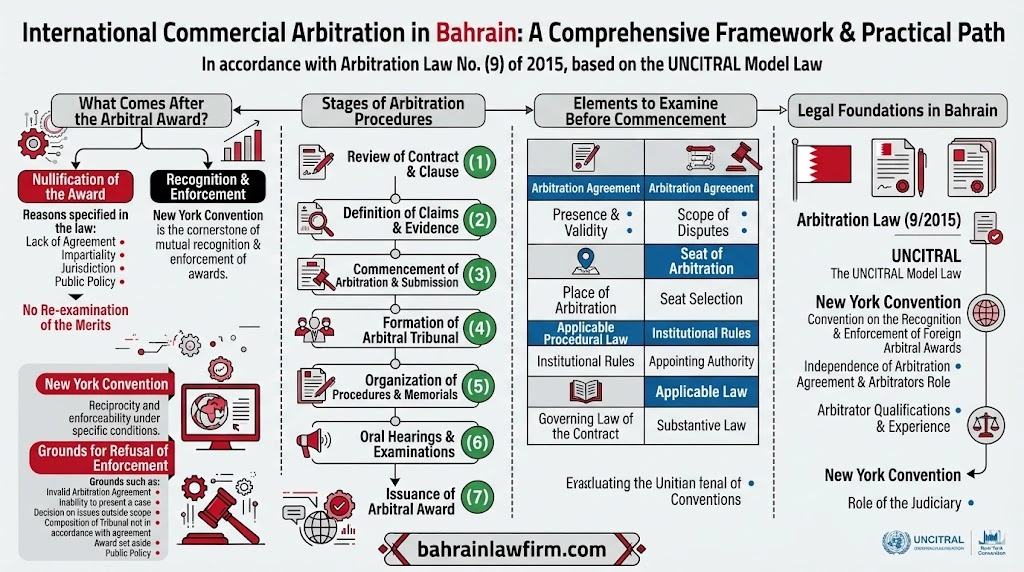
The main elements that should be reviewed before determining the appropriate course can be summarised as follows:
| Element | What Should Be Reviewed? |
|---|---|
| Arbitration Agreement | The existence and validity of the agreement and the scope of disputes covered by it. |
| Seat of Arbitration | The jurisdiction connected with the procedural legal framework governing the arbitration. |
| Selected Rules | Whether the parties agreed to use the rules of a particular arbitration institution or another specific set of rules. |
| Applicable Law | The law governing the substance of the contract and dispute according to the agreement and the relevant legal rules. |
Arbitration is not merely an alternative to court proceedings. It is a legal process built primarily on the parties’ agreement. The wording of the arbitration clause from the date the contract is signed may determine where the proceedings take place, which rules apply, how the arbitral tribunal is formed, and which disputes fall within its jurisdiction.
How Does Bahrain Law Regulate International Commercial Arbitration in Bahrain?
Bahrain enacted its Arbitration Law under Law No. (9) of 2015, adopting the UNCITRAL Model Law on International Commercial Arbitration of 1985, including the amendments adopted in 2006, within the scope specified by the Bahraini legislation.
This framework gives parties considerable flexibility in organising their arbitration proceedings while preserving a role for the courts in matters specifically identified by law.
This becomes particularly important in disputes involving companies or investors from different countries. The legal framework does not merely regulate arbitration hearings. It also addresses the arbitration agreement, formation of the tribunal, jurisdiction, interim measures, conduct of the proceedings, issuance of the award, applications to set aside an award, and its recognition and enforcement.
Bahrain is also a party to the 1958 New York Convention on the Recognition and Enforcement of Foreign Arbitral Awards. The Convention establishes an international framework for recognising arbitration agreements and foreign arbitral awards and enforcing them, while allowing recognition or enforcement to be refused in certain limited circumstances under the Convention and the applicable law.
When Is Arbitration Suitable for a Commercial Dispute?
Arbitration is not necessarily the right choice for every commercial dispute. A proper assessment starts by reviewing the contract, the nature of the dispute, the parties involved, and the assets against which an award may eventually need to be enforced.
International Commercial Arbitration in Bahrain may become particularly relevant in trade, investment, and project agreements that extend beyond the borders of a single country.
This commonly arises in situations such as:
- A contract between a Bahraini company and a foreign commercial party.
- A supply, distribution, or agency agreement performed in more than one country.
- A construction or investment project containing an arbitration clause.
- A shareholders’ agreement or partnership agreement that provides a specific mechanism for resolving disputes.
- A dispute requiring specialised technical or commercial expertise when selecting the arbitral tribunal.
Arbitration should not be selected simply because it is assumed to be faster in every case. Some proceedings may become complex because of the number of parties, the volume of documents, expert evidence, or disputes concerning the tribunal’s jurisdiction.
The suitability of arbitration should therefore be assessed according to the contract and the facts of the case rather than general assumptions.
Why Is the Arbitration Clause Important Before Proceedings Begin?
The arbitration clause determines the starting point in many disputes. It may identify the institution administering the arbitration, the applicable rules, the number of arbitrators, the seat and language of arbitration, and the scope of disputes the parties have agreed to submit to arbitration.
For a more detailed explanation, you may refer to Arbitration Clauses in Commercial Contracts in Bahrain where the main issue concerns the validity or scope of the clause or the arbitration institution named in it.
Before sending any request or formal notice, several important points should be reviewed:
- Does an arbitration agreement exist that applies to the current dispute?
- Does the clause cover all claims or only certain claims?
- Does the agreement specify a particular arbitration institution or set of rules?
- Does it identify the seat, language, and number of arbitrators?
- Are there mandatory preliminary stages such as negotiation or mediation?
- Is there already a disagreement between the parties over the interpretation of the clause itself?
This review becomes particularly important in complex contractual structures involving more than one agreement or several parties. Conflicting dispute resolution provisions in related documents may otherwise create a separate jurisdictional dispute.
How Do Arbitration Proceedings Begin in Practice?
The exact process depends on the arbitration agreement and the rules selected by the parties. However, most cases move through a series of connected stages.
Organising the documents from the beginning helps identify the claims, defences, facts, and evidence on which the case will be built.
- The arbitration agreement is reviewed: The clause, its scope, and any rules incorporated by reference are examined.
- The claims are identified: The facts, contracts, correspondence, invoices, and relevant evidence are organised.
- The arbitration is commenced: The procedure required under the selected rules is followed to submit the request for arbitration or notice of arbitration.
- The arbitral tribunal is formed: The arbitrator or arbitrators are appointed according to the agreement and the applicable rules.
- The procedure is organised: The tribunal usually establishes a timetable for written submissions, evidence, and procedural matters.
- Arguments and evidence are presented: Each party presents its position together with relevant documents, witness evidence, or expert evidence where necessary.
- The award is issued: The tribunal decides the matters submitted to it within the limits of its jurisdiction.
The way a case is managed at the beginning can affect the entire proceeding. Ignoring a procedural requirement contained in the agreement or applicable rules may create an additional dispute concerning jurisdiction or admissibility.
For this reason, reviewing the entire contract is more important than relying on a single sentence within the arbitration clause.
Has the dispute reached the stage of formal claims or a threat to commence arbitration?
Review Your Arbitration Case Before Taking Action
You can also continue reading first to understand what happens after the arbitral tribunal is formed.
How Is the Arbitral Tribunal Selected?
The arbitration framework gives significant weight to the parties’ agreement when determining how an arbitrator or arbitral tribunal will be appointed.
The contract may specify the number of arbitrators or refer to the rules of an arbitration institution that governs the appointment process once a dispute arises.
The decision should not be based on reputation or name recognition alone. Consider the nature of the dispute, the required area of expertise, potential conflicts of interest, independence, impartiality, and the arbitrator’s ability to manage a case of the relevant size and in the required language.
For example, a construction, banking, or investment-related dispute may require different expertise from a relatively straightforward commercial dispute.
Is Arbitration Faster and Less Expensive Than Court Litigation?
There is no single answer that applies to every dispute.
In some cases, International Commercial Arbitration in Bahrain may reduce certain procedural stages. In others, proceedings may take longer because of multiple parties, expert evidence, extensive documentation, or a dispute over the tribunal’s jurisdiction.
The duration and cost may be affected by several practical factors:
| Factor | Potential Effect |
|---|---|
| Number of Arbitrators | May affect costs and the scheduling of proceedings. |
| Volume of Documents | May increase the time required for review and evidentiary preparation. |
| Number of Parties | May increase procedural complexity. |
| Technical Expertise | May require specialist experts and technical reports. |
| Jurisdictional Dispute | May add a procedural stage before the merits of the dispute are considered. |
For this reason, it is not appropriate to give a fixed estimate of cost or duration without knowing the selected rules, the value of the dispute, the number of arbitrators, and the nature of the evidence.
An assessment based on the specific case is more useful than relying on a general figure that may not reflect its circumstances.
What Happens After an Arbitral Award Is Issued?
The arbitral award concludes the issues decided by the tribunal within the scope of the matters submitted to it.
A separate stage may follow, however, involving recognition or enforcement of the award, particularly where the unsuccessful party does not comply voluntarily.
At this stage, the location of the other party’s assets and the country in which enforcement is sought become important.
The New York Convention facilitates the recognition and enforcement of foreign arbitral awards among contracting states. It does not, however, make enforcement automatic in every case. Specific requirements and limited grounds for refusing recognition or enforcement may still apply.
Can an Arbitral Award Be Set Aside?
An application to set aside an arbitral award is not treated like an ordinary appeal that allows the entire dispute to be argued again from the beginning.
Arbitration law provides specific legal grounds on which an application to set aside an award may be based. Broadly, these may include issues relating to the validity of the arbitration agreement, a party’s ability to present its case, the limits of the tribunal’s jurisdiction, the constitution of the tribunal or the conduct of the proceedings, whether the subject matter is capable of settlement by arbitration, and public policy.
The award, the procedural record, and the arbitration agreement should therefore be reviewed before determining whether a legal basis exists for any challenge.
Dissatisfaction with the outcome alone is not sufficient to assume that an arbitral award can be cancelled.
When Do You Need a Lawyer in an Arbitration Dispute?
The need for legal advice may arise long before the first arbitration hearing.
The way a party responds to a notice, interprets the arbitration clause, or collects and organises evidence can affect the development of the case from the beginning.
This becomes even more important when the contracts, parties, and assets are located across several countries.
Legal assistance in an International Commercial Arbitration in Bahrain matter may include:
- Reviewing the contract and the scope of the arbitration agreement.
- Identifying claims, defences, and relevant supporting documents.
- Preparing requests for arbitration, responses, and legal submissions.
- Assessing jurisdictional issues and the constitution of the arbitral tribunal.
- Organising evidence and dealing with expert reports where required.
- Following recognition and enforcement procedures depending on the circumstances of the case.
If the commercial dispute is still at the assessment or contract review stage and arbitration has not yet started, you may also review the services of a Commercial Lawyer in Bahrain to understand the wider scope of legal assistance available for commercial contracts and disputes.
Mistakes to Avoid Before Starting Arbitration
Some problems arise before the arbitral tribunal is even formed.
The risks can be reduced by treating every stage of the case as part of one connected legal process rather than as a series of unrelated steps.
- Ignoring the wording of the clause: This may result in starting proceedings before the wrong institution or under rules that were not selected in the contract.
- Sending rushed correspondence: A message may contain admissions or positions that later affect the dispute.
- Failing to preserve documents: Certain facts may become difficult to prove if correspondence, contracts, invoices, and other records are not properly retained and organised.
- Assuming an award can be appealed like an ordinary court judgment: The grounds for setting aside an arbitral award differ from traditional court appeal procedures.
- Ignoring enforcement: Consider the location of the other party’s assets and the potential enforceability of an award from an early stage.
FAQ About International Commercial Arbitration in Bahrain
Must the Contract Include an Arbitration Clause?
A valid arbitration agreement must exist for the parties to be required to resolve a dispute through arbitration where that dispute falls within the scope of the agreement.
The arbitration agreement may be included in the contract itself or set out in a separate agreement, subject to the applicable legal rules. Its wording and scope should therefore be reviewed before proceedings begin, particularly where several contracts or multiple parties are involved.
Can a Bahraini Company Arbitrate with a Foreign Company?
Yes. A Bahraini company may be a party to arbitration with a foreign company where a valid arbitration agreement exists and covers the dispute. The way the arbitration is conducted will depend on the wording of the agreement, the seat of arbitration, the selected rules, the applicable law, and other elements of the commercial relationship.
Must All Arbitration Hearings Take Place in Bahrain?
No. The seat of arbitration does not necessarily mean that every meeting or hearing must physically take place in the same location. Depending on the applicable rules, procedural decisions, the circumstances of the case, and the parties’ agreement, hearings or meetings may take place elsewhere or be conducted remotely.
Can an Arbitral Award Issued Outside Bahrain Be Enforced?
Yes. Recognition and enforcement of foreign arbitral awards may be sought in accordance with the applicable legal rules and international conventions, including the 1958 New York Convention, to which Bahrain is a party. Each case remains subject to specific conditions, procedures, and grounds that may affect recognition or enforcement.
Can an Arbitral Award Be Challenged Simply Because the Outcome Is Considered Wrong?
No. An arbitral award is not reconsidered in the same way as an ordinary appeal before a court. The law sets out specific grounds on which an award may be challenged or set aside. It is therefore necessary to identify the relevant legal ground and connect it to the arbitration agreement, the conduct of the proceedings, or the award itself, rather than merely arguing that the outcome was incorrect.
A safe approach to International Commercial Arbitration in Bahrain begins with the contract rather than the hearing room.
The wording of the arbitration agreement, the nature of the dispute, the selected rules, the seat of arbitration, and the available documents can determine the course the parties will later need to follow.
When an actual dispute arises, reviewing these elements before sending formal requests or responses can help build a clearer legal position and avoid procedural steps that may be difficult to correct once arbitration has begun.
Official Legal Sources
- Legislation and Legal Opinion Commission – Kingdom of Bahrain — Arbitration Law issued under Law No. (9) of 2015 and related official legal publications.
- United Nations Commission on International Trade Law – UNCITRAL — UNCITRAL Model Law on International Commercial Arbitration and the status of legislation based on or influenced by the Model Law.
- United Nations Commission on International Trade Law – UNCITRAL — 1958 New York Convention on the Recognition and Enforcement of Foreign Arbitral Awards.

A Bahraini lawyer and the founder of a legal consultancy firm established in February 2019. He holds a Higher Degree in Sharia and Law from Al-Azhar University. He has extensive experience in court representation and providing legal advice in criminal, personal status, civil, and commercial matters. He is known for delivering clear, practical, and effective legal advice aimed at protecting his clients’ rights and interests, and has achieved tangible results in notable cases, including commercial litigation and inheritance matters
