

When including Arbitration Clauses in Commercial Contracts in Bahrain, it is not enough to simply state that disputes will be referred to arbitration. The clause should fit the nature of the contract and clearly address the key points that may otherwise cause disagreement later over the scope of arbitration or the way proceedings should begin.
Bahrain’s Arbitration Law No. (9) of 2015 regulates arbitration agreements and their legal effect. This article focuses specifically on the points that should be reviewed when including an arbitration clause in a commercial contract. For the general rules on the validity, invalidity, and independence of arbitration clauses, you can also refer to Arbitration Clauses in Bahrain.
Carefully drafted Arbitration Clauses in Commercial Contracts can help the parties reduce uncertainty and agree in advance on how future disputes will be handled.
Are you concerned that gaps in your commercial contracts could lead to costly and lengthy disputes that affect your business or projects? Protect your investment with clear drafting.
Table of Content
Arbitration Clauses in Commercial Contracts in Bahrain
When drafting an arbitration clause in a commercial contract, distinguish between the legal requirements needed for a valid arbitration agreement and the practical details that the parties may agree in advance to reduce procedural disputes if a disagreement later arises.
The level of detail required in an arbitration clause also depends on the nature of the transaction and the contract. Commercial relationships are not all the same in terms of parties, obligations, and potential risks. You can refer to Types of Commercial Contracts in Bahrain to learn more about the main forms of commercial contracts and the differences between them.
The wording of Arbitration Clauses in Commercial Contracts should therefore reflect the nature of the transaction, the parties involved, and the risks that may arise.
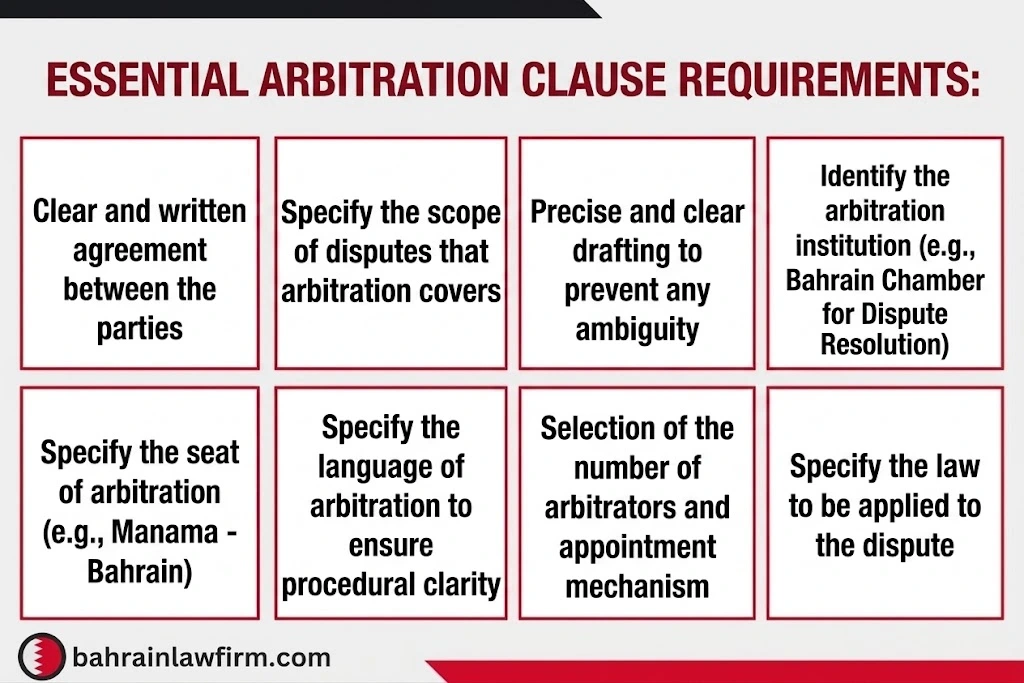
Some of the most important points to review include:
1. Having a Written Arbitration Agreement
The Arbitration Law requires the arbitration agreement to be in writing. This does not necessarily mean that it must appear only as a traditional signed clause inside the contract. Depending on the documents and communications used by the parties, the writing requirement may also be satisfied in other forms recognised by law.
For this reason, make sure there is clear evidence showing that the parties agreed to refer disputes to arbitration.
2. Defining the Scope of Disputes Covered
Define whether arbitration will cover all disputes arising out of or connected with the contract, or whether it will apply only to certain types of disputes.
This becomes especially important in complex commercial contracts involving several obligations or multiple documents, as unclear wording may later lead to a separate dispute over whether a particular claim falls within the scope of the arbitration clause.
When defining the scope, consider the type of rights governed by the contract. Some commercial arrangements, such as licensing or distribution agreements, may include issues involving the use of a name or trademark in addition to financial and contractual obligations. In these cases, distinguish between contractual disputes and procedures relating to trademark protection in Bahrain.
For this reason, Arbitration Clauses in Commercial Contracts should clearly define which disputes fall within the scope of arbitration.
3. Choosing the Arbitration Institution or Rules
The parties may agree to institutional arbitration administered by a specialised body, such as the Bahrain Chamber for Dispute Resolution (BCDR), or they may choose ad hoc arbitration under procedural rules agreed between them.
If the parties choose an arbitration institution, clearly state its correct name and the applicable rules. Doing so helps avoid uncertainty or references to an institution whose jurisdiction or rules may not suit the nature of the dispute.
4. Choosing the Seat of Arbitration
Specify the legal seat of arbitration, such as Manama, Kingdom of Bahrain. The seat can affect the procedural law governing the arbitration and the jurisdiction of the courts that may support or supervise the arbitration process.
Do not confuse the legal seat of arbitration with the physical location where a particular hearing or meeting takes place.
5. Determining the Number of Arbitrators and the Appointment Process
The parties may agree on a sole arbitrator or a tribunal made up of several arbitrators, depending on the value and complexity of the dispute. They should also take into account the selected rules governing the appointment process.
Clear drafting helps prevent a further dispute at the start of arbitration over how the tribunal should be formed.
6. Choosing the Language of Arbitration
When the parties or documents use different languages, agree in advance on the language, or languages, to be used in the arbitration. Take into account the language of the contract and the main supporting documents.
7. Choosing the Law Governing the Substance of the Dispute
Distinguish between the seat of arbitration and the law governing the substantive rights and obligations arising from the contract.
If the parties want the contract to be governed by a particular law, state this separately and clearly rather than assuming that the choice of seat automatically determines the law governing the contract.
This becomes even more important when the contract is connected to more than one country or involves parties from different jurisdictions. International Commercial Contracts often require particular care when determining both the applicable law and the dispute resolution mechanism.
Clear Arbitration Clauses in Commercial Contracts should address these issues separately to avoid confusion between the governing law and the seat of arbitration.
8. Coordinating the Arbitration Clause with the Rest of the Contract
Review the arbitration clause together with the other dispute resolution provisions in the contract, especially clauses requiring negotiation, notice, or mediation before arbitration begins.
Treat the arbitration clause as part of the contract as a whole. It should not conflict with provisions on jurisdiction, governing law, notices, or any other related terms. For further guidance on preparing the contract itself, see our guide on How to Draft Commercial Contracts under Bahraini law.
Does the Arbitration Clause Become Invalid if the Contract Is Invalid?
The Arbitration Law treats the arbitration clause as an agreement that is separate from the other terms of the contract for the purpose of determining the arbitral tribunal’s jurisdiction. Therefore, simply alleging that the main contract is invalid does not automatically mean that the arbitration clause also ceases to have effect.
For a broader explanation of this issue and the circumstances affecting the validity or invalidity of the clause, see Arbitration Clauses in Bahrain.
When Can a Dispute Arise Over an Arbitration Clause in a Commercial Contract?
A dispute may arise over the validity or scope of an arbitration clause even when the clause appears in the contract. Certain situations require particular legal review, including:
- Failure to establish the arbitration agreement in writing in the form required by law.
- A dispute over a party’s legal capacity or the authority of the person who agreed to arbitration.
- A dispute arising from a matter that falls outside the scope of the arbitration clause.
- A dispute concerning a matter that cannot legally be resolved through arbitration under the applicable law.
- Conflicting or unclear wording between the arbitration clause and other dispute resolution provisions.
- An incorrect reference to an arbitration institution or set of rules, leading to disagreement over the procedure the parties intended to follow.
Not every drafting issue automatically makes an arbitration agreement invalid. The legal effect will depend on the nature of the defect, the contract, the facts of the case, and the applicable law.
Reviewing Arbitration Clauses in Commercial Contracts
Having an arbitration clause reviewed before signing the contract can be useful, particularly in high-value agreements, international contracts, or agreements involving several parties or connected documents. A lawyer in Bahrain can review the clause in the context of the full contractual relationship.
Depending on the nature of the agreement, the legal review may include:
- Defining the scope of disputes that should be referred to arbitration.
- Reviewing the choice of arbitration institution or procedural rules.
- Determining the seat and language of arbitration and the number of arbitrators.
- Checking that the clause is consistent with the governing law and the other provisions of the contract.
- Reviewing any negotiation or mediation stages that must take place before arbitration begins.
To understand the full path of a dispute after arbitration proceedings begin, see Commercial Arbitration in Bahrain and Its Advantages.
Reviewing the agreement before signing becomes especially useful when arbitration provisions overlap with other commercial obligations or when several related agreements and documents are involved. In these situations, a commercial lawyer in Bahrain can review the contractual relationship and the legal consequences connected with it.
A legal review of Arbitration Clauses in Commercial Contracts can also help ensure that the clause works consistently with the other provisions of the agreement.
FAQ Abut Arbitration Clauses in Commercial Contracts
Can an Arbitration Clause Be Included in Any Commercial Contract?
Arbitration can be used in a wide range of commercial relationships. However, it is important to confirm that the subject matter of the dispute is arbitrable and that the clause suits the nature of the contract, the parties, and the applicable law. For this reason, using the same standard clause in every contract without legal review is not recommended.
Must the Arbitration Clause Be in Writing?
The Arbitration Law requires the arbitration agreement to be in writing. This requirement may be satisfied in several forms, depending on how the agreement and communications between the parties are documented.
Must an Arbitration Institution Be Named in the Contract?
Not every arbitration must be institutional. However, if the parties choose a specific arbitration institution, it is important to identify the institution and its rules clearly. The parties may also agree on ad hoc arbitration if the contract wording and selected procedural rules are suitable.
What Happens After an Arbitral Award Is Issued?
If the losing party does not comply with the award voluntarily, it may be necessary to take steps for its recognition and enforcement. Further details can be found in the guide to enforcing arbitral awards in Bahrain.
Careful drafting of an arbitration clause in a commercial contract helps define the process the parties will follow if a dispute arises. It also reduces the risk of a separate disagreement over the chosen institution, the scope of arbitration, the seat, or the formation of the arbitral tribunal.
For this reason, review the clause as part of the entire commercial contract rather than treating it as a standalone paragraph that can simply be copied from one agreement to another without considering the nature of the transaction, the parties involved, and the applicable law.
For legal advice on drafting or reviewing an arbitration clause in a commercial contract, you can contact us through the contact options shown on the website.

A Bahraini lawyer and the founder of a legal consultancy firm established in February 2019. He holds a Higher Degree in Sharia and Law from Al-Azhar University. He has extensive experience in court representation and providing legal advice in criminal, personal status, civil, and commercial matters. He is known for delivering clear, practical, and effective legal advice aimed at protecting his clients’ rights and interests, and has achieved tangible results in notable cases, including commercial litigation and inheritance matters
