
In today’s article, we explain the key information you need to know about Limited Liability Company Liquidation Procedures in Bahrain under Law No. 21 of 2001. If this topic is relevant to you, keep reading to understand the company liquidation process in Bahrain, and reach out if you have any questions about the procedure.
Have you decided to close your company but are concerned about dealing with government procedures and creditors’ claims? Let us handle the legal burden of the liquidation process.
Appoint a Lawyer to Liquidate Your CompanyOr continue below to learn about the legal steps for appointing a liquidator and officially registering the dissolution.
Table of Content
Limited Liability Company Liquidation Procedures in Bahrain
The liquidation of limited liability companies in Bahrain is addressed under Commercial Companies Law No. 21 of 2001, particularly Articles 325 through 344. Below, we explain the main steps involved in Limited Liability Company Liquidation Procedures in Bahrain.
1. Submit the Liquidation Application Through Sijilat
In Bahrain, most commercial registration transactions are completed electronically through Sijilat, the online portal operated by the Ministry of Industry and Commerce. For this reason, the practical process of liquidating a limited liability company will usually begin through the Sijilat portal.
The usual steps through Sijilat are:
- Log in to your Sijilat account.
- Select the relevant Commercial Registration.
- Open the Commercial Registration amendment service.
- Select liquidation management.
- Enter the Commercial Registration number.
- Select the type of liquidation.
- Upload the required documents.
- Submit the application for review.
The service appears on Bahrain’s government services portal under the name “Liquidation Registration – Commercial Company.” According to the portal, the registration fee for liquidating a commercial company is BHD 20, and the service is usually completed within three working days when all required documents and information have been submitted.
2. Is the Liquidation Voluntary or Compulsory?
This distinction matters because not every liquidation follows the same process. A company may enter voluntary liquidation, or it may be liquidated compulsorily through a court order.
Voluntary liquidation takes place when the partners decide to close the company by agreement. They may decide that the business is no longer suitable, that they no longer wish to continue, or that the company has already achieved the purpose for which it was established.
Compulsory or judicial liquidation, on the other hand, takes place when a court issues a judgment ordering the company to be liquidated. This commonly occurs when there is a dispute or another legal reason that requires the court’s involvement.
| Type of Liquidation | When Does It Take Place? | Who Appoints the Liquidator? |
| Voluntary liquidation | By a decision of the partners | The partners or the competent general assembly |
| Judicial liquidation | By a court judgment | The court |
Bahrain’s Commercial Companies Law provides that liquidation must be carried out by one or more liquidators. In a voluntary liquidation, the partners appoint the liquidator. If the company is dissolved or declared invalid by a court judgment, the court determines the liquidation procedure and appoints the liquidator, including setting the liquidator’s remuneration.
3. Prepare the Documents Before Filing the Application
Incomplete or unclear documents are among the most common reasons for delays in liquidation applications. Prepare a complete file before starting the process through Sijilat.
Documents you may need include:
| Document | When Is It Required? |
| Partners’ resolution or meeting minutes | For voluntary liquidation |
| Court judgment or court letter | For judicial liquidation |
| Liquidator’s details | In all cases |
| Power of attorney or authorization | If the applicant is acting as an agent or representative of the company |
| Statement of creditors and debtors | To identify liabilities and outstanding claims |
| List of employees and workers | To settle employment-related rights and obligations |
| VAT information | If the company is registered for VAT |
| Commercial address and municipal fee details | To close or update the municipal file |
Practical tip: Use clear file names when uploading documents. Avoid names such as “Document” or “Image.” Instead, use direct names such as “Liquidation Resolution,” “Liquidator Details,” “Employee List,” or “Court Judgment.” This small step can make the review process smoother and reduce unnecessary delays.
3. Prepare the Document File
Prepare the documents before starting the transaction so the application does not get held up in Sijilat. The following practical file structure may help:
| Document | When Is It Required? |
|---|---|
| Partners’ resolution or meeting minutes | For voluntary liquidation |
| Court judgment or court letter | For judicial liquidation |
| Liquidator’s details | In all cases |
| Power of attorney or authorization | If the applicant does not have direct legal authority to act |
| Statement of creditors and debtors | To help the liquidator notify creditors |
| List of employees and workers | To settle employment rights and work permits |
| VAT details, if applicable | To review the company’s position with the National Bureau for Revenue |
| Municipal fee account and commercial address | To close or update the municipal file |
Use clear file names when uploading your documents, such as “Liquidation Resolution,” “Liquidator Details,” “Employee List,” and “Creditors List.” It may seem like a small detail, but it can reduce the chance of the application being returned because the supporting documents are unclear or incomplete.
4. Appoint the Liquidator
The liquidator is the person responsible for managing the company during the liquidation stage. The liquidator does not run the company as though it were continuing its normal business. Instead, the role focuses on bringing the company’s affairs to an orderly close by identifying its assets, collecting receivables, paying debts, notifying creditors, and preparing the final accounts.
As part of the Limited Liability Company Liquidation Proceduresin Bahrain, the liquidator’s name and the method of liquidation must be registered in the Commercial Register and published in a local daily newspaper. The appointment of the liquidator does not become effective against third parties until the day following publication.
5. Notify the Creditors
Notifying creditors is a central part of the liquidation process. It gives each creditor an opportunity to submit a claim before the company’s assets are distributed or its Commercial Registration is cancelled.
Under the Commercial Companies Law, the liquidator notifies the creditors that liquidation has started and invites them to submit their claims. The notice is sent by registered mail with acknowledgment of receipt.
If the creditors are unknown or their addresses cannot be identified, notice may be given through publication in a local daily newspaper.
The liquidation notice should preferably include the following information:
- Company name.
- Commercial Registration number.
- Name of the liquidator.
- Contact details for the liquidator.
- Address for submitting claims.
- Deadline for creditors to submit their claims.
This step is particularly important. The company’s assets should not be distributed to the partners before its debts and creditors’ claims have been properly addressed.
6. Settle Government Files and Registrations
After registering the liquidation of a limited liability company in Bahrain, review any open files or registrations with government authorities. The authorities involved will differ from one company to another, but attention is usually required in the following areas:
| Authority | What Needs to Be Settled? |
| Labour Market Regulatory Authority (LMRA) | Cancel foreign workers’ permits or arrange their transfer to another employer |
| Social Insurance Organization (SIO) | Pay outstanding contributions and update end-of-service information |
| National Bureau for Revenue (NBR) | Deregister for VAT if the company is registered |
| Ministry of Municipalities Affairs and Agriculture | Close the municipal fees account or update address details |
| Authorities licensing the company’s activity | Terminate or cancel any activity-specific licence where required |
For example, if the company employs foreign workers, their status must be settled with the Labour Market Regulatory Authority. Depending on the applicable conditions and procedures, this may involve cancelling a work permit or transferring the worker to another employer.
If the company is registered for VAT, review its position with the National Bureau for Revenue. Where the applicable conditions are met, submit a VAT deregistration request, file the final returns, and pay any outstanding amounts.
As part of the Limited Liability Company Liquidation Procedures, any commercial address linked to municipal fees should also be reviewed, and the relevant municipal account should be closed or updated as required.
Settling Employees’ and Workers’ Rights
Employees’ rights do not end simply because a limited liability company in Bahrain enters liquidation. Before the company is removed from the Commercial Register, the liquidator or company management should review the entitlements of each employee individually.
These entitlements will usually include:
- Unpaid wages.
- Payment for unused leave.
- End-of-service benefits, where applicable.
- Any compensation due under the employment contract or the law.
- Updating the employee’s information with the Social Insurance Organization.
- Cancelling or transferring the foreign employee’s work permit.
The Labour Law for the Private Sector provides that a worker who is not subject to the Social Insurance Law is entitled to an end-of-service benefit calculated at half a month’s wage for each of the first three years of service and one month’s wage for each subsequent year. Fractions of a year are calculated in proportion to the actual period of service.
Before starting the liquidation, it is useful to prepare a simple employee schedule containing information such as:
| Information | Purpose |
| Employee’s name | Identify the person entitled to payment |
| Joining date | Calculate length of service |
| Last salary | Calculate employment entitlements |
| Outstanding leave balance | Determine payment for unused leave |
| Work permit status | Arrange cancellation or transfer |
| Social insurance status | Update end-of-service records |
This step helps reduce the risk of later employment claims and supports a cleaner and more orderly closure of the company’s file.
How Long Does It Take to Liquidate a Limited Liability Company in Bahrain?
The timeframe depends on the company’s circumstances. Sijilat lists liquidation registration as a service that may be completed within three working days when the application is complete. The full liquidation process, however, may take longer if the company has debts, employees, objections, a VAT registration, or existing contracts that still need to be settled.
| Situation | Practical Expectation |
|---|---|
| Company with no employees, debts, or VAT registration | Usually faster |
| Company with foreign workers | Requires settlement with LMRA and the Social Insurance Organization |
| Company registered for VAT | Requires final returns and VAT deregistration |
| Creditors or a dispute between partners | May take several weeks or months |
| Court-ordered liquidation | Depends on court proceedings and the liquidator’s reports |
Avoid giving a firm completion date before reviewing the company’s Commercial Registration, employment files, tax obligations, and outstanding debts.
It is also worth noting that the company’s books and records must be kept for ten years from the date the company is removed from the Commercial Register, at a location designated by the partners and the general assembly.
How Much Does Company Liquidation Cost?
The cost of liquidation is not limited to the application registration fee charged through Sijilat. Bahrain’s government services portal lists the commercial Limited Liability Company Liquidation Procedures registration fee as BHD 20, but this does not always represent the full cost of the process.
Other costs may include:
| Item | Does It Vary from One Company to Another? |
| Liquidation registration fee | Fixed according to the published service fee |
| Liquidator’s fees | Varies according to the amount and complexity of the work |
| Publication costs | Varies depending on the publication outlet and procedure |
| Lawyer’s or accountant’s fees | Varies according to the scope of services |
| Employees’ entitlements | Varies according to the number of employees and their length of service |
| Debts and liabilities | Depends on the company’s financial position |
| VAT or other government fees | Depends on the company’s status with the relevant authorities |
For this reason, it is not possible to give an accurate final figure without first reviewing the company’s position. A company with no outstanding liabilities will usually face lower costs than one with employees, debts, tax obligations, or ongoing disputes.
When Do You Need a Lawyer for Company Liquidation?
Limited Liability Company Liquidation Procedures may be relatively straightforward when the company has no debts, employees, or disputes. In many cases, however, working with a corporate lawyer can be important, especially if the company has creditors, foreign employees, disputes between partners, tax registrations, or contracts that have not yet ended.
A lawyer’s role goes beyond filing the application. The lawyer can help organize the required documents, draft the liquidation resolution, review the liquidator’s authority, follow up on publication requirements, and make sure that the company is not finally removed from the Commercial Register before its key obligations have been properly settled.
To arrange a review of your company documents and identify the most suitable course of action, you can contact Abdulrahman Khalifa Law Firm and request a specialized lawyer in Bahrain through the WhatsApp button at the bottom of the screen.
FAQ About Limited Liability Company Liquidation Procedures
Related questions include:
How Is a Limited Liability Company Liquidated?
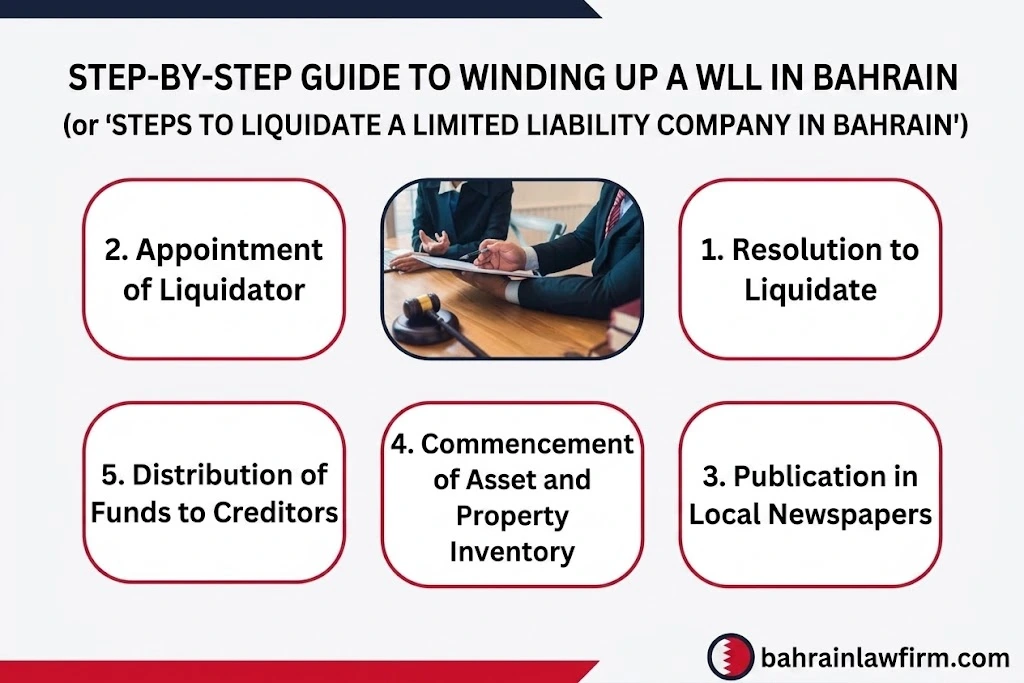
A limited liability company is liquidated by issuing a liquidation decision, appointing a liquidator, and publishing the decision in a daily newspaper.
The liquidator then prepares an inventory of the company’s assets and property, converts the relevant assets into cash, and distributes the proceeds to creditors.
What Are the Consequences of Liquidating a Limited Liability Company?
The consequences of liquidating a limited liability company include ceasing its business activities, settling debts with creditors, and distributing the remaining funds among the partners. The company’s documents and accounting records must also be retained for ten years.
Must VAT Registration Be Cancelled When a Company Is Liquidated?
If the company is registered for VAT, its tax status must be reviewed with Bahrain’s National Bureau for Revenue (NBR). A VAT deregistration application should be submitted when the applicable conditions are met, while ensuring that all required VAT returns are filed and any outstanding amounts are settled.
Is the Liquidation Fee Only BHD 20?
The fee shown for registering the liquidation in Sijilat is BHD 20. However, the total cost of liquidation may also include the liquidator’s fees, publication costs, legal or accounting fees, as well as the settlement of employee entitlements or outstanding debts.
Can the Company’s Assets Be Distributed to the Partners as Soon as Liquidation Begins?
No. The company’s debts must first be paid, or sufficient amounts must be set aside to cover them. A final account must then be prepared, after which any remaining surplus may be distributed according to the partners’ ownership shares and the provisions of the company’s memorandum of association.
Is the Appointment of a Liquidator Mandatory?
Yes. The liquidator is responsible for managing the liquidation process, including preparing an inventory of the company’s assets, notifying creditors, settling liabilities, and preparing the final account.
This brings us to the end of our article, where we explained Limited Liability Company Liquidation Procedures in Bahrain under the Bahraini Commercial Companies Law in practical detail.
If you are considering liquidating your company, seek advice from a corporate lawyer in Bahrain who can review your company’s position and guide you through the required legal steps.

A Bahraini lawyer and the founder of a legal consultancy firm established in February 2019. He holds a Higher Degree in Sharia and Law from Al-Azhar University. He has extensive experience in court representation and providing legal advice in criminal, personal status, civil, and commercial matters. He is known for delivering clear, practical, and effective legal advice aimed at protecting his clients’ rights and interests, and has achieved tangible results in notable cases, including commercial litigation and inheritance matters
