

Many employees in Bahrain face challenges related to their employment rights, whether because of unpaid wages, unfair termination, or other outstanding financial entitlements.
Understanding your rights and knowing which legal procedures are available can make a real difference when seeking to recover what you are legally owed.
In this article, we explain a Labour Rights Claim in Bahrain, the most common types of labour claims, and the main steps involved in filing a claim under Bahraini law.
Is your employer refusing to pay your overdue entitlements or end-of-service benefits and continuing to delay payment? Do not give up the financial rights you earned through your work.
Appoint a Labour Lawyer to Recover Your RightsTo understand the labour claim process and its legal steps in more detail, continue reading below.
Table of Content
Labour Rights Claim in Bahrain
A Labour Rights Claim in Bahrain is a legal procedure that allows an employee to seek unpaid entitlements from an employer when rights granted under Bahrain Labour Law No. 36 of 2012 have been violated.
These rights may include unpaid wages, end-of-service benefits, compensation for unfair dismissal, and other employment-related financial entitlements.
Several authorities may become involved in labour disputes, including:
- Bahrain Ministry of Labour: A labour complaint may first be submitted through the competent labour authority in an attempt to resolve the dispute amicably.
- Labour Court: If the dispute cannot be resolved amicably, the employee may proceed with the required legal procedures and bring the matter before the competent labour court.
Labour disputes are generally handled with particular attention because employment claims often involve wages and other essential financial rights.
The time needed to resolve a case depends on its circumstances, the evidence submitted, the parties’ responses, and the procedures required by the court.
Employees should keep their employment contract, salary statements, correspondence, and any other documents that support their claim. Proper documentation can significantly strengthen the case before the competent authorities and court.
Employees should also pay close attention to the applicable limitation period. Claims arising from an employment relationship may be subject to a legal time limit, so delaying legal action can affect the right to bring a claim.
Common Types of Labour Claims
Employees in Bahrain may bring labour claims when their statutory or contractual employment rights are violated.
Some of the most common claims include:
- Claims for unpaid wages:
Employees may seek unpaid salaries and other financial entitlements, including allowances, bonuses, and payments that became due during employment. - Unfair dismissal:
If an employment contract is terminated without a lawful reason or in breach of the applicable legal requirements, the employee may be entitled to claim compensation in accordance with Bahrain Labour Law. - End-of-service benefit claims:
Employees may be entitled to claim end-of-service benefits when their employment relationship ends, subject to the rules and conditions set out by law. - Compensation for workplace injuries:
An employee who suffers an injury at work or because of employment-related circumstances may be entitled to seek financial compensation in accordance with the applicable legal provisions. - Claims for unused leave entitlements:
If an employee does not receive the annual leave to which they are entitled, or does not receive payment for unused leave when legally due, they may seek the outstanding amount. - Unpaid overtime:
If an employee works additional hours and does not receive the overtime payment required by law, those amounts may form part of the labour claim.
Where possible, the competent labour authorities may attempt to resolve the dispute amicably before the case proceeds to court. Reaching an early settlement can save both parties time, expense, and further litigation.
Procedures for Filing a Labour Claim
When an employee believes that their employment rights have been violated, a labour claim may be pursued through the following steps:
- Communicate with the employer:
Where appropriate, start by attempting to resolve the dispute directly with the employer. This may involve negotiation or submitting a formal written request for payment of the outstanding entitlements. - Submit a complaint to the Ministry of Labour:
If the dispute is not resolved, the employee may submit a formal complaint to the competent department at the Bahrain Ministry of Labour. The matter may then be reviewed in an attempt to reach an amicable settlement. - File the claim before the Labour Court:
If the dispute cannot be settled, the employee may proceed with filing a labour claim before the competent court and submit supporting documents such as:- The employment contract.
- Salary statements or payslips.
- Correspondence, notices, or other documents supporting the claim.
- Attend court hearings:
The parties may be summoned to attend hearings where they can submit evidence, documents, legal arguments, and, where relevant, witness testimony. Each party may obtain legal representation in accordance with the applicable procedures. - Issuance of the judgment:
After examining the case, the court issues its judgment. If the employee’s claim is established, the employer may be ordered to pay the amounts awarded by the court. Where the judgment is legally appealable, the dissatisfied party may challenge it within the applicable appeal period.
Frequently Asked Questions About a Labour Rights Claim in Bahrain
How Do You Draft a Labour Claim Petition?
To draft a labour claim petition, include the employee’s and employer’s details, a clear description of the claim, and supporting documents such as the employment contract and salary records. The petition should also state the legal claims based on Bahrain Labour Law. It is advisable to consult a lawyer to help ensure the claim is filed correctly.
When Does an Employee Lose the Right to Claim Labour Entitlements?
Under Bahrain Labour Law, an employee’s right to claim labour entitlements generally expires one year after the employment relationship ends, unless a legally recognized excuse prevented the employee from making the claim during that period.
How Do I File a Labour Rights Claim Before the Labour Court?
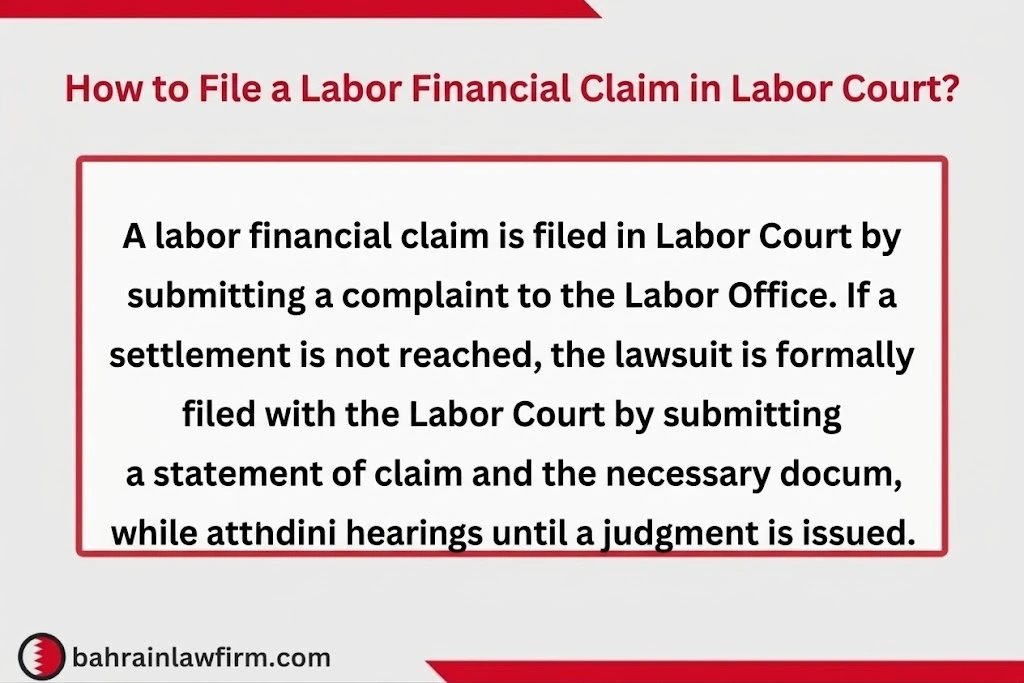
A Labour Rights Claim in Bahrain is typically initiated by submitting a complaint to the relevant labour authority. If no settlement is reached, the claim may then be formally brought before the Labour Court by filing the claim petition and the required supporting documents, followed by attendance at the court hearings until a judgment is issued.
In conclusion, filing a Labour Rights Claim in Bahrain is one of the legal routes available to employees seeking to protect and recover their employment entitlements.
However, pursuing a claim properly requires an understanding of the applicable legal procedures, evidence, deadlines, and the nature of the rights being claimed.
For this reason, employees should take the appropriate legal steps without unnecessary delay when their rights are affected.
You may also appoint a lawyer in Bahrain to review your case, explain your legal position, and assist you through the appropriate procedures.
To read more, see:
- Learn more about financial claims and recovering overdue payments in Bahrain.
- Read about Appeal in Labour Cases in Bahrain.
- Learn more about legal claims relating to marital movables and family disputes in Bahrain.
- Read about a Construction Contract Payment Claim arising from the performance of a construction agreement.
- Read our guide to choosing a lawyer in Bahrain for legal representation and advice.

A Bahraini lawyer and the founder of a legal consultancy firm established in February 2019. He holds a Higher Degree in Sharia and Law from Al-Azhar University. He has extensive experience in court representation and providing legal advice in criminal, personal status, civil, and commercial matters. He is known for delivering clear, practical, and effective legal advice aimed at protecting his clients’ rights and interests, and has achieved tangible results in notable cases, including commercial litigation and inheritance matters
