

Legal Review: This content was written and reviewed by the legal team at Abdulrahman Khalifa Law Firm.
Last Updated: 1 September 2026.
Category: Bahrain Corporate Law.
A business owner in Bahrain started preparing to launch a small commercial venture. He chose a suitable name, identified the nature of the business, and began collecting the required documents. During the process, however, he discovered that a sole proprietorship is not the same as a Single Person Company, even though both can be owned by one person.
That distinction affected both the registration process and his liability for the business’s debts. Choosing a legal structure is not simply about the name shown on the Commercial Registration. It determines who bears the obligations, which documents must be submitted, and how the business will operate after it begins trading.
In most cases, Establishing a Sole Proprietorship in Bahrain means registering a business owned by one natural person. That person remains responsible for the obligations arising from the business. A Single Person Company, on the other hand, becomes a separate commercial company once registered, and its owner’s liability is generally limited to the capital allocated to the company.
Do you have a promising business idea and want to launch it officially, but find the Ministry of Industry and Commerce requirements difficult to navigate? Start your business journey with greater clarity and confidence.
Table of Content
Laws Governing Establishing a Sole Proprietorship in Bahrain
Bahraini law regulates sole proprietorships and Single Person Companies through different legal provisions. The main legal framework can be summarised as follows:
- Commercial Registration Law: Regulates the registration of sole proprietorships, the issuance of Commercial Registrations, amendments to registration details, and cancellation of registrations.
- Governing legislation: Legislative Decree No. (27) of 2015 Promulgating the Commercial Registration Law was issued on 7 October 2015.
- Amendments to the Commercial Registration Law: The law was amended by Legislative Decree No. (52) of 2018 and later by Law No. (9) of 2022, which is the latest amendment shown in the official legislative amendment record.
- Nationality of the sole proprietor: Article (10) of the Commercial Registration Law generally requires an applicant for registration to be a Bahraini national, subject to the laws and international agreements in force in the Kingdom.
- Legal age: The same Article requires an applicant seeking registration of a sole proprietorship to be at least 18 years old.
- Law governing Single Person Companies: A Single Person Company is governed by Legislative Decree No. (21) of 2001 Promulgating the Commercial Companies Law.
- Amendments to the Commercial Companies Law: The Commercial Companies Law has been amended several times. One of its most recent amendments is Legislative Decree No. (38) of 2025, published on 11 September 2025 and effective from the day following its publication.
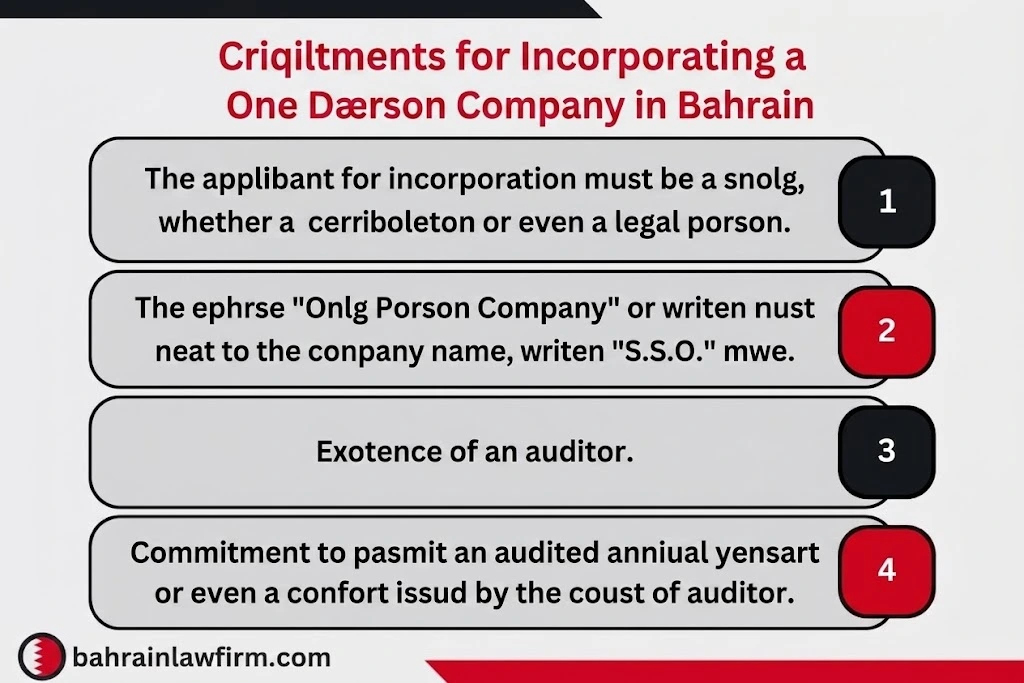
- Definition of a Single Person Company: Article (289) defines a Single Person Company as an economic activity whose entire capital is owned by one natural or legal person.
- Legal personality of the company: A Single Person Company acquires separate legal personality once it is registered in the Commercial Register in accordance with the prescribed procedures.
- Difference in terminology: The expression “individual company” or “sole company” is sometimes used loosely, but it does not accurately identify the legal form. It is therefore important to determine whether the intended structure is a sole proprietorship or a Single Person Company before starting the procedures for company formation.
Requirements for Establishing a Sole Proprietorship in Bahrain
The main requirements relate to the owner’s legal eligibility, the type of business activity, the trade name, and whether a sole proprietorship is suitable for the level of risk involved in the proposed business.
1. Owner Eligibility and Registration Requirements
As a general rule, the law requires the owner of a sole proprietorship to be a Bahraini national and at least 18 years old. This requirement, however, applies subject to international agreements in force. Ministry of Industry and Commerce guidance therefore indicates that registration may also be available to GCC nationals residing in Bahrain and nationals of countries that have free trade agreements with the Kingdom, depending on the activity and the applicable requirements.
These exceptions do not mean that every foreign national can open a sole proprietorship for any type of activity. The outcome depends on the applicant’s nationality, residency status, the applicable agreement, and the business activity concerned.
Establishing a Single Person Company may also be available under the foreign ownership rules applicable to companies and according to the type of activity. It remains, however, a separate legal route from registering a sole proprietorship.
2. Choosing the Business Activity
The business activity determines which approvals will actually be required. Select the activity through the Unified Guide for Commercial and Industrial Activities, then check whether it requires professional, municipal, health, industrial, or other regulatory approval.
Ministry of Industry and Commerce guidance also explains that certain activities are not available under every legal form. Applications are electronically referred to the relevant authorities depending on the nature of the activity. It is therefore not enough to choose a broad description such as “contracting” or “consultancy.” Select the exact classified activity and review its specific requirements before submitting the application.
3. Choosing the Trade Name and Legal Structure
The trade name must not already be registered to another party. It must also comply with public order, beliefs, and established traditions, and it must not create a misleading impression about the true nature of the business.
The name must also avoid infringing a trademark owned by another party without permission. Before reserving a name, decide which of the following legal structures is appropriate:
| Element | Sole Proprietorship | Single Person Company |
|---|---|---|
| Owner | One natural person | One natural or legal person |
| Legal personality | For liability purposes, it is not legally separate from its owner in the same way as a company | Acquires separate legal personality after registration |
| Debts | The owner is personally liable for them | Liability is generally limited to the company’s capital |
| Formation document | Registration application and details of the owner and activity | Articles or declaration of incorporation and capital-related documents |
| Generally suitable for | Small, lower-risk businesses | Projects that require clearer separation between business and personal assets |
Is a Sole Proprietorship Suitable for Every Business?
No. Ease of formation should always be weighed against the extent of personal liability. A sole proprietorship may be suitable for a business with limited contracts, debts, and staffing obligations.
If the project involves high-value contracts, loans, or significant operating liabilities, a Single Person Company may be more suitable because it provides a clearer separation between the company’s financial liabilities and the owner’s personal assets.
This comparison is not an automatic rule. It is a professional assessment based on the nature of the activity, financing arrangements, contracts, assets, and the likelihood of claims. The official sources do not specify a particular financial threshold at which converting to a Single Person Company becomes mandatory.
To assess the legal structure that best suits your business, you may contact Abdulrahman Khalifa Law Firm and appoint a lawyer in Bahrain through the WhatsApp button fixed at the bottom of the screen.
Steps for Establishing a Sole Proprietorship in Bahrain
The procedures for Establishing a Sole Proprietorship in Bahrain are completed electronically through the “Sijilat” Commercial Registration system, starting with the selection of the business activity and ending with the issuance of the Commercial Registration certificate and licence.
1. Identify the Activity and Choose the Legal Structure
Begin the process by reviewing the Unified Guide for Commercial and Industrial Activities and selecting the official description of the intended activity. Then choose the appropriate legal structure, whether a sole proprietorship, Single Person Company, or another available form.
Complete this step before preparing the documents because some activities may require academic qualifications, professional experience, a technical manager, or premises that meet specific standards. Certain activities may also be unavailable under a sole proprietorship structure.
2. Prepare the Owner’s Details and Documents
Electronic filing requires an eKey account. Prepare an electronic copy of the smart card or passport as well. If an agent or professional office submits the application, a valid authorisation or power of attorney will be required according to the applicant’s capacity.
A No Objection Certificate may be required in certain cases, together with qualifications or certificates related to the activity. A Single Person Company will usually require additional documents, such as a declaration or articles of incorporation and documents relating to cash or in-kind capital, depending on the circumstances.
3. Choose the Trade Name
Submit the proposed trade name through the electronic system. It will then be reviewed for availability, legal compliance, and consistency with the business activity. In practice, prepare several name options so the application does not stall if the first choice has already been reserved or closely resembles an existing name.
Approval of the trade name alone does not give the owner the right to start operating. The required approvals and final licence must still be obtained before the activity can legally begin.
4. Submit the Registration Application and Obtain Approvals
Submit the registration application electronically through the owner, an authorised agent, or a professional office. The Ministry of Industry and Commerce reviews the information and then refers the application to the relevant licensing authorities where additional approvals are required.
Distinguish between a Commercial Registration without a licence and a licensed Commercial Registration. Receiving the initial registration does not mean the business can start operating immediately. Complete the address requirements, obtain the necessary approvals, pay the applicable fees, and receive the Commercial Registration certificate together with the relevant licence. The National Portal explains that the Commercial Registration certificate with a licence is issued after completing the approvals required to carry out the activity.
5. Receive the Commercial Registration and Start the Business
Once approval is granted and the fees are paid, the Commercial Registration certificate is issued electronically. The Ministry’s guide also states that a paper copy may be requested for an additional fee of BHD 2, according to the published version of the guide.
Start operating only after the licence has been issued, not merely after submitting the application or reserving the trade name. Use the correct Commercial Registration details in contracts and invoices, and update any changes to the trade name, address, activity, or owner’s information within the legally prescribed deadlines.
Documents Required for Establishing a Sole Proprietorship in Bahrain
The basic documents are relatively limited, although the selected business activity may require additional documents and approvals. The following table outlines the documents referred to in the official sources:
| Document or Information | When Is It Required? |
| Smart card or passport | To verify the identity of the sole proprietor |
| eKey | To access the system and submit the application |
| Business activity and trade name details | For all formation applications |
| Power of attorney or authorisation | If the application is submitted by an agent or professional office |
| No Objection Certificate | In employment-related situations where the procedures require it |
| Qualification or experience certificate | For regulated professional or technical activities |
| Approval from the regulatory authority | If the activity is subject to a specific licence |
| Premises and address details | When completing licensing and municipal approvals |
When forming a Single Person Company, additional documents may include a declaration or articles of incorporation, a bank certificate where the capital is paid in cash, documents relating to the valuation or transfer of in-kind contributions, and a resolution issued by the legal entity where another company owns the Single Person Company.
The official sources do not indicate that one standard list of documents applies to every business activity. Review the requirements for the relevant activity in the Sijilat system before uploading the application.
Fees and Expected Time for Establishing a Sole Proprietorship in Bahrain
There is no single fixed total cost for all sole proprietorships because the amount varies according to the business activity and the approvals it requires.
The official services show the following basic fees:
| Procedure | Fee Shown in the Source |
| Issuing a new Commercial Registration without a licence for a sole proprietorship | BHD 50 |
| Application for a sole proprietorship licence | BHD 20 |
| Municipal fee stated in the procedures guide | BHD 10 |
| Paper copy of the certificate according to the Ministry guide | BHD 2, optional |
Based on these figures, the listed procedural fees may start at approximately BHD 80 before any sector-specific or professional fees are added, excluding the optional paper copy. This is an approximate calculation rather than a fixed price, as the regulatory authority responsible for the activity may charge additional fees.
As for processing time, the official portal states that issuing a new Commercial Registration without a licence for a sole proprietorship takes three working days, while a licence application also takes three working days when the application is complete. This does not necessarily mean that the entire formation process will be completed within six days. Additional sector approvals or missing documents may extend the process. The official sources do not provide one overall processing period that applies to every type of sole proprietorship.
Legal Liability in a Sole Proprietorship
The most important difference between a sole proprietorship and a Single Person Company lies in the scope of liability for debts and other obligations.
Liability of a Sole Proprietor
A sole proprietorship is a business owned by one natural person, who remains responsible for all obligations arising from it. Put simply, there is no complete legal barrier between the business assets and the owner’s personal assets when creditors seek payment of the business’s debts.
If the business cannot pay an amount due under a contract, compensation claim, or other financial obligation, the claim may extend to the owner’s personal assets in accordance with the applicable legal rules and enforcement procedures. For that reason, do not choose a sole proprietorship merely because its procedures are simpler without first considering the level of contractual and financial risk involved.
Liability of the Owner of a Single Person Company
A Single Person Company differs because it acquires separate legal personality after registration. Article (291) of the Commercial Companies Law provides that the owner of the company’s capital is not liable for the company’s obligations beyond the amount of capital allocated to it.
Limited liability, however, does not provide absolute protection against wrongdoing or poor management. The amendment to the Commercial Companies Law introduced by Legislative Decree No. (38) of 2025 expanded the scope of liability relating to persons exercising actual management where negligence, gross fault, breach of the law, or violation of the company’s incorporation documents is established. Maintaining separate accounts, using properly drafted contracts, and avoiding the mixing of company funds with personal funds therefore remain essential.
Establishing a Sole Proprietorship for Contracting and the Related Liability
An investor may consider establishing a contracting company as a sole proprietorship or opening an individual contracting business. Whether this legal form is accepted depends on the classified activity, the licensing authority’s requirements, the business premises, and the necessary technical approvals.
Liability becomes particularly important in contracting activities because they commonly involve contracts, suppliers, employees, equipment, and potential claims arising from delays, defects, or damage. Assess whether a sole proprietorship provides a suitable structure or whether a Single Person Company offers clearer organisation and separation of business risks.
The official sources do not provide a single classification, minimum capital requirement, or separate list covering every procedure for setting up an individual contracting business. Refer to the requirements for the specific contracting activity in the Unified Guide and the Sijilat system.
FAQ About Establishing a Sole Proprietorship in Bahrain
Some of the most frequently asked questions include:
What Are the Procedures for Establishing a Single Person Company in Bahrain?
The procedures for establishing a Single Person Company in Bahrain generally include:
1. Preparing the company’s incorporation document.
2. Obtaining the required initial approvals.
3. Submitting all required documents and supporting papers.
4. Paying the applicable fees and completing notarisation.
5. Submitting the Commercial Registration application.
6. Completing the designated application form.
7. Receiving the company licence from the competent authorities.
Is a Sole Proprietorship the Same as a Single Person Company?
No. A sole proprietorship is owned by a natural person who is personally responsible for its obligations. A Single Person Company, however, has a separate legal personality, and its owner is generally liable only up to the capital allocated to the company.
Can a Non-Bahraini Establish a Sole Proprietorship?
Not in all cases. As a general rule, Commercial Registration is restricted to Bahraini nationals, subject to applicable international agreements. Ministry guidance also allows certain resident GCC nationals and nationals of countries covered by free trade agreements to register, depending on the business activity and applicable conditions.
What Is the Minimum Age for Establishing a Sole Proprietorship?
The applicant must be at least 18 years old, in accordance with the Commercial Register Law and the guidance issued by Bahrain’s Ministry of Industry and Commerce.
How Much Does It Cost to Establish a Single Person Company in Bahrain?
The cost of establishing a Single Person Company in Bahrain starts at approximately BHD 800 and may reach around BHD 1,300, depending on the applicable requirements and fees.
What Are the Fees for Establishing a Sole Proprietorship?
The fee for issuing a Commercial Registration without a licence is BHD 50, while the fee for submitting a sole proprietorship licence application is BHD 20. The procedures guide also lists a municipal fee of BHD 10. Additional fees may apply depending on the business activity.
This brings us to the end of our article on Establishing a Sole Proprietorship in Bahrain, where we covered the main information concerning the cost of setting up a Single Person Company, the procedures for establishing a sole proprietorship in Bahrain, the requirements for forming a Single Person Company, and the declaration of incorporation for a Single Person Company.
You may also obtain a Single Person Company incorporation agreement template in Word format or a sole proprietorship formation agreement template in PDF format by contacting a corporate lawyer in Bahrain.
You may also be interested in: Steps and Requirements for Foreigners Establishing a Company in Bahrain.

A Bahraini lawyer and the founder of a legal consultancy firm established in February 2019. He holds a Higher Degree in Sharia and Law from Al-Azhar University. He has extensive experience in court representation and providing legal advice in criminal, personal status, civil, and commercial matters. He is known for delivering clear, practical, and effective legal advice aimed at protecting his clients’ rights and interests, and has achieved tangible results in notable cases, including commercial litigation and inheritance matters
