

Drafting Commercial Contracts under Bahraini Law is an essential step in defining the rights and obligations of the parties and reducing the risk of disputes that may arise during the performance of a commercial relationship.
Drafting Commercial Contracts under Bahraini Law requires the parties’ obligations to be clearly defined. It should also regulate financial terms and performance deadlines, set out termination rights, liability, warranties, and dispute resolution procedures, and ensure that all provisions are carefully reviewed before the contract is signed.
In this article, we explain the key points to consider when drafting and reviewing a commercial contract, as well as the role of a lawyer in Bahrain in ensuring that its terms are clear and suitable for the nature of the transaction. If you are still deciding which contractual framework best suits your transaction, you can first explore the types of commercial contracts in Bahrain and their requirements before drafting the contract terms.
Do you rely on ready-made contract templates and worry that they may contain legal gaps that could lead to serious financial losses or weaken your position in a commercial dispute? Protect your business with a contract tailored to your transaction.
Table of Content
How to Approach Drafting Commercial Contracts under Bahraini Law
Drafting commercial contracts in Bahrain requires careful attention to several essential elements. The wording should be balanced, suitable for the transaction, consistent with the applicable laws, and capable of protecting the rights of all parties.
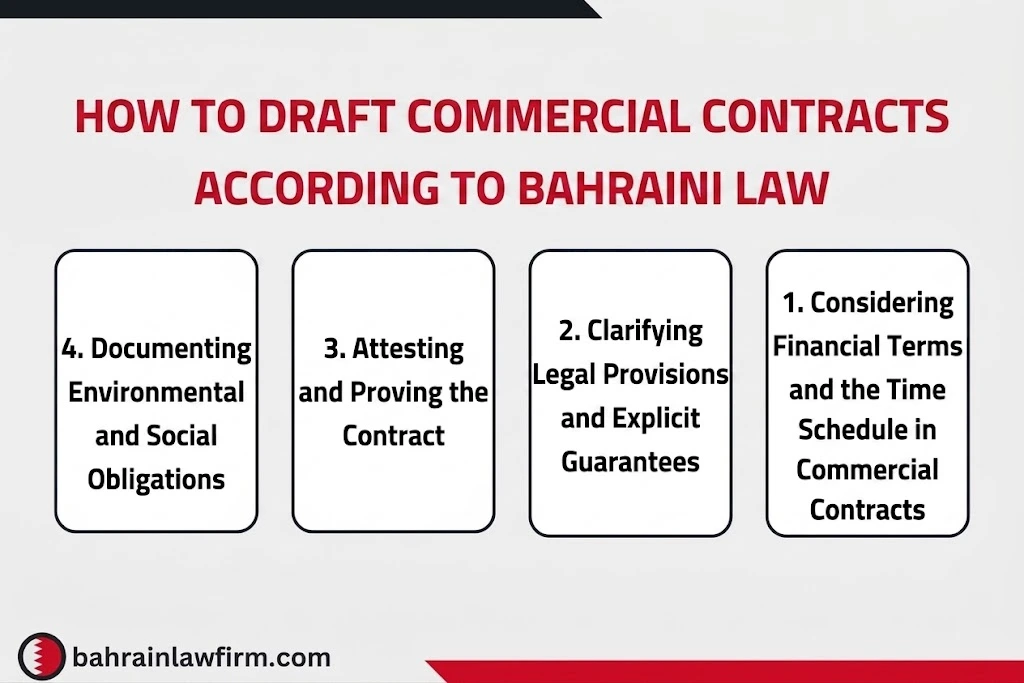
Below are the main points to consider when drafting contracts under Bahraini law:
1. Address Financial Terms and the Contract Timeline
Financial terms and the timetable for payment and performance are among the most important parts of any commercial contract. Define the financial details clearly so that every party understands what must be paid, when payment is due, and how the financial obligations will operate.
This usually includes:
- The total contract value.
- Payment dates and deadlines.
- Terms relating to advance or partial payments.
- Penalties or agreed consequences that may apply in the event of delayed payment or performance.
- A timetable setting out when the work or contractual obligations will begin and end.
- Any interim stages or milestones required to keep performance on schedule.
2. State Legal Clauses and Warranties Clearly
Commercial contracts should contain detailed provisions that protect the parties’ rights and clearly define their respective obligations. These provisions may cover quality warranties, performance standards, agreed contractual remedies in the event of breach, and procedures for resolving disputes.
The contract should also explain the circumstances in which it may be terminated or rescinded and set out the procedure to be followed if the contractual relationship ends before the agreed expiry date.
3. Formalise and Establish Evidence of the Contract
Formalising a commercial contract may be important for proving the agreement and ensuring compliance with any formal requirements that apply to the particular transaction. Depending on the type of contract, this may involve signatures by the relevant parties, witnesses, notarisation, registration, or another procedure required by the competent authority.
Proper documentation can also reduce future disputes by providing clear written evidence of what the parties agreed and a reliable document that can be referred to when needed.
4. Review the Commercial Contract Before Signing
The drafting process does not end once the clauses have been written. Review the full contract before signing to confirm that the parties’ actual agreement has been reflected clearly and accurately in the final wording.
A thorough review should focus in particular on the following:
- Confirming the identity, legal status, and capacity of each contracting party.
- Reviewing the scope of each party’s obligations and the deadlines for performance.
- Checking that the consideration, price, payment dates, and payment method are clearly stated.
- Reviewing the contract term and any provisions governing renewal, termination, or rescission.
- Ensuring that liability for breach or failure to perform is clearly addressed.
- Reviewing the dispute resolution mechanism and the governing law where relevant.
- Checking that there are no inconsistent, contradictory, or ambiguous clauses.
Review becomes particularly important when a commercial contract involves substantial financial commitments or a long-term business relationship. A single unclear clause may later cause the parties to disagree over how their rights or obligations should be interpreted after the contract has been signed.
Consider the Legal Requirements for a Valid Contract
When drafting Commercial Contracts under Bahraini Law, do not focus only on the clarity of the wording. It is equally important to confirm that the basic legal requirements needed for the contract to be valid have been satisfied.
Key matters to consider include:
- Consent: The parties must properly express their intention and agreement to enter into the contract.
- Legal capacity: The parties must have the required legal capacity and authority to enter into the agreement.
- Lawfulness of the subject matter: The contractual obligation must be possible, lawful, and not contrary to public order.
- Lawfulness of the purpose: The contract must be based on a legally permissible purpose.
- Specific formal requirements: Any requirement for writing, registration, notarisation, or another legal formality must be followed where the nature of the contract or transaction requires it.
Some requirements differ depending on the nature of the contractual relationship. For this reason, the drafting process normally begins by identifying the type of contract that best fits the transaction. We discuss this in more detail in our guide to the types of commercial contracts in Bahrain and their requirements.
At this stage, the focus shifts to turning the parties’ agreement into clear, consistent, and workable contractual provisions.
Legal Advice on Drafting and Reviewing Contracts
The role of a contracts lawyer goes beyond preparing the first draft. It can also include reviewing proposed contracts before they are signed and assessing the legal and financial consequences that may arise from their terms.
A lawyer experienced in contract matters can help by:
- Assessing the legal risks before the contract is signed.
- Identifying unclear or unbalanced clauses and suggesting appropriate amendments.
- Ensuring that each party’s duties and responsibilities are clearly defined.
- Reviewing payment, termination, compensation, and liability provisions.
- Checking that the contractual terms comply with the laws and regulations governing the transaction.
This becomes especially important when reviewing a contract prepared by the other party. The purpose of the review is not limited to checking the legal language. It also involves understanding the practical and legal consequences that each provision may have for the client’s rights and obligations before the contract is approved and signed.
FAQ Abut Drafting Commercial Contracts under Bahraini Law
Related questions include:
What Legal Requirements Should Be Considered When Drafting a Commercial Contract?
The main legal requirements to consider when drafting a commercial contract include compliance with applicable local laws and regulations, while ensuring that the contract terms are fair and not unreasonably burdensome.
What Procedures Are Required to Formalize a Commercial Contract?
The procedures may include notarizing the contract before the relevant official authorities and registering it where required to ensure its legal recognition and enforceability.
What Essential Elements Should a Commercial Contract Include?
A commercial contract should generally include:
1. The contracting parties.
2. The subject matter of the contract.
3. The financial terms.
4. The payment schedule.
5. The obligations of both parties.
How Can Commercial Contract Clauses Be Drafted Clearly?
To draft commercial contract clauses clearly, use simple and precise language and define the terms and obligations in sufficient detail to ensure that both parties understand their rights and responsibilities.
How Can the Parties Amend a Commercial Contract After Signing?
The parties may amend a commercial contract after signing by agreeing to the changes in writing and documenting them in a legally valid manner.
What Should Be Reviewed Before Signing a Commercial Contract?
Before signing a commercial contract, review the parties’ details, the scope of obligations, amounts and payment dates, performance periods, renewal and termination terms, liability for breach, and the agreed dispute resolution mechanism.
Drafting Commercial Contracts under Bahraini Law involves far more than simply gathering several clauses into one document. The aim is to create an agreement that clearly defines the rights and obligations of the parties while properly regulating financial matters, performance requirements, termination rights, liability, and dispute resolution in a way that suits the nature of the transaction.
Reviewing the contract before signing is therefore a key stage. It helps identify unclear or conflicting terms and allows each party to understand the legal and practical consequences that may arise during performance or in the event of a breach.
If you are preparing a commercial agreement or have received a draft from another party, a contracts lawyer can review its provisions, identify potential risks, and recommend suitable amendments before the final version is approved and signed.

A Bahraini lawyer and the founder of a legal consultancy firm established in February 2019. He holds a Higher Degree in Sharia and Law from Al-Azhar University. He has extensive experience in court representation and providing legal advice in criminal, personal status, civil, and commercial matters. He is known for delivering clear, practical, and effective legal advice aimed at protecting his clients’ rights and interests, and has achieved tangible results in notable cases, including commercial litigation and inheritance matters
