
Child Visitation Rules after divorce are among the main issues that concern separated parents. In this article, we explain the right to visit children after divorce in Bahrain.
We also provide a clear overview of the rules governing child visitation after divorce under Bahraini law, along with the main conditions and procedures that apply to visitation.
Contact us now by clicking the WhatsApp button at the bottom of the screen.
Table of Content
Child Visitation Rules After Divorce in Bahrain
Start by understanding the meaning of custody under the Bahraini Family Law. Custody refers to protecting, caring for, and raising the child.
Apply this right in a way that remains consistent with the guardian’s legal authority over the child. Under the Sunni school, a woman’s custody of a male child ends when he reaches the age of fifteen, while custody of a female child continues until she marries and the marriage is consummated.
Under the Ja’fari school, however, the mother’s custody continues until the child, whether male or female, reaches the age of seven. Custody then transfers to the father.
During the custody period, the mother and father should agree on how often the child will be visited, where the visits will take place, and when they will occur.
If the parents cannot reach an agreement, the judge regulates visitation and sets a time and place that do not cause psychological harm to the child.
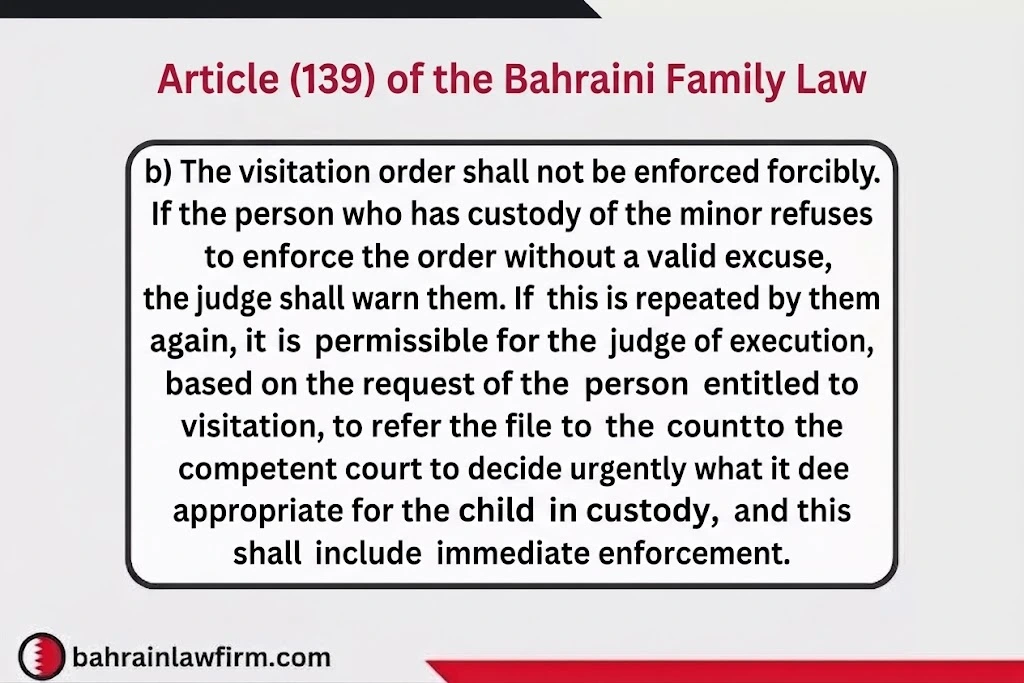
Clarifies Article 139 of the Bahraini Family Law that a visitation judgment cannot be enforced through physical force.
However, if the custodial parent refuses to comply with visitation orders without a legally valid excuse, the judge may issue a warning.
If the refusal happens again, the judge may refer the case file to the court hearing the main dispute so that it can issue urgent decisions that serve the child’s best interests as it considers appropriate.
Regulating Child Visitation Times and Locations
Provides Article 139 of the Bahraini Family Law that the non-custodial parent has the right to see and receive visits from the child, provided that this does not harm the child’s interests or affect their psychological and social stability.
Determines the Sharia Court the time, duration, and location of visitation in a way that serves the child’s best interests. When issuing a visitation order, the court may consider several factors, including:
- The child’s age.
- The child’s school and health circumstances.
- The distance between the custodial parent’s residence and the visiting parent’s residence.
- The availability of a safe environment for visitation.
Visits are usually arranged on weekends or for specific hours on certain days. They may also include public holidays and official vacations.
As for the visitation location, the court determines what is most suitable. Possible locations may include:
- The custodial parent’s home, if sufficient privacy is available.
- Safe public places, such as family care centers.
- In cases involving serious disputes, a location supervised by a competent authority.
Cases Where Child Visitation May Be Restricted or Prevented
Under the Child Visitation Rules, the court may restrict or prevent visitation if it is proven that the visit could harm the child. This decision is based on the principle of the child’s best interests established under the Family Law.
Common reasons for restricting or preventing visitation include:
- Evidence that the visiting parent has abused the child.
- Encouraging the child to turn against the custodial parent or involving the child in family disputes.
- Attempting to take the child outside Bahrain unlawfully.
- Causing a negative effect on the child’s mental health or education.
In these situations, the court may:
- Temporarily or permanently prevent visitation.
- Require visits to take place under the supervision of a competent authority.
- Change the time or location of visitation to reduce any psychological impact on the child.
Resolving Disputes Related to Visitation Rights
When disagreements arise between the parties over the enforcement of a visitation order or a request to amend it, either party may approach the competent Sharia Court. The court has the authority to decide such disputes in accordance with the Family Law.
Methods for resolving visitation disputes include:
- Filing a request to enforce the visitation order if the other party refuses to comply.
- Filing an urgent claim requesting immediate enforcement of visitation.
- Requesting an amendment to the judgment if new circumstances arise that affect the child.
- Seeking the assistance of a social expert when the dispute requires an assessment of the child’s living environment.
Some courts may also rely on family mediation and reconciliation efforts before moving toward compulsory enforcement, especially in cases involving young children.
Visitation Under the Supervision of a Competent Authority or at a Designated Location
When a serious dispute exists between the custodial parent and the visiting parent, or when there is a possible risk to the child, the court may order visitation to take place at a designated location under the supervision of a competent authority, such as:
- Family support or family care centers affiliated with the Ministry of Social Development.
- Family protection centers when there is a history of domestic violence.
- A court-appointed social worker or family counselor.
This type of supervised visitation aims to:
- Protect the child and prevent exposure to pressure, threats, or coercion.
- Make it easier to enforce the judgment in a monitored environment.
- Assess the behavior of the parties before reorganizing future visitation arrangements.
The Lawyer’s Role in Resolving Disputes Over the Right to See the Child
Plays a lawyer in Bahrain an important professional role in cases involving Child Visitation Rules. The lawyer’s duties may include:
- Providing accurate legal advice to a party affected by improper or unavailable visitation arrangements.
- Drafting claims and applications to regulate or amend visitation arrangements.
- Representing the client before the Sharia Court at different stages of litigation.
- Following up on the enforcement of judgments when the other party refuses to comply or causes delays.
- Requesting urgent court intervention when the child may face risks such as violence, abduction, or manipulation.
- Negotiating professionally to reach a settlement that protects the child’s rights and prevents the dispute from escalating.
A lawyer handling these cases should have a strong understanding of the Bahraini Family Law and should consider the psychological and social needs of children. Doing so supports legal awareness and promotes social justice within Bahraini society.
Frequently Asked Questions
Many questions arise about Child Visitation Rules in Bahrain. Below, we answer some of the most common questions.
Can the father request a change to the child's visitation times in Bahrain?
Yes. The father may request a change to the child's visitation times in Bahrain. Either party may request an amendment if new circumstances arise that affect the child's best interests.
What is the legal duration of a father's visit with the child?
There is no fixed legal duration for a father's visit with the child. The court determines the duration based on the child's best interests. In many cases, visits are arranged weekly and may also include public holidays and official vacations.
What should I do if the mother prevents me from seeing my children despite a court order?
If the mother refuses to allow the father to see the children despite a court order, you may approach the Enforcement Court and file a complaint. The necessary legal measures may then be taken to enforce the judgment.
This brings us to the end of our article on Child Visitation Rules after divorce in Bahrain. We discussed custody requirements, the rules governing visitation under Bahraini law, and the main procedures involved.
We also answered common questions about the subject and highlighted the importance of seeking help from a qualified lawyer who can assist with legal matters related to custody and visitation.
Do not forget to click the WhatsApp button at the bottom of the screen to receive legal advice from an experienced lawyer.
Dear reader, you may also learn more about: Divorce lawyer in Bahrain.

A Bahraini lawyer and the founder of a legal consultancy firm established in February 2019. He holds a Higher Degree in Sharia and Law from Al-Azhar University. He has extensive experience in court representation and providing legal advice in criminal, personal status, civil, and commercial matters. He is known for delivering clear, practical, and effective legal advice aimed at protecting his clients’ rights and interests, and has achieved tangible results in notable cases, including commercial litigation and inheritance matters
