

In 2023, Mrs. Fatima approached our law firm after her husband had deserted her for nine years without any contact or financial support.
She was living in a state of uncertainty and instability, which led her to file a Divorce Claim for Desertion in Bahrain
With God’s grace, we were able to help her obtain a divorce judgment after submitting the necessary evidence and witness testimony.
Has your husband been absent for a long time, leaving you in marital uncertainty without stability or clear rights? Suffering in silence will not resolve the situation.
Table of Content
Divorce Claim for Desertion in Bahrain
Desertion occurs when a husband withdraws from his wife and leaves her without a legitimate religious or legal reason, causing her psychological and social harm.
In Bahrain, desertion may constitute grounds for seeking divorce. A wife who suffers harm as a result may therefore file a divorce claim based on desertion.
Requirements for Filing a Divorce Claim for Desertion
To file a Divorce Claim for Desertion in Bahrain, the following requirements should be met:
- Proof of desertion: The desertion must be genuine and continuous for a significant period without a legitimate excuse.
- Failure to provide maintenance: If the husband also fails to financially support his wife during the period of desertion, this may constitute additional harm and strengthen her position in the case.
- Proof of harm: The wife must provide evidence showing the harm she suffered because of the desertion, whether financial or non-financial.
Procedures for Filing a Divorce Claim for Desertion
To file a divorce claim based on desertion, the following steps should be followed:
- Prepare the statement of claim: Include the spouses’ details, the circumstances of the desertion, and the specific relief requested.
- Submit the required documents:
- A copy of the marriage certificate.
- The wife’s identification card.
- Evidence proving the desertion and the resulting harm.
- File the claim electronically: Submit the case through Bahrain’s eGovernment portal by following these steps:
- Visit the eGovernment website (Bahrain.bh).
- Select the court and case services.
- Log in using the eKey.
- Complete the required information and attach the necessary documents.
- Attend court hearings:
After the claim is filed, the court will schedule hearings to consider the case. Witnesses may be called and supporting evidence may also be submitted.
Sample Divorce Claim for Desertion and Failure to Provide Maintenance
To the Honorable Family Court in [City Name]
Circuit: [Circuit Name]
Claimant: Mrs. [Wife’s Name], ID No.: [ID Number], Contact No.: [Phone Number], Residential Address: [Address], Occupation: [Occupation].
Defendant: Mr. [Husband’s Name], ID No.: [ID Number], Contact No.: [Phone Number], Residential Address: [Address], Occupation: [Occupation].
Subject of the Claim: Divorce based on desertion and failure to provide maintenance.
Facts of the Claim:
I married the defendant on [Date of Marriage] under a valid marriage contract No. [Contract Number]. During our marriage, we had [Number of Children] children.
For the past [Duration of Desertion], the defendant has deserted me without a legitimate reason. I have not known his whereabouts, and he has not contacted me throughout this period. He has also failed to provide financial support, causing me both psychological and financial harm.
Requests:
- To issue a judgment divorcing me from the defendant by an irrevocable divorce on the grounds of desertion and failure to provide maintenance.
- To order the defendant to pay all financial entitlements arising from the divorce.
With the utmost respect and appreciation.
Date: [Date of Filing]
Signature: [Claimant’s Signature]
If you need to file a divorce claim solely on this ground, request a consultation with a specialized alimony lawyer at Abdulrahman Khalifa Law Firm.
Defense Memorandum in a Divorce Claim Based on Desertion
To the Honorable Family Court in [City Name]
Circuit: [Circuit Name]
Defense Memorandum submitted by: Mr. [Defendant’s Name] (Defendant) against Mrs. [Claimant’s Name] (Claimant) in Case No. [Case Number] for the year [Case Year], scheduled for hearing on [Hearing Date].
Facts of the Case:
Mrs. [Claimant’s Name] filed a divorce claim based on desertion under Case No. [Case Number], alleging that I deserted her without a legitimate reason and failed to provide financial support.
I would like to clarify the following before the Honorable Court:
- The allegations are incorrect: The claimant left the marital home voluntarily more than [Period of Absence] years ago and took all her belongings with her.
- Availability of financial support: The claimant has her own sources of income, and our children are employed and provide for her.
- Attempts at reconciliation: I repeatedly tried to persuade her to return to the marital home, but she refused without justification.
Requests:
- To dismiss the claimant’s case because the alleged desertion and resulting harm have not been proven.
- To order the claimant to return to the marital home.
With the utmost respect and appreciation.
Date: [Date of Submission]
Signature: [Defendant’s Signature]
Frequently Asked Questions
How long must the husband desert his wife before she can seek divorce?
There is no specific period set by law. However, prolonged desertion without a valid Sharia-based reason may be considered sufficient grounds for the wife to seek divorce.
Can a wife request divorce if her husband deserts her?
Yes. In Bahrain, a wife may seek divorce on the grounds of desertion if her husband abandons her without a valid Sharia-based excuse and fails to provide financial support.
Can a Divorce Claim for Desertion be filed without evidence?
No. A Divorce Claim for Desertion cannot succeed without strong evidence supporting the wife’s claims regarding the desertion and the harm caused by it. The wife must prove that her husband deserted her for a prolonged period without a valid Sharia-based reason.
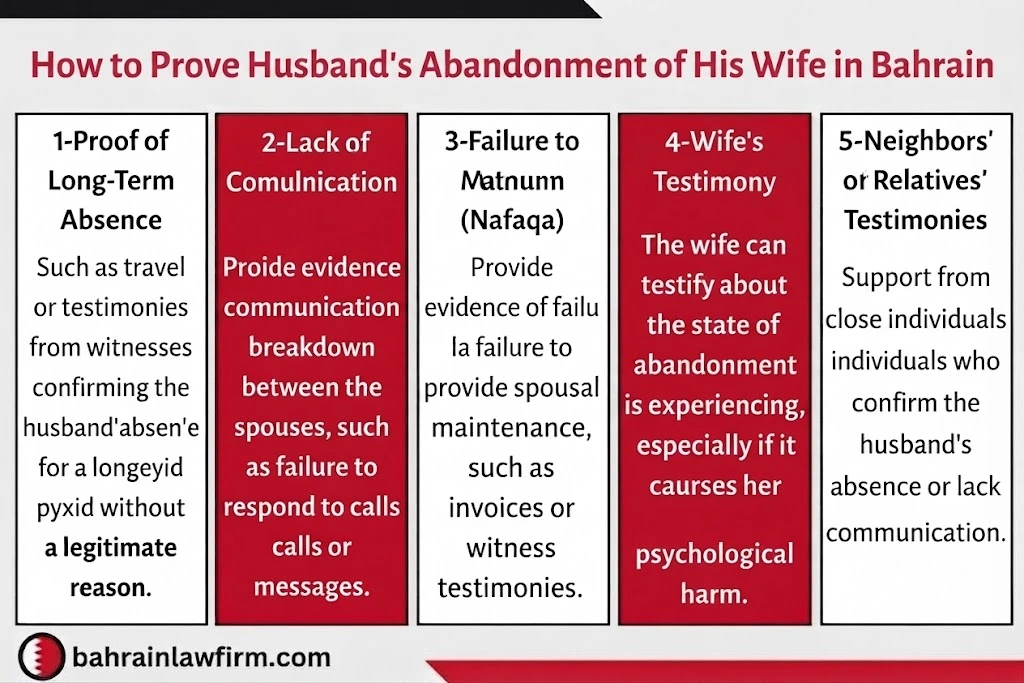
How can a wife prove that her husband deserted her in Bahrain?
Proving marital desertion may require the following:
1. Proof of prolonged absence: This may include travel records or witness statements confirming that the husband remained absent for a long period without a valid Sharia-based reason.
2. Lack of communication: The wife may provide evidence showing that communication between the spouses stopped, such as unanswered calls or messages.
3. Failure to provide financial support: Evidence may be submitted to show that the husband failed to pay spousal maintenance, including bills, financial records, or witness statements.
4. The wife’s testimony: The wife may testify about the desertion she has experienced, particularly where it has caused her psychological or emotional harm.
5. Statements from relatives or neighbors: Testimony from people close to the couple may help confirm the husband’s prolonged absence or lack of communication.
Is desertion considered a divorce?
No. Desertion by itself is not considered a divorce in Bahrain. However, if the desertion continues for a prolonged period and causes harm to the wife, she may seek divorce on this basis by filing a Divorce Claim for Desertion in Bahrain.
In conclusion, this article discussed the details of a Divorce Claim for Desertion in Bahrain and explained the requirements and legal procedures a wife should follow when filing this type of claim.
If you are facing a similar situation and need specialized legal advice, our law firm in Bahrain is ready to provide you with the legal support and guidance you need.
For more information, read: Divorce Procedures in Bahrain.

A Bahraini lawyer and the founder of a legal consultancy firm established in February 2019. He holds a Higher Degree in Sharia and Law from Al-Azhar University. He has extensive experience in court representation and providing legal advice in criminal, personal status, civil, and commercial matters. He is known for delivering clear, practical, and effective legal advice aimed at protecting his clients’ rights and interests, and has achieved tangible results in notable cases, including commercial litigation and inheritance matters
