

Marital separation between spouses occurs either through divorce or annulment. However, many people wonder about the Difference Between Marriage Annulment and Divorce in Bahrain, and whether the reasons for marriage annulment are the same as the reasons for divorce.
Find more details with the best lawyer in Bahrain.
Table of Content
Difference Between Marriage Annulment and Divorce in Bahrain
Marriage annulment means ending the marital relationship between the spouses through a court judgment, which makes each spouse legally unrelated to the other.
Divorce, on the other hand, means the separation of one spouse from the other. Islamic legal scholars have defined divorce as the dissolution of the marriage contract through an explicit or indirect statement accompanied by the intention to divorce.
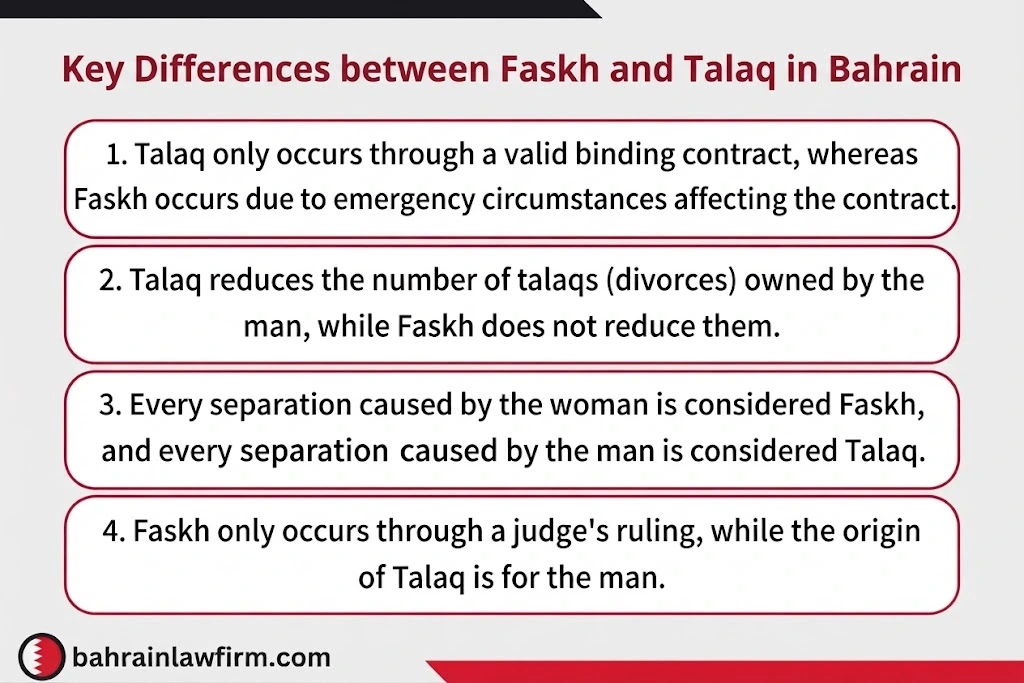
The main differences between marriage annulment and divorce include the following:
- Divorce is considered the termination of the marriage contract, but the marital bond does not completely end until major irrevocable divorce occurs. Marriage annulment, however, means cancelling the contract from its foundation.
- Divorce can only take place through a valid and binding marriage contract, while annulment occurs due to circumstances that arise after the contract, such as certain legal situations affecting the continuation of the marriage.
- Divorce reduces the number of divorces available to the husband, whereas marriage annulment does not affect the number of divorces.
- Any separation that occurs due to a reason related to the wife’s side is considered annulment, while separation caused by the husband is considered divorce.
- Marriage annulment can only take place through a court judgment, while divorce is originally a right exercised by the husband. However, the judge may act on his behalf in certain cases, as may the guardian of an incapacitated person or a minor, while an authorised representative acts within the limits of the authority granted by the principal.
- In the case of marriage annulment, the spouses cannot return to each other unless they enter into a new marriage contract. In the case of divorce, the spouses may reconcile if the marriage was consummated, the husband issued one or two divorces, and the wife is still within the waiting period (iddah).
- If marriage annulment occurs before consummation, no dowry is due. However, if divorce occurs before consummation, the wife is entitled to half of the dowry.
- Divorce only occurs through the husband’s statement, choice, and consent, while annulment may occur without a statement from the husband and does not require his consent or choice.
FAQ About the Difference Between Marriage Annulment and Divorce
Related questions include:
What Is the Difference Between Annulment and Divorce?
The difference between annulment and divorce is as follows:
Annulment is a separation ordered by a court judgment. It results in a minor irrevocable separation and is not counted among the number of divorces. It occurs when a matter arises in the marriage contract that prevents the continuation of the marital relationship under Islamic law.
Divorce, on the other hand, consists of three divorces. When the husband divorces his wife, the number of available divorces decreases. Divorce is divided into two types: revocable divorce and irrevocable divorce.
Is the Wife Entitled to Maintenance After Annulment?
Yes, the wife is entitled to maintenance after annulment according to the Sunni school of thought, in accordance with Article 53 of the Bahraini Family Law. The article states that comprehensive maintenance is due to a woman observing the waiting period, whether the separation is due to revocable divorce, annulment, or consummation of an invalid marriage.
This brings us to the end of our article about the Difference Between Marriage Annulment and Divorce in Bahrain, where we discussed the most important legal information related to divorce and marriage annulment. We also explained whether the wife has the right to claim maintenance after annulment under Bahraini Family Law, whether divorce can occur after annulment, and other important points related to this topic.

A Bahraini lawyer and the founder of a legal consultancy firm established in February 2019. He holds a Higher Degree in Sharia and Law from Al-Azhar University. He has extensive experience in court representation and providing legal advice in criminal, personal status, civil, and commercial matters. He is known for delivering clear, practical, and effective legal advice aimed at protecting his clients’ rights and interests, and has achieved tangible results in notable cases, including commercial litigation and inheritance matters
