
The issue of Post-Divorce Alimony in Bahrain is important for divorced women and children, as it raises many practical and legal questions.
For example, what is Post-Divorce Alimony in Bahrain? What types of maintenance are recognized under Bahraini law? Bahraini legislation includes detailed provisions governing the main forms of maintenance and financial support.
These may include housing, living expenses, and clothing. Another common question is: when does a divorced woman lose her right to housing in Bahrain?
How does the court determine the amount of post-divorce maintenance? This is where the role of a lawyer in post-divorce maintenance cases becomes especially important in protecting legal rights in accordance with the applicable law.
Has your marriage ended, and are you uncertain about your right to housing, iddah maintenance, or mut’ah compensation? The period following divorce may involve important financial claims that require proper legal handling.
Table of Content
What Is Post-Divorce Alimony in Bahrain?
Post-Divorce Alimony in Bahrain generally refers to financial amounts that one former spouse, usually the husband, may be required to pay to the divorced woman or the children in relation to financial rights that continue after the marriage ends.
Such maintenance may continue certain financial obligations that existed during the marriage. After divorce, however, entitlement and payment may become subject to a legal or Sharia court order.
Bahrain’s Family Law, issued under Law No. 19 of 2017, provides the legal framework governing maintenance entitlements, the circumstances in which maintenance becomes due, and the basis on which it may be amended.
If you intend to file a maintenance claim, you generally need to submit a formal application before the competent Sharia Court and provide the facts and supporting evidence on which your claim is based.
Types of Maintenance Under Bahraini Law
Bahraini family law recognizes different forms of maintenance depending on the legal relationship between the parties after divorce and the financial obligations that may continue after the divorce becomes effective.
These categories are governed by Bahrain’s Family Law No. 19 of 2017, which regulates maintenance rights according to the circumstances of the divorced woman and the children.
Each type of maintenance is subject to its own rules concerning duration, amount, and eligibility.
The main types include:
Iddah Maintenance
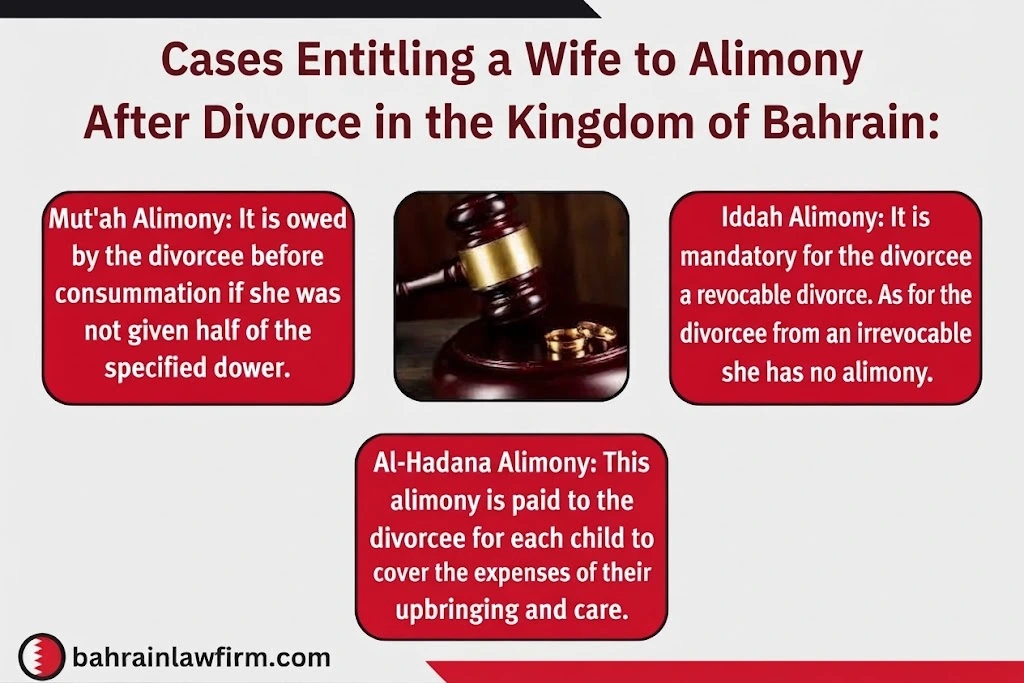
Iddah maintenance may be payable to a woman observing the waiting period following a revocable divorce, or in certain cases involving an invalid marriage or annulment. A woman observing iddah following an irrevocable divorce may not be entitled to maintenance if she was responsible for the circumstances leading to the divorce.
She may, however, retain a right to housing during the iddah period. If the divorced woman is pregnant, maintenance may continue throughout the pregnancy until childbirth.
This form of maintenance protects certain financial rights for a limited period after divorce, particularly where the possibility of reconciliation remains legally relevant.
Maintenance After the Iddah Period
After the iddah period ends, the court may consider whether continued financial support is legally justified in the circumstances of the case, including situations involving child custody, insufficient income, or an existing agreement between the former spouses.
Such maintenance is not automatically granted as an unrestricted right. The court considers the legal basis and circumstances of each individual case.
Mut’ah Compensation
Mut’ah compensation may be payable to a divorced woman before consummation if she has not received half of her specified mahr. If divorce occurs after consummation, she may be entitled to mut’ah compensation where she was not responsible for the divorce. Its amount may be assessed by reference to one year’s maintenance, taking into account the circumstances of the divorce, the duration of the marriage, and the financial means of the former husband.
Housing Maintenance
Housing is frequently disputed after divorce, particularly where children remain in the mother’s custody.
The court may require suitable accommodation to be provided for the custodian, usually the mother. This may involve allowing her to remain in the marital home or requiring the father to provide or pay for suitable alternative accommodation.
The court may consider factors such as the size of the family, the previous standard of living, and the location of the accommodation in order to preserve stability for the children.
Specific Maintenance Expenses: Food, Clothing, Education, and Medical Care
When hearing a maintenance claim, the judge may examine individual categories of expenditure relating to the divorced woman or the children. Depending on the circumstances, the court may award amounts covering specific needs, such as:
Monthly allowances for food and daily living expenses,
- regular clothing expenses, particularly for seasonal needs, Eid, or school;
- school fees and education-related expenses;
- medical expenses where there are chronic illnesses or continuing healthcare needs.
Child Maintenance
Where children remain within the legally recognized custody period, the father is generally responsible for their maintenance regardless of the mother’s financial position.
This may include food, education, healthcare, recreation, and other necessary expenses. The amount of Post-Divorce Alimony in Bahrain relating to children is assessed by balancing the father’s financial ability against the child’s reasonable needs. It may later be increased or reduced if financial or living circumstances change.
Temporary Maintenance Before the Final Judgment
In urgent cases, the court may issue an order for temporary maintenance to cover the essential needs of the divorced woman and her children until a final judgment is issued.
This interim measure may help prevent financial hardship during litigation, and a lawyer may request it where the legal requirements are met.
Bahrain’s Family Law also addresses grounds for loss of maintenance. Article 54 addresses circumstances in which a wife’s maintenance may cease if she refuses, without a lawful reason, to move to the marital residence or leaves it without lawful justification.
Maintenance may also cease where she prevents her husband from entering the marital residence and the relevant facts are established before the court.
Post-Divorce Alimony Law in Bahrain
The legal framework governing Post-Divorce Alimony in Bahrain regulates the financial rights of divorced women and children. Relevant legislation includes:
- Maintenance Fund Law: Law No. 34 of 2005, as amended, established the Maintenance Fund to facilitate payment of maintenance to eligible wives and children where enforcement against the person ordered to pay becomes difficult. The Fund is financed from the state budget and administered through the competent authorities. (Official link)
- Applying to the Fund: An applicant may be required to submit a copy of the maintenance judgment, evidence relating to unsuccessful enforcement, and identification documents. The application is then reviewed in accordance with the applicable procedures.
- Urgent Temporary Maintenance: Under the applicable legal framework, urgent financial support may be available in certain circumstances before a final judgment is issued.
- Updating Beneficiary Information: Beneficiaries may be required to update their information periodically to confirm continued eligibility and report changes in circumstances.
- Jurisdiction of the Sharia Courts: Maintenance claims are filed before the competent Sharia Courts in accordance with the applicable legal and religious jurisdiction, including the provisions of Family Law No. 19 of 2017.
When Does a Divorced Woman Lose Her Right to Housing in Bahrain?
A divorced woman’s right to housing is not necessarily permanent in every case. Whether it continues depends on the legal basis of the right, the custody arrangements, the judgment issued, and the facts before the court.
- If the divorced woman voluntarily leaves the accommodation or reaches an agreement with her former husband regarding alternative housing, the court may consider the legal effect of that conduct or agreement.
- If the divorced woman remarries, her legal position may change, particularly where the housing entitlement was connected to custody or a previous maintenance arrangement.
- If housing was granted only as part of temporary maintenance rather than a final judgment, the court may terminate or modify that arrangement once its purpose ends or circumstances change.
- If the financial circumstances of the person responsible for payment materially change, the court may consider an application to modify the amount or form of the housing obligation in accordance with the law.
- Where a dispute arises, a lawyer can present evidence concerning the basis for continuing or modifying the housing entitlement, including prior accommodation arrangements, existing obligations, and the living circumstances of the children.
How Does the Court Determine the Amount of Post-Divorce Maintenance?
Determining the amount of maintenance is one of the most important stages of a maintenance case. The court exercises discretion based on the evidence and the circumstances placed before it.
- The financial ability of the person responsible for maintenance, including salary, business or investment income, and other financial obligations.
- The reasonable needs of the beneficiary or children, including food, clothing, housing, healthcare, education, and transportation where necessary.
- The family’s previous standard of living, to the extent relevant under the applicable legal rules.
- The number of children and the nature of their needs, particularly where a child requires additional care.
- The circumstances of the marriage and the relevant financial arrangements between the parties, where legally relevant to the particular claim.
- Exceptional circumstances such as illness, disability, or additional financial responsibilities affecting either party.
The judge weighs the relevant factors and may order a monthly amount or another form of payment permitted by law. The judgment may also be subject to later modification if the circumstances materially change.
A lawyer may therefore support the claim by presenting salary records, financial statements, medical reports, invoices, and other evidence relevant to the amount requested.
The Role of a Lawyer in Post-Divorce Maintenance Cases
A lawyer in Bahrain can assist with the legal and procedural aspects of a maintenance claim and help ensure that the evidence is properly presented before the competent court.
- Preparing the financial case: The lawyer can collect documents showing the payer’s income and obligations, as well as the expenses of the claimant or children.
- Drafting the claim or application: Proper legal drafting helps present the claim clearly and reduces the risk of procedural errors.
- Collecting supporting evidence: This may include tenancy agreements, invoices, medical documents, school records, and other documents demonstrating need or entitlement.
- Representing the client before the Sharia Court: The lawyer presents the legal arguments and evidence and responds to the other party’s submissions.
- Following enforcement procedures: This may include filing an enforcement application or pursuing available procedures through the Maintenance Fund where the judgment is not complied with.
- Negotiating a settlement where appropriate: In some cases, the parties may resolve maintenance issues through a legally structured settlement, reducing the time and cost of continued litigation.
When choosing a lawyer, consider someone with practical experience in maintenance cases in Bahrain, familiarity with the procedures of the Maintenance Fund, and experience in enforcement matters.
Frequently Asked Questions About Post-Divorce Alimony in Bahrain
Below, we answer some of the most common questions concerning maintenance rights for divorced women under Bahraini law.
Is a Wife Entitled to Alimony After Divorce?
Yes. A wife may be entitled to Post-Divorce Alimony in Bahrain, including iddah maintenance, mut’ah compensation, and child-related maintenance, in accordance with the provisions of Bahrain’s Family Law.
What Is the Ruling on a Wife’s Maintenance After Divorce?
The husband is required to pay the wife’s maintenance after divorce in an amount sufficient to cover food, clothing, housing, and other customary living expenses.
How Much Is Post-Divorce Alimony in Bahrain?
Post-Divorce Alimony in Bahrain is assessed according to the financial means of the divorced husband, the circumstances of the divorce, and the needs of the person entitled to maintenance, while also taking into account prevailing customs, time, and place.
What Happens If the Husband Refuses to Pay Alimony?
If the husband refuses to pay alimony after a final court judgment has been issued, the Sharia Court may take enforcement measures to compel payment. These may include:
1. Garnishment of salary or seizure of bank accounts or property.
2. A travel ban until full payment is made.
3. Enforcement detention if the refusal continues, in accordance with Bahrain’s Civil and Commercial Procedures Law.
The person entitled to maintenance may also apply to receive payments from Bahrain’s Maintenance Fund under Law No. 34 of 2005. The Fund pays the amounts on behalf of the defaulting husband and later recovers them from him through compulsory enforcement procedures.
During divorce proceedings, Post-Divorce Alimony in Bahrain may become an important issue for both the divorced woman and the children, particularly where continued financial support is required after the marriage ends.
Understanding the different forms of maintenance and the legal requirements for claiming, increasing, reducing, or enforcing them can help the parties deal with the issue more effectively.
A lawyer experienced in family and maintenance cases can assist from the initial filing through enforcement of the judgment or, where applicable, procedures involving the Maintenance Fund.
If you are facing a maintenance dispute, you may seek legal advice from an experienced divorce lawyer who can review your circumstances and explain the legal options available for claiming your rights.
To contact a lawyer from our office who handles maintenance cases, use the WhatsApp button at the bottom of the screen.
Maintenance Lawyer in Bahrain for further legal advice.

A Bahraini lawyer and the founder of a legal consultancy firm established in February 2019. He holds a Higher Degree in Sharia and Law from Al-Azhar University. He has extensive experience in court representation and providing legal advice in criminal, personal status, civil, and commercial matters. He is known for delivering clear, practical, and effective legal advice aimed at protecting his clients’ rights and interests, and has achieved tangible results in notable cases, including commercial litigation and inheritance matters
