
Defense Memorandum for a False Report Compensation Claim is more than a document submitted to the court. It is a legal argument that organizes the facts and connects the false report to the damage suffered.
In Bahrain, a person may face a malicious complaint that harms their reputation or career, only for the case to later end with dismissal or acquittal.
This raises the key question: how can the injured person prove that the report was false and filed with the intention to cause harm? This article explains the legal basis, the required documents, and provides a brief practical template to help readers understand the process before seeking professional assistance through WhatsApp.
It also explains the difference between the lawful right to report an incident and an abuse of that right that may give rise to compensation under current Bahraini law and the cited legal sources.
Has a malicious report damaged your reputation or caused financial losses? You do not have to leave your legal rights unprotected.
Request an Assessment of Your Compensation Case
If you would first like to understand the procedures and required documents, continue reading below.
Table of Content
What Is the Legal Basis for a Defense Memorandum for a False Report Compensation Claim?
The legal basis involves connecting the false report to civil fault and the resulting damage. Article 234 of the Bahraini Penal Code promulgated by Legislative Decree No. 15 of 1976 criminalizes false reporting when a person knowingly makes a false report against another person before a judicial or administrative authority with the intention of causing harm.
The latest amendments to the Penal Code also include Law No. 16 of 2026, dated May 14, 2026, as published in Official Gazette No. 3883.
A Defense Memorandum for a False Report Compensation Claim should address the following points:
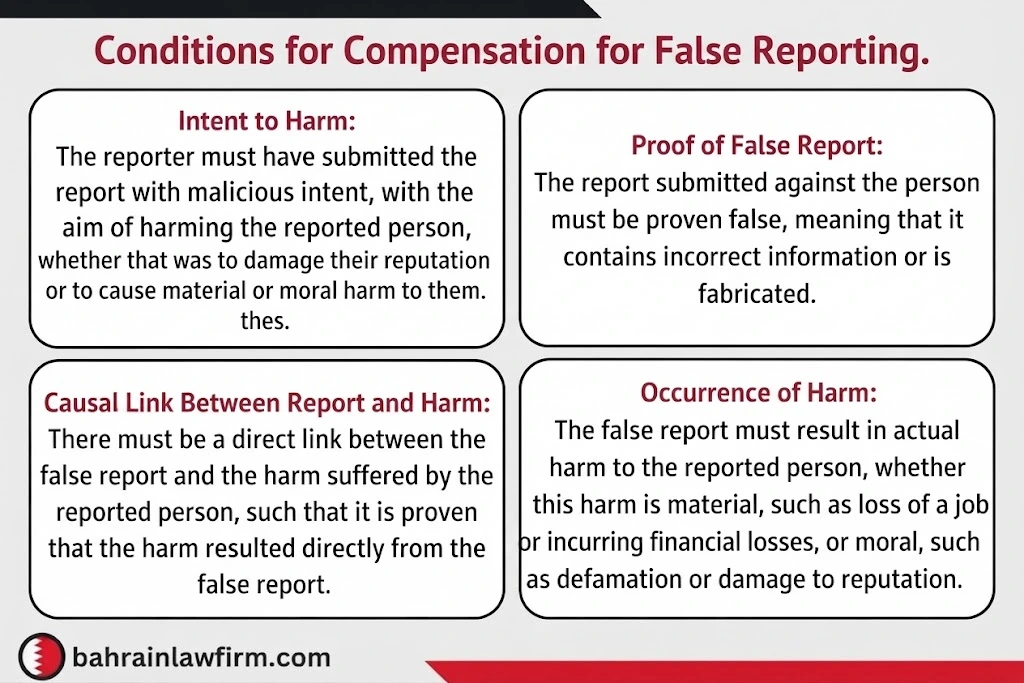
- Prove that the report contained false facts.
- Show that the reporting party knew, or should have known, that the allegations were untrue.
- Explain the material or moral damage caused by the report.
- Establish a direct connection between the report and the damage, rather than another independent event.
When Does a Report Become a Malicious Complaint That May Give Rise to Compensation?
Not every report that is dismissed, or every accusation that ends in acquittal, amounts to a false report. A person may submit a complaint in good faith based on facts they reasonably believed to be true, even though the available evidence later proves insufficient to convict the accused.
For this reason, the court generally looks for bad faith, abuse of rights, or fabrication of facts rather than relying solely on the outcome of the original complaint.
The following points help distinguish a lawful report from a malicious complaint:
- A lawful report generally exists when the reporting party had serious and reasonable grounds at the time the report was made.
- A complaint may be considered malicious when facts are fabricated, documents are distorted, or the complaint is used as a means of retaliation.
- A compensation claim may become stronger when the injured party supports it with a reasoned decision to dismiss the complaint, an acquittal judgment, or material contradictions in the reporting party’s statements.
- The claim may be weaker if the claimant cannot prove either the damage or bad faith.
Elements of a Compensation Claim for a False Report in Bahrain
A civil compensation claim is based on three elements: fault, damage, and causation. Article 158 of the Bahraini Civil Code, promulgated by Legislative Decree No. 19 of 2001, establishes the general rule that anyone whose wrongful act causes damage to another person is liable to compensate them.
Article 162 of the same law also permits compensation for moral damage, which may support a claim involving harm to reputation or social standing.
These elements can be organized in the memorandum as follows:
| Element | Meaning in the Case | Practical Supporting Evidence |
|---|---|---|
| Fault | Submitting a false or abusive report | Report record, Public Prosecution decision, judgment |
| Damage | Financial loss or damage to reputation | Cancelled contracts, correspondence, witness testimony |
| Causation | The damage resulted from the report | A clear timeline and connected documents |
Documents Required Before Drafting the Defense Memorandum
A Defense Memorandum for a False Report Compensation Claim becomes stronger when it is supported by documents rather than general allegations. Anyone looking for a ready-made template should first understand what evidence should be collected before filing or responding to a damages claim.
It is advisable to prepare the following documents:
- A copy of the report or complaint record.
- The Public Prosecution decision or judgment issued in the case.
- Evidence showing dismissal of the complaint, acquittal, or failure to establish the accusation.
- Documents proving financial damage, such as cancelled contracts or business losses.
- Evidence of moral damage, such as correspondence, witness testimony, or proof of harm to reputation.
- Any messages or other evidence indicating an intention to cause harm or act maliciously.
- A short timeline beginning with the date of the report and ending with the resulting damage.
Brief Defense Memorandum for a False Report Compensation Claim Template
The following template is provided for guidance and must be adapted to the facts of each case. It should not be relied upon without review by a qualified lawyer, as the claims and legal defenses differ depending on whether the party is the claimant or the defendant.
…….. Civil Court
Case No.: …….. of ……..
Memorandum on Behalf of: Claimant / ……..
Against: Defendant / ……..
Subject: Compensation for a false report and resulting material and moral damage.
First: Facts
The claimant filed this action seeking an order requiring the defendant to compensate them for the damage resulting from a report submitted against them. The report contained false allegations and caused harm to the claimant’s reputation and professional and social standing.
The proceedings ultimately resulted in …….., demonstrating that the accusation made against the claimant was not established.
The facts may be summarized as follows:
- The defendant submitted a report on ……..
- The report accused the claimant of ……..
- The competent authority ultimately decided ……..
- The claimant suffered damage consisting of ……..
Second: Establishing Fault
Fault is established by submitting a report containing false allegations and by exercising the right to complain in a manner that directly caused damage to the claimant.
Article 234 of the Bahraini Penal Code addresses the seriousness of false reporting when it is accompanied by an intention to cause harm, while Article 158 of the Bahraini Civil Code establishes liability to compensate for wrongful acts that cause damage.
The claimant relies on the following evidence to establish fault:
- The allegations in the report conflict with the documentary evidence.
- The investigation or trial ended without establishing the alleged facts.
- Evidence exists indicating malice or bad faith.
- The claimant suffered damage directly after the report was filed.
Third: Establishing Damage
The claimant suffered material damage consisting of …….., as well as moral damage resulting from harm to their reputation, dignity, and peace of mind.
Compensation for moral damage may be claimed under Article 162 of the Bahraini Civil Code when the damage is established and connected to the wrongful act.
The damage may include:
- Loss of an employment opportunity or commercial contract.
- Disruption of professional or family relationships.
- Damage to reputation before clients or within the person’s social circle.
- Legal defense or case follow-up expenses.
Fourth: Causation
The damage began after the report was submitted and did not exist beforehand or arise independently from it. The claimant therefore asks the court to establish the causal relationship from the sequence of events and the documents submitted in the case.
Causation may be established through:
- The date of the report.
- The date on which the damage occurred.
- Correspondence or documents linking the damage to the report.
- Witness testimony where necessary.
Fifth: Relief Sought
The claimant therefore requests that the court:
- Accept the claim procedurally.
- Order the defendant to pay appropriate compensation for material damage.
- Order the defendant to pay compensation for the moral damage suffered.
- Order the defendant to pay court fees, expenses, and legal fees.
- Reserve all other legal rights of the claimant.
Did the malicious complaint against you end in dismissal or acquittal, yet you are still dealing with its consequences? You may have legal options to seek compensation for the damage caused.
Contact a Lawyer to Discuss Your RightsTo learn about the requirements for accepting the claim and the documents that may support your position, continue reading the article.
Key Defenses Available to the Defendant in a False Report Compensation Claim
The defendant may argue that the report was not malicious and was instead submitted on serious and reasonable grounds. This is an important defense because exercising the right to approach the competent authorities does not, by itself, create liability for compensation unless fault, abuse, or bad faith is established.
Common practical defenses include:
- The defendant submitted the report in good faith.
- The report was based on facts or documents reasonably available when it was submitted.
- An acquittal alone does not prove that the original report was false.
- The claimant failed to prove the damage or exaggerated its extent.
- The causal connection between the report and the alleged damage was broken.
- The claimant’s own actions contributed to some of the consequences.
Procedures for Filing a Compensation Claim for a False Report
To file a compensation claim for a false report in Bahrain, the following procedures should be followed:
1. File a Criminal Complaint
The injured party begins by submitting a complaint to the Public Prosecution and explaining the circumstances surrounding the false report.
The complaint should contain accurate information about the incident, including when and where the report was made and how it adversely affected the injured party.
2. Collect Evidence
The complaint should be supported by evidence showing that the report was false and that the reporting party acted in bad faith. Such evidence may include witness testimony or official documents.
3. Obtain a Court Judgment
Following the investigation, if the false nature of the report is established, the court may issue a judgment convicting the reporting party.
4. File a Civil Compensation Claim
Based on the criminal judgment, the injured party may file a civil action before the competent court seeking compensation for the material and moral damage suffered.
The civil proceedings may include:
- Filing the claim.
- Attending court hearings and submitting evidence and witness testimony by both parties.
- Issuance of the compensation judgment.
5. Follow Up on the Court Proceedings
This includes attending hearings and submitting the legal memoranda required to support the claim.
FAQ About Defense Memorandum for a False Report Compensation Claim
Is an Acquittal Enough to File a Compensation Claim for a False Report?
No. An acquittal alone is not always sufficient. The claimant must usually prove that the report was false or malicious and that it caused material or non-material harm.
What Is the Difference Between a False Report and a Good-Faith Report?
A false report involves fabricating facts or making a report with the intention of causing harm. A good-faith report, by contrast, is based on reasonable grounds, even if the case is later dismissed or ends in an acquittal.
Can I Claim Compensation for Non-Material Harm Caused by a False Report?
Yes. Compensation for non-material harm may be claimed if the false report damaged the claimant’s reputation, dignity, or social standing, subject to the general rules of Bahraini civil law.
What Are the Most Important Documents in a Compensation Claim for a False Report?
Key documents include the original report, the Public Prosecution decision or court judgment, and evidence showing the damage and its direct connection to the report, such as the loss of a contract or harm to professional reputation.
Can the Defendant Rely on Good Faith as a Defense?
Yes. The defendant may argue that the report was made on serious and reasonable grounds. This defense may affect the court’s assessment of fault, especially where bad faith or malicious intent has not been established.
Do I Need a Lawyer to Draft the Defense Memorandum?
Legal assistance is recommended because a defense memorandum depends on more than a standard template. It requires careful presentation of the facts, selection of the relevant legal provisions, and proper organization of supporting documents.
False reports may give rise to legal consequences where the required legal elements are established, and a person who has suffered damage may seek the remedies available under Bahraini law.
A well-prepared Defense Memorandum for a False Report Compensation Claim can organize the facts, evidence, damage, and legal arguments relied upon in the case.
It is advisable to seek assistance from an experienced lawyer in Bahrain to review the facts, prepare the required documents, and handle the proceedings correctly.
For further reading, see: Defenses Available to the Defendant in a Compensation Claim in Bahrain.

A Bahraini lawyer and the founder of a legal consultancy firm established in February 2019. He holds a Higher Degree in Sharia and Law from Al-Azhar University. He has extensive experience in court representation and providing legal advice in criminal, personal status, civil, and commercial matters. He is known for delivering clear, practical, and effective legal advice aimed at protecting his clients’ rights and interests, and has achieved tangible results in notable cases, including commercial litigation and inheritance matters
