

Execution of a Will in Bahrain is a sensitive legal process that requires accuracy and an understanding of Sharia principles and the law.
This process involves a series of steps for the Execution of a Will in Bahrain, beginning with opening the estate and ending with its distribution in accordance with the testator’s instructions. However, disputes concerning wills in Bahrain may arise, particularly where there are doubts about the validity of the document or whether it exceeds one-third of the estate.
It is important to understand the rules governing wills under Bahraini law to avoid errors that could lead to the will being declared invalid.
Practical steps are always recommended to ensure the will is valid and properly carried out, including correct legal authentication and consulting specialists to respect the testator’s wishes and protect the heirs’ rights.
Proper legal documentation and consultation with specialists are recommended to ensure that the testator’s wishes are respected and the heirs’ rights are protected.
Are you facing difficulties with the Execution of a Will in Bahrain due to objections from some heirs or complex legal procedures? Are you concerned that your loved one’s final wishes may not be fulfilled? Let us help ease this burden.
Or continue reading to understand the legal requirements for enforcing a will within the one-third limit of the estate.
Table of Content
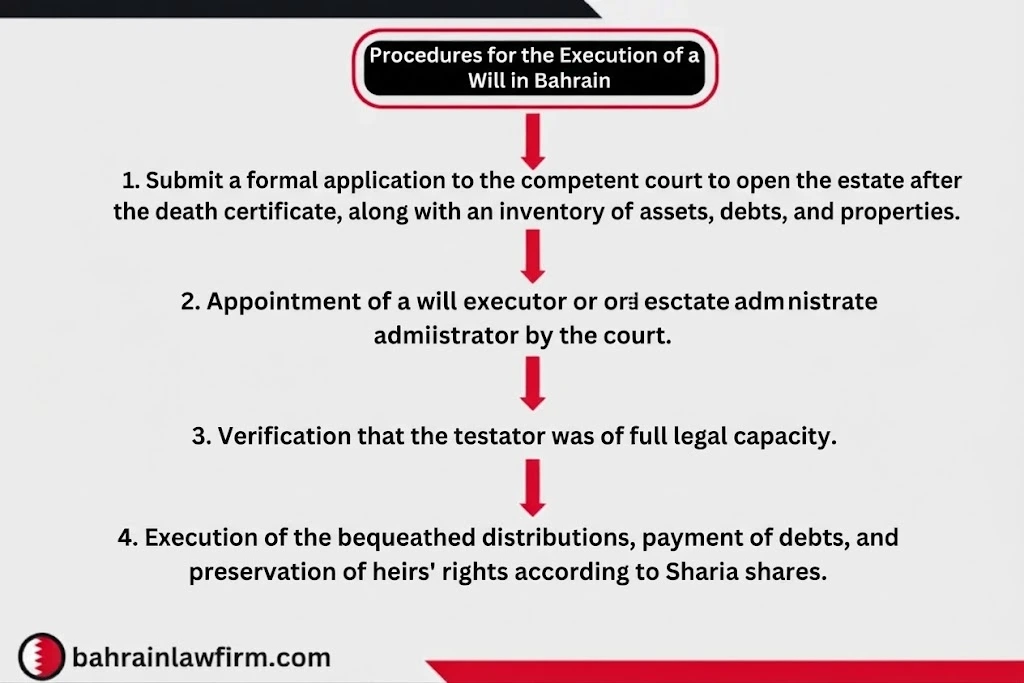
Procedures for the Execution of a Will in Bahrain
After the testator’s death, the process of carrying out the will in accordance with Sharia begins under the laws in force in the Kingdom of Bahrain. The main stages are as follows:
- Opening the estate: Submit a formal application to the competent court to open the estate after obtaining a death certificate, and identify the assets, debts, and property.
- Appointing an executor or estate administrator: If the testator has not appointed an executor in the will, the court appoints someone to carry out the will or administer the estate.
- Verifying the will’s validity and legal soundness: Confirm that the testator had full legal capacity, that the will was prepared in accordance with Sharia requirements, and that it does not exceed one-third of the estate where it is made in favour of a non-heir.
- Implementing the will’s provisions after the testator’s death: Make the specified distributions, pay debts, and protect the heirs’ rights in accordance with the prescribed Islamic inheritance shares and Family Law No. (19) of 2017.
Will-Related Disputes in Bahrain
Disputes often arise after the testator’s death and include the following:
- Seeking to have the will declared invalid for reasons such as lack of capacity, an invalid signature, coercion, or fraud.
- Disagreement over the amount bequeathed, particularly where it exceeds the Sharia limit of one-third or the will is made in favour of an heir.
- Disputes over the legal status of the beneficiaries or the identity of the rightful heirs.
- Disputes over carrying out the will, including the timing of execution or the actual distribution of money and property.
The Role of the Sharia Court in Resolving Disputes
When any of the above disputes arise, the Sharia court plays a central role by:
- Examining the will’s witnesses and ensuring that the applicable Sharia requirements for testimony are met.
- Assessing the testator’s capacity, including soundness of mind, understanding, and discernment, and ensuring that no Sharia-based impediment exists, such as mental incapacity.
- Determining whether the will exceeds one-third of the estate. If it does, the amount may be reduced to one-third or the excess may be accepted with the consent of the heirs who have full legal capacity.
- Issuing a final judgment confirming the will’s validity or invalidity and ordering that it be carried out, cancelled, or amended in accordance with the court’s decision.
Rules Governing Wills under Bahraini Law
Wills under Bahraini Law are governed as follows:
A Will in Favour of an Heir
A bequest in favour of an heir is not accepted beyond one-third of the estate, after the estate has been inventoried and inheritance shares and debts have been calculated. If the testator bequeaths to an heir more than that heir’s prescribed inheritance share without the other heirs’ consent, the heirs may reject the excess.
A Will in Favour of a Non-Muslim
Bahraini law takes into account the school of jurisprudence followed by the testator. If the testator is a Muslim who follows a particular school, a will in favour of a non-Muslim is governed by the relevant principles of Islamic jurisprudence and that school. Charitable gifts to non-Muslims or to entities that do not inherit are not prohibited, provided that the will complies with the applicable legal requirements.
A Bequest of Usufruct or Benefits
This is a bequest in which the testator grants the benefit or use of an asset without transferring ownership, such as the right to use something for a specified period or purpose. The bequest must be capable of being carried out, must not conflict with Sharia requirements, and must not deplete the estate or deprive the heirs of their rights.
A Will Made During a Life-Threatening Illness
The testator must be of sound mind and understand the nature of the act when making the will, even if suffering from a serious illness. The testator’s intention must be clear, and no one should exploit the testator’s weakness or fear to induce wording that does not reflect the testator’s true wishes.
Invalidity of a Will
A will is invalid if the testator lacked mental capacity when making it. If the will fails to meet Sharia or legal requirements concerning witnesses, or exceeds one-third of the estate without the heirs’ consent, it may be invalid in whole or in part. A will may also be invalid if it contains provisions contrary to Sharia or public order, or harms the apparent heirs without a valid Sharia justification.
Practical Tips to Ensure a Will Is Valid and Properly Carried Out
The following practical steps can help avoid disputes and protect rights:
- Make the will when the testator has full mental capacity, is acting freely and with clear intent, and is not under pressure or coercion.
- Consult leading lawyers in Bahrain to draft the will in compliance with the law and Sharia, and have it authenticated by the Sharia court.
- Use the official application for a Sharia will document from the Ministry of Justice, Islamic Affairs and Waqf, and provide the required documents, such as an identity card, title deed, and power of attorney, if applicable.
- Clearly name the executor in the document or appoint a lawyer to carry out the will, and specify how the assets are to be distributed after death to avoid disputes.
- Keep a copy of the will in a secure, officially registered location and inform the relevant heirs of it in advance to reduce the likelihood of challenges.
When Should I Consult a Lawyer About the Execution of a Will in Bahrain?
It is essential to consult a lawyer in Bahrain who specialises in this area when beginning the process of carrying out a will, especially if legal or Sharia-related complications arise. Legal advice is recommended in the following circumstances:
- There is a disagreement among the heirs about the validity of the will or the interpretation of its provisions.
- The will includes real estate or high-value assets that require official registration or transfer of ownership.
- There are concerns that the will exceeds one-third of the estate and the heirs have not consented to the excess.
- The wording of the will is unclear or its contents conflict with Sharia provisions.
- The will benefits entities outside Bahrain or non-Muslim beneficiaries.
In such cases, it is advisable to appoint a lawyer in Bahrain to file the necessary applications before the Sharia court and follow up on the Execution of a Will in Bahrain in a way that respects the law and protects the rights of all parties.
Frequently Asked Questions About the Execution of a Will in Bahrain
Where Can I File a Will Dispute in Bahrain?
You can file a will dispute before the competent High Sharia Court through the Sharia Courts Department in Bahrain. The court handles disputes relating to the validity of a will, its execution, its compliance with Sharia principles, and any irregularities in its provisions, in accordance with the Family Law No. (19) of 2017.
The claim should be supported by a copy of the will, the death certificate, and any documents or evidence relevant to your case.
How Can I Execute a Will in Bahrain?
To execute a will in Bahrain, the following steps should be followed:
1. File an application to open the estate: After the testator’s death, submit an application to the Sharia Court to initiate the estate proceedings.
2. Submit the required documents: These include the original or a certified copy of the will, the death certificate, and the heirs’ identity documents.
3. Appoint an executor: The court may appoint an executor, either from among the heirs or another trusted person designated by the testator or selected by the court.
4. Ensure compliance with the one-third limit: The will is generally enforceable up to one-third of the estate after the deceased’s debts have been settled.
5. Court supervision: The court oversees the execution process to ensure compliance with applicable Sharia principles and Bahraini law.
What Happens If a Will Exceeds One-Third of the Estate and the Heirs Do Not Consent?
If a will exceeds one-third of the estate, the excess portion can only be enforced with the consent of the adult heirs who are legally entitled to give such consent. This consent should be expressly given and properly documented.
If the heirs do not consent, the will is generally enforceable only up to one-third of the estate, while the excess portion is not binding on them. This principle is based on Islamic inheritance rules and Bahraini law, which seek to protect the legal rights of the heirs.
Can I Amend or Revoke My Official Will?
Yes. In Bahrain, a person may amend or revoke an official will at any time, provided they have the necessary legal capacity and mental competence when making the change.
Ultimately, a will is an important Sharia-based means of organising rights after death, and carrying it out requires a clear understanding of the provisions of Bahraini law.
Whether you are a testator or a beneficiary, complying with legal requirements and seeking advice from a specialised legal adviser helps protect the rights of all parties and prevents heirs from becoming involved in lengthy disputes.
Do not leave your future to uncertainty; put it in order now within the applicable Sharia and legal framework.
You may also find the following related information useful: Inheritance rights of a maternal half-sister.

A Bahraini lawyer and the founder of a legal consultancy firm established in February 2019. He holds a Higher Degree in Sharia and Law from Al-Azhar University. He has extensive experience in court representation and providing legal advice in criminal, personal status, civil, and commercial matters. He is known for delivering clear, practical, and effective legal advice aimed at protecting his clients’ rights and interests, and has achieved tangible results in notable cases, including commercial litigation and inheritance matters
