

An employee at a private-sector company in Bahrain was suddenly dismissed after years of service. He then discovered that his final salary, unused annual leave balance, and end-of-service benefits had still not been paid.
In such a situation, knowing that employees have general legal rights is not enough. The employee needs to understand exactly what Employee Rights under Bahrain Labour Law include, which documents are required, and which legal deadlines could prevent a claim from being heard if missed.
Bahrain’s Labour Law for the Private Sector, Law No. 36 of 2012, was issued on 26 July 2012 and published in the Official Gazette on 2 August 2012. It came into force one month after its publication.
This guide explains the practical process of handling an employment claim, from the moment a dispute arises through to filing a complaint or court case. It focuses on the situations employees most commonly face. Read on to understand the key steps.
Are your wages delayed, or have you been unfairly dismissed and feel that your employment rights are at risk? Do not let your efforts disappear through lengthy legal procedures.
Table of Content
Employee Rights in Cases of Unfair Dismissal in Bahrain
Bahraini Labour Law provides clear protection when an employee’s contract is terminated without a lawful reason. It gives the employee the right to compensation when the employer ends the contract without a genuine and valid basis.
The law also places the burden of proving that the termination was lawful on the employer rather than the employee. For that reason, understanding Employee Rights under Bahrain Labour Law in this situation begins with two basic questions:
- Was there a genuine reason for the termination?
- Did the employer follow the required notice and investigation procedures where applicable?
Unfair dismissal commonly appears in situations such as the following:
- The employer terminates the contract because of the employee’s sex, colour, religion, marital status, or family responsibilities.
- The employer dismisses a female employee because of pregnancy, childbirth, or breastfeeding.
- The employer terminates the contract because the employee belongs to a trade union or lawfully participates in its activities.
- The employer dismisses an employee because they filed a genuine complaint, report, or legal claim.
- The employer terminates the contract because the employee exercised their legal right to leave.
Employees should distinguish between lawful and unlawful termination. An employer may have the right to terminate a contract in certain circumstances, such as serious misconduct, unjustified absence, or disclosure of confidential business information. If you believe your employment was terminated without a lawful reason, do not hesitate to consult an unfair dismissal lawyer.
However, the employer must still comply with the law and the required procedures. This is where Employee Rights under Bahrain Labour Law help prevent an employer from using a formal excuse to hide what is, in reality, an unfair dismissal.
To assess your position in practice, review the following points before taking action:
- Did you receive written notice?
- Did the notice explain the reason for termination?
- Was the dismissal preceded by a complaint or a claim for financial rights?
- Did the termination occur while you were on leave or because you exercised your right to leave?
- Was there a written investigation if the reason was disciplinary?
Compensation for Unfair Dismissal
The law calculates compensation according to the type of employment contract and the employee’s length of service. If an employer terminates an indefinite-term contract without cause or for an unlawful reason after the first three months of employment, the employee is generally entitled to compensation equal to two days’ wages for every month of service. The compensation must not be less than one month’s wages or more than 12 months’ wages.
For a fixed-term contract, compensation is generally equal to the wages payable for the remaining period of the contract, subject to the statutory minimum where the parties have agreed on a lower amount.
Employee Rights under Bahrain Labour Law become broader if the termination qualifies as unfair dismissal under Articles 104 or 105. In such cases, the employee is entitled to additional compensation equal to half of the compensation otherwise due, unless the employment contract provides for a higher amount.
In certain cases involving trade union membership or employee representation, the court may also order the employee’s reinstatement if the employee requests it and the relevant reason for dismissal is established.
Where the legal conditions are met, the employee should claim the following entitlements:
- Compensation for unlawful or unfair dismissal.
- Payment in lieu of notice where the required notice period was not observed.
- Outstanding wages.
- Payment for unused annual leave.
- End-of-service benefits, where applicable.
- Any commissions, allowances, or fixed benefits provided for in the employment contract or company regulations.
Employee Rights When a Company Is Liquidated in Bahrain
Company liquidation or closure does not cancel Employee Rights under Bahrain Labour Law. The Labour Law provides that liquidation, closure, bankruptcy, or reduction of business activity does not remove the employer’s legal obligations. Likewise, a transfer, merger, or sale of the business does not automatically terminate employment contracts, and the successor remains jointly liable for the obligations arising from them.
This rule protects employees from a common misunderstanding: that closing a commercial registration or liquidating a company automatically means that employment claims are lost. Employees should therefore treat liquidation as a legal situation requiring a full calculation of their entitlements, not as a reason to give them up.
Employee rights during company liquidation generally include:
- Outstanding wages up to the employee’s final working day.
- Payment in lieu of notice if the employer did not observe the required notice period.
- Payment for any unused leave balance.
- End-of-service benefits, where applicable.
- Any fixed amounts stated in the employment contract or company regulations.
- Any compensation or benefit payable upon termination for economic reasons, where the required conditions are met.
The law gives employees’ wages and other amounts owed to them priority over the employer’s movable and immovable assets. These amounts are recovered before any other debt, including debts owed to the State.
This rule is one of the most important protections for Employee Rights under Bahrain Labour Law during liquidation because it places employee claims in a preferred legal position where several creditors are competing for payment.
Under Article 111, as amended, an employer may terminate an employment contract because of the full or partial closure of the establishment, a reduction in business activity, or the replacement of a production system in a way that affects the workforce. However, the employer must notify the Ministry of the reason for termination 30 days before notifying the employee. Except in cases of complete closure, priority must also be given to Bahraini employees where their competence and experience are equal to those of foreign employees.
Before accepting any settlement during liquidation, check the following:
- Was the reason for termination stated in writing?
- Was the Ministry notified within the legal deadline where Article 110 applies?
- Were leave, wages, and allowances calculated separately from termination compensation?
- Are there other employee debts involving colleagues that could affect the liquidation process?
- Does the settlement contain an unlawful waiver of statutory employment rights?
Employees should also remember that any settlement or release that reduces their statutory rights during the employment relationship, or within three months after it ends, is invalid if it conflicts with the Labour Law. For that reason, an employee should not sign a general settlement before checking the figures and supporting documents carefully.
Employee Rights under Bahrain Labour Law According to the Law
Bahrain Labour Law regulates the employment relationship from beginning to end. For that reason, Employee Rights under Bahrain Labour Law are not limited to dismissal or company liquidation.
Protection starts with the employment contract and extends to wages, working hours, leave, disciplinary investigations, and the procedures used to pursue claims before the competent authorities.
The following table highlights some of the main legal provisions employees may need when assessing their position:
| Area | Right | Legal Basis |
|---|---|---|
| Employment Contract | The employment contract must be written in Arabic in two copies. If no written contract exists, the employee may prove their rights using all available methods of evidence. | Articles 19 and 20 of Labour Law No. 36 of 2012 |
| Probation Period | A probation period is valid only if it is expressly stated in the contract. It generally cannot exceed three months, although it may reach six months for certain occupations. | Article 21 |
| Wages | Wages must be paid on time, and the employee’s financial entitlements upon termination must be paid in accordance with the law. | Article 40 and its amendments |
| Wage Protection | Employers must pay employees through the Wage Protection System and by using authorised payment methods. | Resolution No. 68 of 2019 |
| Working Hours | An employee may not actually work more than 48 hours per week, with a special limit applying to Muslim employees during Ramadan. | Article 51 |
| Overtime | Employees are entitled to additional pay of at least 25% for daytime overtime and 50% for nighttime overtime. | Article 54 |
| Weekly Rest | Employees are entitled to a weekly rest period of at least 24 hours and, where they work during that period, to compensation or an alternative day off in accordance with the law. | Article 57 |
| Disciplinary Penalties | No disciplinary penalty may be imposed before the employee is notified in writing, given an opportunity to respond, allowed to present a defence, and provided with the reasons for the decision. | Article 76 |
| Court Fees | Employment claims brought by employees or their beneficiaries are exempt from court fees. | Article 6 |
This structure makes it easier for the reader to move from understanding the right, to identifying the relevant legal provision, and then preparing the required documents.
Employee Rights under Bahrain Labour Law should therefore be explained in practical language rather than simply listing separate legal provisions.
To identify the type of claim you may have, follow these steps:
- Identify the employment relationship: fixed-term contract, indefinite-term contract, or employment for a specific task.
- Gather your documents: employment contract, payslips, bank transfers, messages, warnings, and leave records.
- Classify the claim: wages, leave, dismissal compensation, work injury, or end-of-service benefits.
- Check the deadline: some claims have very short limitation periods, particularly claims for compensation following termination.
- Avoid signing too soon: do not sign a general settlement before calculating everything you are owed.
Employee Rights under Article 58
Article 58 establishes an important part of Employee Rights under Bahrain Labour Law: paid annual leave. An employee who has completed at least one year of service is entitled to annual leave of no less than 30 days, calculated at two and a half days for each month. If the employee has worked for less than one year, leave is calculated in proportion to the period of employment.
Employees should understand that annual leave is not an optional benefit granted at the employer’s discretion. It is a statutory right designed to protect health, rest, and continued productivity. An employee therefore cannot waive the right to annual leave while the employment relationship continues and may be entitled to cash compensation for unused leave in the circumstances provided by law.
Article 58 becomes particularly important in situations where:
- The employer refuses to allow the employee to take annual leave.
- The employer allows annual leave to accumulate without regularly settling the balance.
- The employment relationship ends before the employee has used their leave.
- The parties disagree about the leave balance or how cash compensation should be calculated.
- The employer confuses occasional leave with annual leave.
Article 59 complements this right. The employer may determine annual leave dates according to the needs and circumstances of the business, but the employee must in all cases receive at least 15 days of annual leave, including at least six consecutive days.
The employer must also settle the employee’s leave balance and the corresponding pay at least once every two years. If the employment relationship ends before the employee uses their outstanding leave, the employee becomes entitled to cash compensation for the remaining balance.
Employee rights under Article 58 also answer several practical questions that commonly arise:
- Can an employer cancel an employee’s leave balance? Not unless the legal conditions allow it.
- Can an employee receive payment instead of annual leave while still employed? As a general rule, annual leave is a right to rest, not simply a financial allowance.
- Is the employee entitled to cash compensation when the contract ends? Yes, if there is an unused leave balance that remains due.
- Is annual leave calculated for service of less than one year? Yes, in proportion to the period worked.
Employee Rights under Article 89
Article 89 deals with a different issue from leave and dismissal. It covers work injuries and occupational diseases. The Minister of Health, in agreement with the competent minister, issues a decision establishing a medical committee responsible for determining whether an employee has an occupational disease, assessing any disability suffered by the injured employee and its percentage, determining when treatment has ended, and resolving disputes about the duration and cost of treatment.
Employee Rights under Bahrain Labour Law Article 89 become particularly important when a workplace injury occurs or an occupational disease develops and a disagreement then arises over treatment, disability, or costs.
The employee should not rely only on a verbal assessment or an internal administrative opinion. Article 89 provides a formal medical process for determining the effect of the injury on the employee’s rights to treatment and compensation.
The medical committee’s responsibilities under Article 89 include:
- Determining whether an occupational disease exists.
- Assessing the injured employee’s disability.
- Determining the percentage of disability.
- Determining when treatment has ended.
- Resolving disputes concerning the duration and cost of treatment.
The employee has the right to appeal any decision issued by the medical committee before the Medical Appeals Committee within 15 days from the date the employee receives written notice of the decision. This deadline is particularly important because a delay may weaken the employee’s position or complicate the claim.
Article 89 also works alongside other provisions that protect injured employees. If an accident causes the employee’s death or prevents the employee from working, the employer must notify the police station, the Ministry, and the Ministry of Health within 24 hours of becoming aware of the accident.
The employer must also bear the full cost of treatment, including medication, transport expenses, rehabilitation services, and any necessary prosthetic or assistive devices.
An injured employee should prepare the following documents:
- The accident report or official notification.
- The initial medical report.
- Copies of notices sent to the employer.
- Treatment and transport invoices.
- Sick leave certificates.
- Any decision issued by the medical committee or the Medical Appeals Committee.
You should then contact an experienced work injury lawyer so the case can be reviewed and your claim pursued as quickly as possible.
Employee Rights Concerning Wages and the Wage Protection System
The law protects wages as the basic payment an employee receives in return for work. An employer is not considered to have discharged its wage obligation unless payment is made through the legally prescribed method. Resolution No. 68 of 2019 also requires employers to pay wages through the Wage Protection System using authorised payment methods that allow the competent authorities to verify payment.
This protection helps employees prove delayed or incomplete wage payments because bank transfers and other authorised payment methods create a record that can be checked if a dispute arises. Employees should therefore avoid relying only on verbal promises when wages are delayed or only partially paid.
If a wage dispute arises, review the following points:
- Was the salary paid through an authorised payment method?
- Does the transferred amount match the agreed wage?
- Are there fixed allowances that were not paid?
- Was overtime paid at the legally required rates?
- Did the employee sign a receipt that does not reflect the amount actually received?
The law also prohibits wage discrimination between male and female employees performing work of equal value. This protection was introduced through the amendment to Article 39 under Decree-Law No. 16 of 2021. It strengthens the principle of equality within Employee Rights under Bahrain Labour Law for both men and women in the workplace.
Do not hesitate to seek advice from a specialised labour lawyer at Abdulrahman Khalifa Law Firm. Simply click the WhatsApp button at the bottom of the screen.
Employee Rights Regarding Notice and Leaving Employment
For indefinite-term contracts, the law requires each party to give the other at least 30 days’ notice before termination. The employment contract remains in force during the notice period. If either party terminates the contract without observing the required notice, that party must compensate the other for the employee’s wages covering the full notice period or the remaining part of it.
This rule protects employees from sudden termination and gives them time to look for another job where the notice comes from the employer. The employee is entitled to take one full day per week, or eight hours during the week, to search for work while continuing to receive pay for that time.
When receiving a termination notice, the employee should check the following:
- Was the notice given in writing?
- Did the employee receive a copy?
- Was the notice period calculated from the correct date of receipt?
- Did the notice coincide with annual or sick leave?
- Was payment in lieu of notice made if the notice period was not observed?
An employee may also terminate the contract without notice in certain situations. These include cases where the employer or someone acting on the employer’s behalf assaults the employee during or because of work, or commits an indecent act against the employee or a member of the employee’s family. In these circumstances, the termination is treated as unfair dismissal by the employer.
Read more about unfair dismissal under Bahrain Labour Law.
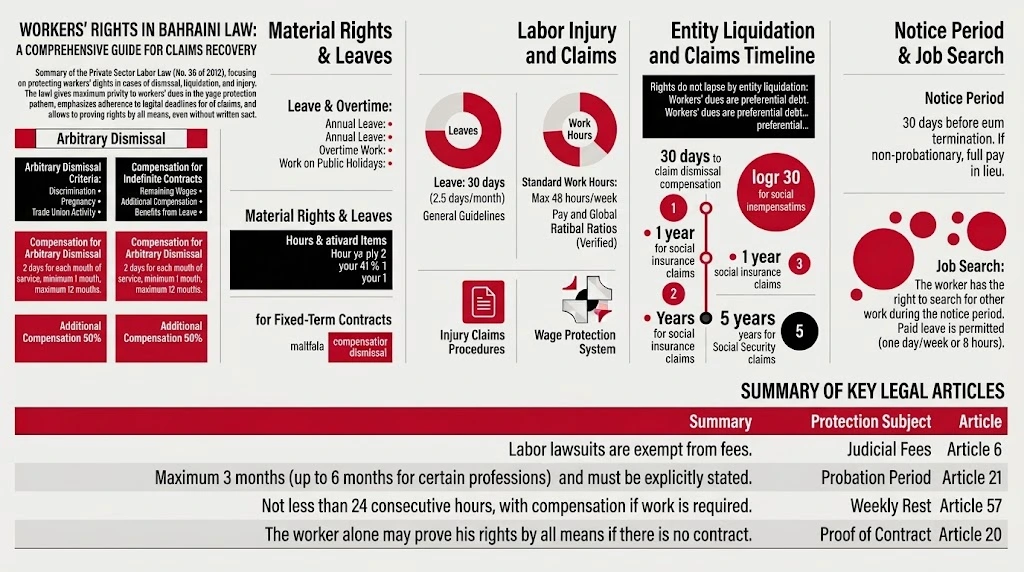
How Can an Employee Claim Their Rights Without Missing Legal Deadlines?
Employees should act quickly after dismissal or non-payment. A claim for compensation arising from termination of employment will not be heard if it is filed more than 30 days after the date of termination. This period is interrupted if, with the agreement of both parties, the dispute is referred to the Individual Labour Dispute Settlement Authority within the deadline. The employee must then file the court case within three months after the proceedings before that authority end.
Employment claims in general become time-barred one year after the employment contract ends. Wage claims are subject to a specific rule: where the claim is denied, an action for unpaid wages will not be heard after five years from the date the wages became due, subject to any applicable special provisions.
To strengthen your claim, prepare an organised file containing:
- The employment contract and any amendments or annexes.
- The employee’s ID card or personal details.
- Payslips and bank transfer records.
- Termination letters, resignation letters, or warnings.
- Annual leave records.
- Attendance and working-time records.
- Emails or WhatsApp messages related to the dispute.
- Work injury or occupational disease reports, where applicable.
Understanding Employee Rights under Bahrain Labour Law becomes easier when the facts are arranged in chronological order. Employees are therefore advised to organise events from the date they started work through to the date of the dispute and to identify each amount claimed, where it comes from, and why it is due.
Frequently Asked Questions
When Is Dismissal Considered Unfair in Bahrain?
Dismissal is considered unfair when it is based on an unlawful reason, such as discrimination, pregnancy, trade union activity, filing a non-malicious complaint, or exercising the employee’s right to leave. Under the law, the employer bears the burden of proving that the termination was lawful.
What Is the Time Limit for Claiming Compensation for Dismissal?
A claim for compensation arising from the termination of an employment contract must be filed within 30 days from the date of termination. Otherwise, the claim may not be heard. Special rules may apply where the dispute is referred to the Individual Labour Disputes Settlement Authority within the prescribed period
Do Employee Rights End When a Company Is Liquidated?
No. Employee rights do not lapse because a company is liquidated, closed, or declared bankrupt. The law grants employees’ wages and other amounts due to them a preferential claim over the employer’s assets, allowing these amounts to be recovered before other debts.
What Is an Employee’s Right to Annual Leave Under Article 58?
An employee who has completed one year of service is entitled to paid annual leave of no less than 30 days, calculated at a rate of two and a half days for each month of service. If the employee has worked for less than one year, annual leave is calculated in proportion to the period of employment.
What Does Article 89 of the Labour Law Regulate?
Article 89 regulates the formation of the medical committee responsible for determining occupational diseases, assessing an injured employee’s disability and the percentage of disability, determining when treatment has ended, and resolving disputes concerning the duration and cost of treatment.
An employee may challenge the committee’s decision within 15 days from the date they are notified of it in writing.
Can an Employee Sign a Settlement Waiving Their Entitlements?
Any settlement or release that reduces an employee’s statutory rights is invalid if it is made during the employment relationship or within three months after its termination and is contrary to the provisions of the Labour Law. For this reason, any settlement or release should be carefully reviewed before it is signed.
Can an Employee Prove Their Rights Without a Written Employment Contract?
Yes. If there is no written employment contract, the law allows the employee alone to prove their rights using all legally accepted methods of evidence. This may include bank transfers, correspondence, attendance records, and witness testimony from colleagues, where admissible under the law.
Employee Rights under Bahrain Labour Law protect wages, annual leave, notice periods, compensation for unfair dismissal, entitlements during company liquidation, and rights arising from workplace injuries.
However, knowing your rights alone is not enough. Employees must act within the correct legal deadlines, collect the necessary documents, and avoid signing a general settlement before calculating everything they are owed.
Legal advice becomes particularly important when several claims overlap, such as dismissal together with unused annual leave, end-of-service benefits, and unpaid wages.
If you are facing dismissal, delayed wages, company liquidation, a dispute over annual leave, or a workplace injury, send your documents through the WhatsApp button at the bottom of the screen so your position can be assessed under Bahraini law.
For more information, you may also read: Labour Legal Consultations.

A Bahraini lawyer and the founder of a legal consultancy firm established in February 2019. He holds a Higher Degree in Sharia and Law from Al-Azhar University. He has extensive experience in court representation and providing legal advice in criminal, personal status, civil, and commercial matters. He is known for delivering clear, practical, and effective legal advice aimed at protecting his clients’ rights and interests, and has achieved tangible results in notable cases, including commercial litigation and inheritance matters
