

Need to appoint a lawyer before the Court of Cassation, but worried you’ll pick someone without the right registration grade? Start by checking the lawyer’s professional status before you sign the power of attorney.
Ask about a lawyer’s registrationOr keep reading to learn the registration conditions and how to check them officially.
Table of Content
Who Are the Authorized Cassation Lawyers in Bahrain?
Authorized Cassation Lawyers in Bahrain are lawyers who’ve met the legal conditions to be registered on the roll for this level of court. That registration qualifies them to act before the Court of Cassation under the rules that govern the profession and court procedure.
You don’t get this status just by building up experience or by practising for many years. You must meet the legal conditions and complete the registration process with the competent authority.
Registration before the Court of Cassation is a professional status regulated by law. A general licence to practise doesn’t prove it.
This status matters in procedures where the law requires a lawyer registered before the Court of Cassation to sign the appeal petition or the memorandum of grounds. The Court of Cassation Law No. (8) of 1989 sets out these requirements in Articles (12) and (28), depending on the type of appeal.
How Do You Check the Names of Authorized Cassation Lawyers in Bahrain?
The Ministry of Justice, Islamic Affairs and Waqf runs an official service that lets you browse licensed lawyers and their contact details. It has separate lists for practising lawyers, lawyers before the Court of Cassation, and trainee lawyers.
You can check a lawyer’s professional status with these steps:
- Open the Lawyers Directory at the Bahrain Ministry of Justice.
- Choose the list of lawyers before the Court of Cassation, not just the list of practising lawyers.
- Search for the lawyer’s name and check that it matches the name on the firm’s details or the power of attorney.
- Review the contact and registration details shown in the list.
- If you can’t find the name, or the details look old, ask the competent authority about the lawyer’s current registration status before you take any court step.
The directory on the Ministry’s website shows an update date of 7 October 2026. Still, check the latest version available when you search, because professional registration status can change.
A name in a general lawyers’ directory isn’t enough on its own to prove registration before the Court of Cassation. And a missing name doesn’t always mean there’s no valid registration, especially if the list needs updating.
What’s the Difference Between a Practising Lawyer and a Lawyer Authorized Before the Court of Cassation?
Bahraini law separates registration to practise from the grades of authorization before the courts. So being a practising lawyer doesn’t mean the person holds the authorization needed for every level of litigation.
Article (7) of the Legal Profession Law No. (24) of 2026 regulates the general roll of lawyers and the rolls attached to it. Article (17) sets the experience periods needed for registration before the High Court of Appeal, the Court of Cassation and the Constitutional Court.
| Registration grade | What it means professionally | What to check |
|---|---|---|
| Trainee lawyer | Does the work allowed within the limits of training and legal supervision. | The limits of authority and supervision. |
| Practising lawyer | Registered to practise under the legal conditions. | The authorization grade that fits the court and the procedure. |
| Lawyer authorized before the High Court of Appeal | Has met the registration conditions for this grade. | Whether the registration is valid and the scope of the authorization. |
| Lawyer authorized before the Court of Cassation and the Constitutional Court | Has met the registration conditions for the grade the law regulates. | Proof of registration on the relevant roll. |
The rules on registering a practising lawyer in Bahrain cover the practice of the profession itself. The conditions for authorization before the Court of Cassation, on the other hand, focus on a specific professional grade with extra requirements.
What Are the Registration Conditions Before the Court of Cassation Under the 2026 Legal Profession Law?
Bahrain’s legislature issued Law No. (24) of 2026 promulgating the Legal Profession Law on 14 June 2026. It reorganised the professional rolls and the conditions for moving between them.
Article (17) sets the experience periods needed to register on the roll of lawyers authorized before the Court of Cassation and the Constitutional Court, under one of the routes the text provides.
| Professional route | Required period |
|---|---|
| Registered on the roll of practising lawyers | Eight years |
| Worked as a judge, a Public Prosecution member, or at the Legislation and Legal Opinion Commission | Eight years |
| Worked in other legal jobs and fields specified in Article (17) | Ten years |
The last category covers legal work the law specifies. That includes legal posts in government bodies, working as a legal adviser, teaching law at recognised universities, and other work that falls under the text and its implementing decisions.
Counting years alone isn’t enough. You also need to check the nature of the experience and whether the general registration conditions and the procedures the law sets are met.
Article (17) requires a specific period of experience for registration before the Court of Cassation. But meeting that period doesn’t grant the authorization automatically. The registration procedures must be completed, and the competent decision must be issued.
How Does a Lawyer Apply for Registration Before the Court of Cassation?
Applications for registration and for transfer between rolls follow the procedures set out in the Legal Profession Law and the decisions issued to implement it. The Registration Committee, mentioned in Article (9), reviews applications for registration and for moving registration between rolls.
The legal path can be summed up in these steps:
- Check eligibility: Review the period of experience, the nature of the professional work and the other legal conditions.
- Submit the application: Attach the details and documents the competent authority asks for under the procedures in force.
- Application review: The Registration Committee studies the application within its legal powers.
- Decision issued: The application is decided under the powers and procedures the law sets.
- Verify registration: The lawyer’s details are checked on the relevant roll once registration is complete.
Check the implementing decisions currently in force for the documents, fees and administrative details required. Finishing the experience period alone shouldn’t be treated as final approval of the application.
What Changed for Lawyers Registered Before the 2026 Law?
The new Legal Profession Law repealed the law issued by Decree-Law No. (26) of 1980. It also organised the transfer of professional registration to the new rolls through the provisions of the promulgating law.
Article 3 of the promulgating law deals with adjusting the status of lawyers registered before the law took effect. It exempts lawyers registered on the Court of Cassation roll from the re-registration it requires.
It also set a six-month deadline to complete re-registration for the groups it covers. The law lets the minister responsible for justice affairs extend that deadline by a decision for the same period.
So you should tell apart a lawyer who was already registered before the Court of Cassation from a lawyer subject to redistribution among the other rolls. Not every lawyer moves automatically to one grade.
Why Do Cassation Procedures Require a Lawyer With a Specific Registration Grade?
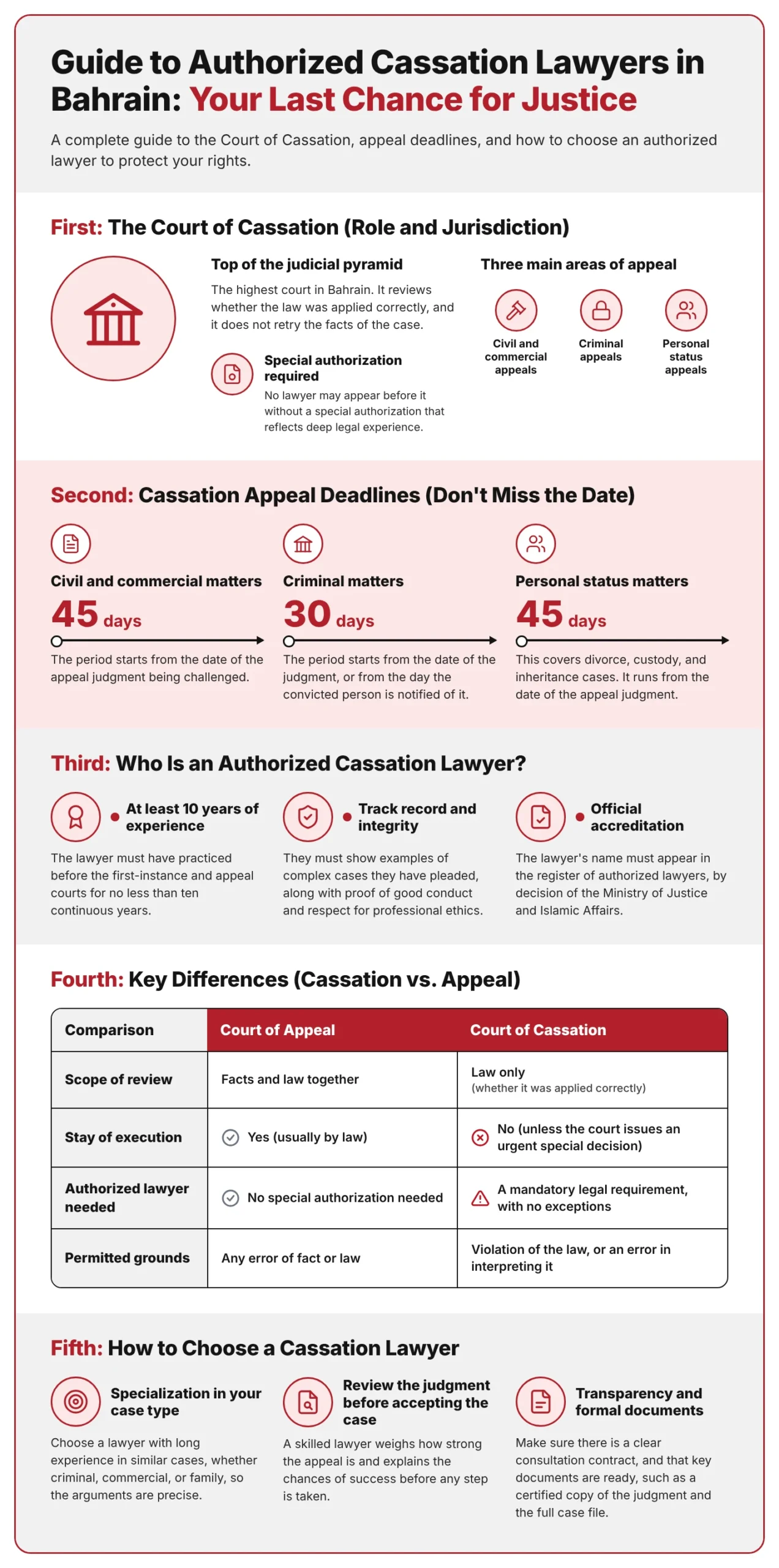
Cassation differs from appeal. At this stage the court focuses on specific legal grounds. It doesn’t simply go back over the facts and evidence the way the trial court did.
Article (12) of the Court of Cassation Law, within the appeals it covers, requires the appeal petition to be signed by a lawyer registered on the roll of lawyers before the Court of Cassation.
Article (28) governs criminal appeals. It requires the memorandum of grounds filed by the convicted person to be signed by a lawyer registered on the same roll. The grounds must also be clear and detailed, and they must name the points of appeal.
Procedures aren’t identical across all case types. So the signing and filing requirements depend on the nature of the appeal and the legal text that governs it.
These differences become clearer when you study the difference between appeal and cassation in Bahrain, because the court’s jurisdiction shapes the grounds, the procedures and the type of judicial review.
Got a judgment in your case and need to know who has the legal standing to appeal it?
Ask for a cassation consultationOr keep reading to see what to check before appointing a lawyer.
What Should You Check Before Appointing a Lawyer Before the Court of Cassation?
Start by checking the professional status. Then discuss the scope of the legal service you need. The right registration matters, but it doesn’t replace understanding your case and the expected costs.
The main points include:
- Valid registration: Check that the lawyer holds the authorization needed for the procedure you want.
- Type of experience: Ask about experience in legal matters similar to your case, and don’t rely on promises of a result.
- Judgment review: Find out whether the assessment covers reviewing the judgment, the grounds of appeal and the deadlines.
- Scope of work: Decide whether the agreement covers consultation, preparing the appeal or following up the procedures.
- Fees: Agree clearly on the fee and the services it covers.
- Communication: Learn how you’ll follow the case and which documents are needed during the work.
It helps if the legal consultancy agreement clearly states the scope of work, the fees and the agreed obligations. That cuts down disputes over what the service includes.
Don’t treat the label “best lawyer” as professional proof on its own. Selection criteria vary with the case, the registration grade and the experience you can verify. So when you compare lawyers in Bahrain, look at the actual professional information, not just marketing titles.
Does a Lawyer’s Eligibility Before the Court of Cassation Depend on Experience Alone?
No. The length of experience is one requirement for registration, but it isn’t the only standard. The law sets general conditions for practising the profession, and it defines the procedures for registration, for transfer between rolls and for professional duties.
A lawyer may have long experience in contracts or commercial disputes without being registered before the Court of Cassation. On the other hand, professional authorization alone doesn’t mean the lawyer specialises in every type of case.
You should also check who will actually handle the procedure, especially when you hire a law firm in Bahrain with several lawyers on different registration grades.
How Does Professional Registration Relate to Cassation Appeal Deadlines?
Checking professional authorization early matters when a judgment can be appealed within a set period. Delay in preparing the file or choosing the right lawyer can make it hard to finish the procedures in time.
Article (11) of the Court of Cassation Law sets a 45-day deadline for appeals under Part Two, with special rules on when it starts running. Article (28) governs the criminal appeal within 30 days, under its conditions.
Not all deadlines start counting the same way. So link the type of judgment to the date it was issued or notified, and to the cases the law specifies.
The rules on studying a judgment’s grounds and whether it can be appealed before the Court of Cassation in Bahrain cover procedures, deadlines and documents in more depth. This article only deals with professional registration, meaning the lawyer’s eligibility to handle the procedure.
How Do You Check the Firm’s and Lawyer’s Details Before Signing?
You can check the professional details the firm publishes and compare them with the official information from the competent authorities. Keep the firm’s licence separate from the registration grade of the lawyer who’ll represent you in court.
The Abdulrahman Khalifa law firm publishes the professional accreditation details of lawyer Abdulrahman Abdullah Khalifa, which you can use to verify the information published about the firm.
A general licence isn’t independent proof of registration before the Court of Cassation, though. Checking the official rolls, or asking the competent authority, remains an important step before you sign the power of attorney.
And once it’s clear the file needs a specialised judicial review, you can discuss the scope of a cassation lawyer in Bahrain service, which includes studying the judgment and the legal procedures, after confirming the professional status required.
FAQ About Authorized Cassation Lawyers in Bahrain
Is every practising lawyer in Bahrain authorized before the Court of Cassation?
No. Being a practising lawyer is different from holding authorization before the Court of Cassation. You need to check registration on the roll set aside for this grade.
How many years of experience does a lawyer need to register before the Court of Cassation?
Article (17) of Law No. (24) of 2026 sets eight years for some professional routes and ten years for other specified legal routes. The lawyer must also meet the remaining conditions and complete the registration procedures.
Where can I find the names of authorized cassation lawyers?
The Bahrain Ministry of Justice publishes a list of lawyers before the Court of Cassation in its official lawyers directory. It's best to check the latest data, or ask the competent authority when you need to verify a particular name.
Can a practising lawyer prepare a cassation appeal?
Handling procedures and signing petitions and memoranda are subject to the law's requirements. Articles (12) and (28) require the signature of a lawyer registered before the Court of Cassation in the cases they specify.
Does registration before the Court of Cassation guarantee the appeal will succeed?
No. Registration proves the professional eligibility to carry out the procedures the law allows. The result of the appeal depends on the judgment, its grounds, the conditions for admissibility, and what the court decides.
Knowing the Authorized Cassation Lawyers in Bahrain helps you pick the person with the right professional standing for the court step, especially now that the rolls and registration conditions fall under Law No. (24) of 2026 on the Legal Profession.
Start by checking the lawyer’s name in the official list. Then confirm the registration grade, the type of experience and the scope of the engagement. If you have a judgment you want reviewed, work out the legal deadline before you take any step. A lawyer’s eligibility and a judgment’s appealability are two separate questions, and you need to check each one.
This article gives general legal information about registration grades for lawyers in the Kingdom of Bahrain under the legislation mentioned. It isn’t a certificate about the registration of any particular lawyer, and it isn’t individual legal advice. Check the current professional details and the implementing decisions in force with the competent authority before taking any procedure.
Official Legal Sources
- Law No. (24) of 2026 promulgating the Legal Profession Law, especially Articles (7), (9) and (17) and Article 3 of the promulgating law.
- Decree-Law No. (8) of 1989 promulgating the Court of Cassation Law and its amendments, especially Articles (12) and (28).
- Ministry of Justice, Islamic Affairs and Waqf: Lawyers Directory and the list of lawyers before the Court of Cassation.

A Bahraini lawyer and the founder of a legal consultancy firm established in February 2019. He holds a Higher Degree in Sharia and Law from Al-Azhar University. He has extensive experience in court representation and providing legal advice in criminal, personal status, civil, and commercial matters. He is known for delivering clear, practical, and effective legal advice aimed at protecting his clients’ rights and interests, and has achieved tangible results in notable cases, including commercial litigation and inheritance matters
