

Legal Review: The content was written and reviewed by the legal team at Abdulrahman Khalifa Law Firm.
Last Updated: 2026/09/1.
Category: Bahraini Contract Law.
A Court of Appeal judgment was issued in a commercial dispute that had continued for months. The business owner read the operative part of the judgment several times and felt that one point had not been addressed as expected. His first thought was to file another appeal immediately, but a review of the case revealed that the more important question was not: Do I agree with the judgment? Rather: Does the judgment contain a legal error that can actually form the basis of a cassation appeal?
This is where the role of a Cassation Lawyer in Bahrain begins. This stage is not based on retelling the case from the beginning or raising as many objections as possible.
It begins with reading the judgment, understanding the basis on which the outcome was reached, and then examining whether the law permits a cassation appeal and whether the grounds available in the case file are worth relying on.
Has an unsatisfactory Court of Appeal judgment been issued against you in a dispute involving termination of a contract, and do you believe there may have been an error in applying the law? Do not lose hope.
Table of Content
When Do You Need a Cassation Lawyer in Bahrain?
Take action when the judgment reaches a stage at which the law allows the possibility of a cassation appeal to be examined, particularly if the judgment has significant financial, personal, or commercial consequences.
The need becomes clearer when:
- A judgment is issued by the Court of Appeal and you believe that the law was applied incorrectly.
- You find that the judgment relied on a legal interpretation that requires review.
- A defect appears in the judgment itself or in a procedure that affected the outcome.
- Enforcement begins and you need to understand the effect of the cassation appeal on the ongoing procedures.
- You are involved in a commercial, civil, Sharia, or criminal dispute that has reached an advanced stage.
- You want to understand your actual legal position before paying the cost of a cassation appeal that may not be suitable for your case.
The existence of a problem in the judgment does not mean that acceptance of the cassation appeal is guaranteed. The judgment must first be examined because the Court of Cassation considers specific legal grounds and is not a route for retrying the case merely because one of the parties is dissatisfied with the outcome.
What Does a Cassation Lawyer Provide Before and During the Appeal?
The real work begins before drafting the cassation petition.
A Cassation Lawyer in Bahrain examines the judgment and the memoranda and documents submitted during the previous stages of the case in order to identify the legal issue that deserves examination. The scope of work is then determined according to the case file.
Depending on the needs of the case, the service may include:
- Studying the judgment, its reasoning, and its operative part.
- Reviewing the course of the case during the previous stages.
- Examining whether legal grounds exist on which a cassation appeal may be based.
- Reviewing the applicable deadlines before drafting begins.
- Preparing the cassation petition where an appropriate legal basis exists.
- Preparing memoranda and responses related to the case.
- Examining the need to request a stay of enforcement where permitted by law.
- Following up on the procedures up to the agreed stage.
- Explaining the available options and risks to the client in clear language.
Abdulrahman Khalifa Law Firm does not begin by promising a particular outcome. It begins with the documents. The judgment itself often reveals whether there is a legal point worth analyzing or whether the objection is primarily concerned with the court’s assessment of the facts.
How Does a Cassation Lawyer in Bahrain Review a Judgment Before Filing an Appeal?
Read the reasoning of the judgment, not only its operative part. The outcome tells you what the court decided, but the reasons help explain how the court reached that conclusion.
During the review, the lawyer examines several points, including:
- What legal rule did the judgment apply?
- Was the legal provision applied correctly to the facts?
- Is there a defect in the judgment that could affect its validity?
- Was there a procedural defect that affected the outcome?
- Does the final judgment conflict with a previous judgment that has acquired res judicata effect in a situation regulated by law?
- Is the ground the client wishes to rely on actually a legal ground, or is it simply an attempt to reargue a factual issue that has already been considered?
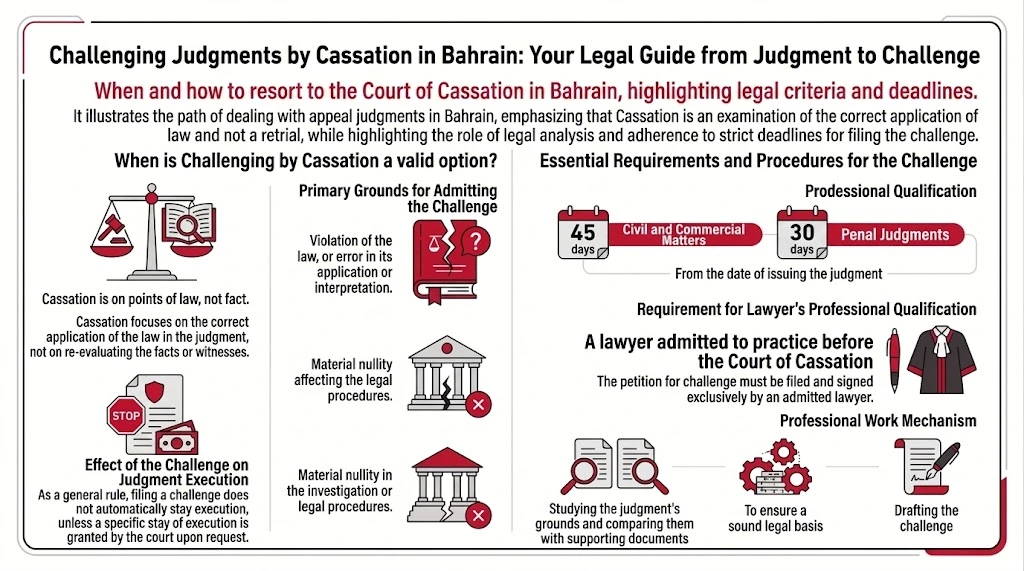
Article 8 of the Court of Cassation Law, issued by Decree-Law No. 8 of 1989 and amended by Law No. 27 of 2018, provides for grounds including that the judgment violates the law, incorrectly applies or interprets it, or is affected by invalidity in the judgment itself or in procedures that influenced it.
Professional View: A cassation appeal becomes clearer when the precise location of the legal error in the judgment can be identified and directly connected to a legal rule, rather than collecting numerous grounds that do not serve the issue the court will examine.
What Is the Time Limit for Filing a Cassation Appeal in Bahrain?
Review the date immediately upon receiving the judgment. Do not allow the search for a lawyer or the organization of documents to consume the available time.
Article 11 of Court of Cassation Law No. 8 of 1989 provides that the time limit for appeals in matters governed by Chapter Two is forty-five days, subject to special rules regarding the commencement of the period in the circumstances stated in the provision.
Article 28, however, regulates appeals in criminal judgments and provides for a period of thirty days from the date of the judgment in accordance with its provisions.
For this reason, do not take a time limit you found in an old article and apply it directly to your case. First determine the type of judgment, how it was issued, and whether any circumstances affect the date from which the appeal period begins.
Do not confuse the deadlines at this stage with the appeal period under Bahraini law, because each legal route has its own rules and procedural stage.
Is Cassation the Same as an Appeal?
No. Their purpose and scope are different.
An appeal allows a judgment to be reviewed within a broader framework according to the rules governing appeals, while cassation focuses on the legal validity of the judgment and the specific grounds established by law.
Accordingly, a ground of objection may be important at the appeal stage but may not be suitable in the same form before the Court of Cassation.
If you are still unsure which stage your case has reached, the article explaining the difference between appeal and cassation in Bahrain explains the distinction in greater detail without repeating those rules here.
Does a Cassation Appeal Suspend Enforcement of the Judgment?
As a general rule in cases governed by the Court of Cassation Law, enforcement does not automatically stop merely because a cassation appeal has been filed.
Article 10 of Court of Cassation Law No. 8 of 1989 provides that filing a cassation appeal does not suspend enforcement, although the court may order a temporary stay where the conditions stated in the provision are satisfied. The rules differ in criminal matters, so any request must be connected to the type of case and the legal provision governing it.
Where enforcement has already begun, understanding how to suspend an enforcement file pending determination of the cassation appeal can help explain the procedure more broadly, while the possibility of making such a request in your case remains dependent on the judgment and the facts.
Who Is Authorized to Conduct Cassation Proceedings?
Verify the appropriate level of professional registration before signing the power of attorney.
Law No. 24 of 2026 concerning the Legal Profession reorganized the lawyers’ registers. Article 7 provides that the register of practicing lawyers includes supplementary registers, including a register of lawyers authorized to appear before the Court of Cassation and the Constitutional Court.
Article 12 of the Court of Cassation Law also provides, with respect to appeals governed by that provision, that the cassation petition must be filed bearing the signature of a lawyer registered to appear before the Court of Cassation.
It is therefore not enough to ask: “Is this person a lawyer?” You should also ask about the lawyer’s professional status and the level of registration required for the procedure to be undertaken.
What Documents Should You Send to Begin Reviewing the Judgment?
Organize the file before sending it. This can shorten the review time and help identify the important legal issue more quickly.
Where possible, begin with the following documents:
- The judgment you want reviewed.
- The judgment from the previous level of litigation if relevant to the case.
- The most important memoranda submitted during the proceedings.
- The contracts, correspondence, and documents around which the dispute revolved.
- Expert reports, if any.
- Proof of service or notification where this affects the appeal deadline.
- The case number and basic case details.
- Documents showing any enforcement procedures that have already begun.
Article 14 of Court of Cassation Law No. 8 of 1989 regulates certain documents relating to appeals governed by its provisions, including the power of attorney, the memorandum explaining the grounds, and supporting documents, according to the details stated in the provision.
If the case requires a new power of attorney, you can review what is required regarding issuing a power of attorney for a lawyer in Bahrain according to the nature of the required procedure.
How Does the Firm Handle a Cassation Case?
Break the decision-making process into stages rather than beginning immediately with the drafting of a lengthy cassation petition.
A Cassation Lawyer in Bahrain handles the file within the firm according to the nature of the case. The practical workflow can be summarized as follows:
1. Receiving the Judgment
You send the judgment and the essential related documents through the WhatsApp button at the bottom of the screen.
2. Identifying the Procedural Stage and Deadline
The judgment details are reviewed first to determine the legal route that may be examined and the time available for taking action.
3. Reading the Reasons for the Judgment
The basis on which the court reached its conclusion is examined, followed by a review of the legal issues connected to it.
4. Comparing the Judgment With the Case File
The important memoranda and documents are reviewed so that the cassation appeal is not based on an idea disconnected from the documents actually contained in the case file.
5. Identifying the Available Options
The firm explains whether the case reveals grounds worth pursuing, the limits of those grounds, and the risks associated with them.
6. Preparing the Cassation Appeal Where an Appropriate Basis Exists
Drafting begins only after the legal ground has been identified, not before. The procedures are then completed within the scope of the agreed engagement.
This is the same method reflected in the firm’s working approach: understanding the facts, organizing the documents, identifying strengths and weaknesses, and then selecting the step that best serves the case without making advance promises about the outcome.
How Do You Choose a Cassation Lawyer in Bahrain for Your Case?
Evaluate the lawyer’s way of thinking before evaluating the strength of their marketing language.
Ask about the following points:
- Does the lawyer ask to see the judgment before giving an opinion? It is difficult to professionally assess a cassation appeal based only on a verbal account.
- Does the lawyer distinguish between a legal error and dissatisfaction with the judgment? This reflects an understanding of the nature of cassation proceedings.
- Does the lawyer explain the scope of the engagement? Find out whether the agreement covers only reviewing the judgment or also preparing the cassation petition, memoranda, follow-up, and any potential request to stay enforcement.
- Does the lawyer explain the risks? Be cautious of anyone guaranteeing the result before reviewing the file.
- Can the lawyer’s professional credentials be verified? Registration and licensing make professional credibility verifiable rather than merely a marketing claim.
- Is communication organized? Cassation proceedings involve precise deadlines and documents, so it is useful to know how updates will be provided and what will be required from you at each stage.
What Distinguishes Working With Abdulrahman Khalifa Law Firm?
Start with the case file itself.
The firm focuses on analyzing the documents before proposing the next step. It explains to the client where the case currently stands, what requires additional work, and what risks should be taken into consideration. Its scope of practice includes legal consultations, litigation representation, drafting memoranda, and following disputes in civil, commercial, labor, family, criminal, and other areas.
Lawyer Abdulrahman Abdullah Khalifa is the founder and general manager of the firm and holds a Higher Degree in Sharia and Law from Al-Azhar University according to the information published on the team page.
The accreditation page on the website also displays the firm’s professional information and status as a licensed law firm, together with the lawyer’s accreditation details before the relevant regulatory authority.
You can review the professional credentials of lawyer Abdulrahman Khalifa if you wish to verify the professional information published about the firm.
The presentation of experience or licensing does not guarantee the result of any cassation appeal. The outcome depends on the judgment, the grounds of cassation, the case file, and the court’s decision.
How Are the Fees for Reviewing and Filing a Cassation Appeal Determined?
The cost of a case varies according to the amount of work required from a Cassation Lawyer in Bahrain.
Factors commonly considered include:
- The number of pages in the judgment and case file.
- The number of previous levels of litigation.
- The type of dispute.
- The volume of memoranda and documents that need to be reviewed.
- The existence of multiple legal issues.
- The need for a procedure related to suspension of enforcement.
- Whether the engagement is limited to legal review or extends to preparing and following up on the cassation appeal.
Professional View: Ask about the scope of the service before agreeing. The cost of reviewing the judgment and providing a legal opinion may differ from the cost of preparing and fully following up on the cassation appeal. Clarity on this point makes the financial decision easier.
FAQ About a Cassation Lawyer in Bahrain
When do I need a Cassation Lawyer in Bahrain?
You may need a Cassation Lawyer in Bahrain after a Court of Appeal judgment is issued and there are grounds to believe that the judgment contains a legal error, an incorrect interpretation or application of the law, or a procedural defect that affected the outcome.
What does a Cassation Lawyer in Bahrain review before filing an appeal?
The lawyer reviews the judgment, its reasoning and operative part, the previous stages of the case, the submitted memoranda and documents, the applicable deadlines, and whether there are legal grounds that can properly support a cassation appeal.
What are the legal grounds for cassation in Bahrain?
According to the article, grounds may include violation of the law, incorrect application or interpretation of the law, invalidity in the judgment itself, or a procedural defect that affected the judgment.
What is the time limit for filing a cassation appeal in Bahrain?
The article states that the time limit under Article 11 of the Court of Cassation Law for matters governed by Chapter Two is 45 days. For criminal judgments regulated by Article 28, the period is 30 days from the date of the judgment, subject to the applicable legal rules.
Is cassation the same as an appeal in Bahrain?
No. An appeal allows broader review of the judgment according to the rules governing appeals, while cassation focuses mainly on legal errors and the specific grounds recognized by law.
Review the judgment first, determine the deadline, and collect the documents that explain the course of the case before taking any step. A cassation appeal before the Court of Cassation is not based solely on dissatisfaction with the outcome. It requires a legal ground that can be identified from the judgment and the case file.
A Cassation Lawyer in Bahrain can help you understand whether the judgment opens a route for cassation, whether the grounds available in the file are worth pursuing, and which procedure is most appropriate at the current stage. The correct decision may be to proceed with the cassation appeal, or the review itself may prevent you from beginning a procedure that does not serve your legal position.
If a judgment has been issued and you want to assess whether a cassation appeal is possible, send a copy of the judgment and the essential documents to Abdulrahman Khalifa Law Firm using the WhatsApp button at the bottom of the screen. The review begins by examining the judgment and the current procedural stage, followed by an explanation of the legal options that may be discussed according to your case file.

A Bahraini lawyer and the founder of a legal consultancy firm established in February 2019. He holds a Higher Degree in Sharia and Law from Al-Azhar University. He has extensive experience in court representation and providing legal advice in criminal, personal status, civil, and commercial matters. He is known for delivering clear, practical, and effective legal advice aimed at protecting his clients’ rights and interests, and has achieved tangible results in notable cases, including commercial litigation and inheritance matters
