

Rescission and termination sound alike, because in both cases the contract stops. But in law, the reason a contract ends and the effects of that end are not the same in every case.
So you need to know whether your case is a rescission for breach of a duty, or an ending of the relationship for another reason, such as the term, the type of contract or the agreement of the parties. This is the core of contract rescission vs termination in Bahrain.
In simple terms, rescission usually concerns a valid contract in which a party did not perform a duty, and the other party may ask for rescission under the law. Termination is a wider word. It may be used when the relationship ends because the term ended, the parties agreed to end it, or a party used a right to end it.
Not sure whether your case is a rescission or a termination? Using the wrong word in a notice can affect your claim. Our contracts lawyers can review your contract and explain the right route.
Table of Content
Contract Rescission vs Termination in Bahrain: The Main Difference
Rescission usually follows a breach of an existing contract. Termination can happen with no breach at all, such as when the term ends or the parties agree not to continue.
| Point | Rescission | Termination |
|---|---|---|
| Usual cause | A breach of a duty, or another ground for rescission | End of the term, an agreement, or a right to end under the contract or the law |
| Valid contract | Assumes a valid contract that exists | The contract exists, and its effects end for the stated reason |
| Effect on the past | The parties may return to their earlier position, with special rules for continuing contracts | Often stops the relationship from the time of ending |
So it is not enough that a party calls the step a rescission or a termination. Go back to the reason the contract ended, its text, its nature and the rules that apply.
What Does Rescission of a Contract Mean?
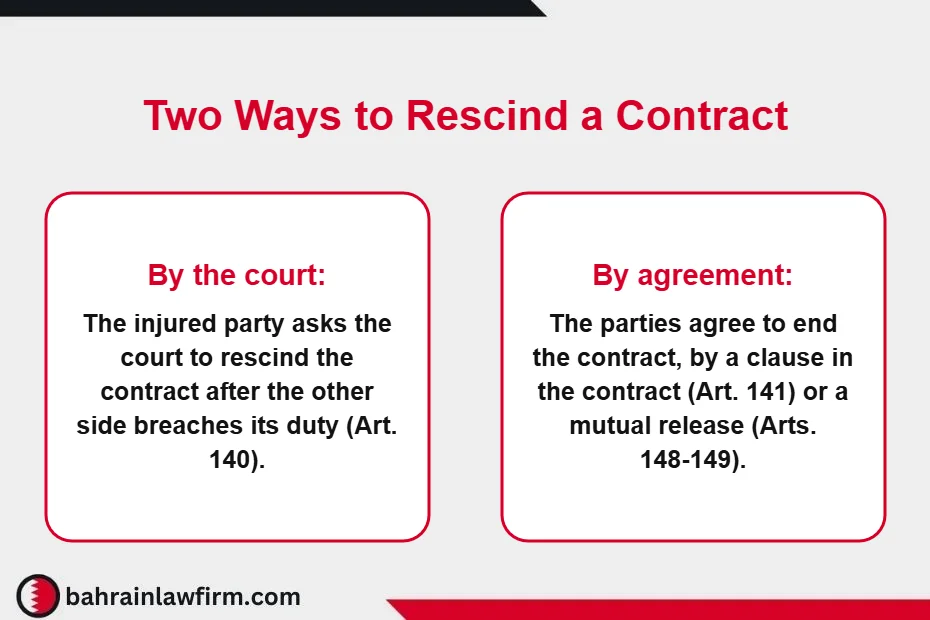
Rescission is one way to dissolve a contract when its legal ground exists. In contracts that bind both sides, Article 140 of the Civil Code covers a party that does not perform a duty when it falls due. After a formal notice, the other party may ask the court for performance or rescission, with compensation in both cases if there is a basis for it.
But not every delay or dispute leads to rescission. The result depends on the nature of the duty, how serious the breach is, whether the other party performed its own duties and the terms of the contract.
We wrote a separate guide on the conditions for contract termination in Bahrain, so we do not repeat its steps and effects here.
What Does Termination of a Contract Mean?
Termination means that the relationship stops, and it can happen for reasons that do not depend on a breach. A fixed-term contract may end on the agreed date, its purpose may be achieved, the parties may agree to end it, or one party may have a right to end it under the contract or the law.
So the word termination has no single legal meaning that fits every contract. Employment, lease, agency, commercial and service contracts may each follow special rules on when and how they can be ended. The Labour Law for the Private Sector, for example, regulates the ending of employment contracts and the notice for it in set cases.
When Is the End of a Contract a Rescission and When Is It a Termination?
The difference is clearer when you look at the reason the contract stopped.
If a Party Breaches an Essential Duty
When the contract exists and one party fails to perform a due duty, the case may be a rescission if the legal conditions are met. This differs from a contract that ended naturally, with no breach by anyone.
If the Term of the Contract Ends
If the parties set a term and it ends as the contract provides, there is no rescission just because the term ended. The reason is not a breach, but the relationship reaching its agreed end, subject to any renewal, extension or steps that the contract or the law requires.
If the Parties Agree Not to Continue
The parties may agree to end the relationship, but the agreement must state its content and effects. It should say when duties stop, how sums due are settled and what happens to work already done. If the agreement is about mutual rescission of the contract, read our guide on mutual contract termination in Bahrain.
If One Party Has a Right to End the Contract
The contract or the law may give one party a right to end the relationship on conditions, such as sending a notice or respecting a notice period. Here you must separate the use of a right to end from a request for rescission for breach, because each has its own basis and effects.
What Is the Effect of Rescission Compared With Termination?
This is the most practical point in contract rescission vs termination in Bahrain. Article 142 returns the parties, in principle, to their position before the contract, and deals with the case where that is impossible. For continuing contracts, Article 143 says that rescission takes effect only from the time it occurs.
So rescission does not always wipe out everything in the relationship, because the result depends on the nature of the contract. With a termination that stops the relationship from a set date, the focus is usually on ending its future effects, while rights and duties that arose before that date stay in place.
Examples That Show the Difference
These cases show contract rescission vs termination in Bahrain in practice.
- Non-performance: a person agrees with a company on a set duty, and the due date passes without performance. Rescission may be raised, under its conditions.
- End of the term: the parties sign a one-year contract, and the year ends with no agreement to continue. The relationship ends because the term ended, and not because of a ground for rescission.
- Agreement to stop: the parties agree to end the contract on a set date and settle their rights. The agreement should state what happens to earlier and later duties.
- A clause that allows ending: the contract gives a party the right to end it after notice within a set period. Using this right under its terms differs from asking for rescission because the other party breached.
Is Automatic Dissolution the Same as Rescission?
Not necessarily. In contract rescission vs termination in Bahrain there is a third case, because the Civil Code also covers a contract that dissolves by itself when performance becomes impossible because of a cause outside the control of the party. Under Article 145, in contracts that bind both sides, the impossible duty ends, the matching duties end with it and the contract dissolves by itself.
Partial impossibility has a special rule. This differs from the usual case, where a party asks for rescission because the other party breached.
What Is the Difference Between Rescission and Nullity?
Nullity raises a different issue. With rescission, the contract exists and a later cause leads to a request to dissolve it, while nullity concerns the validity of the contract or one of its legal elements.
We wrote a separate guide on the difference between contract nullity and termination in Bahrain, so this article does not widen into nullity.
Common Mistakes When Separating Rescission From Termination
The most common mistake is to use the two words as if they mean the same in every case. This causes confusion in contract rescission vs termination in Bahrain.
Another mistake is to think that a wish to leave the contract gives a right to end it at once, or that every breach leads to rescission. The result depends on the wording and type of the contract, the nature of the duties, how each party performed and any special law.
So before you send a notice, review the contract text and decide the legal basis of the step. The wrong route may affect a claim for compensation, sums due or duties that remain after the relationship ends.
Frequently Asked Questions About Rescission and Termination
Here are short answers to common questions.
What is the difference between rescission and termination of a contract?
Rescission usually follows a valid contract and a legal ground that allows it to be dissolved, most often a breach of a duty. Termination is wider and may result from the end of the term, an agreement or the use of a right to end under the contract or the law.
Does the end of the term mean rescission?
Not just because the term ended. If the contract reached its set end, the reason is the end of the term, unless other facts or texts change the legal description.
Can the parties end a contract by agreement?
Yes, where the law allows it for that contract. But the date of ending, the settlement of duties and rights, and the financial effects must be set out clearly.
Can I rescind a contract at once if the other party breaches?
It is not safe to apply this to all cases. Article 140 sets rules for rescission in contracts that bind both sides, and there are rules on notice, conditions and the nature of the breach. So review the contract and the case before you act.
Does rescission cancel all earlier effects?
The basic rule is to return the parties to their earlier position. But the law sets a different rule for continuing contracts, where rescission takes effect from the time it occurs. So the exact answer depends on the type of contract.
What is the difference between rescission and nullity?
Rescission dissolves an existing contract for a later cause, while nullity concerns the validity of the contract itself.
The difference between rescission and termination is not only a matter of words. It reaches the reason the relationship ended and the legal effects of each case. Rescission usually follows a valid contract and a cause that justifies dissolving it, while termination may result from the end of the term, an agreement or the use of a right under the contract or the law.
So do not decide on contract rescission vs termination in Bahrain by the name alone. Review the contract, the nature of the duties and the reason the relationship stopped, and you may also want to read about the difference between annulment and divorce in Bahrain.

A Bahraini lawyer and the founder of a legal consultancy firm established in February 2019. He holds a Higher Degree in Sharia and Law from Al-Azhar University. He has extensive experience in court representation and providing legal advice in criminal, personal status, civil, and commercial matters. He is known for delivering clear, practical, and effective legal advice aimed at protecting his clients’ rights and interests, and has achieved tangible results in notable cases, including commercial litigation and inheritance matters
