

Some contracts say that they end if one duty is not performed. In other cases, the parties agree after signing to walk away from the deal together. The two cases look close, but the law gives each one a different basis.
Understanding mutual contract termination in Bahrain helps you see whether you must use a termination clause or agree with the other side on a mutual release. It also shows what happens to payments, work already done and the rights of third parties. This matters most for long contracts, large sums and continuing duties.
In short, the Bahraini Civil Code separates the clause that the parties write inside the contract from the release that they agree on after it is formed. Article 141 covers the express termination clause, while Articles 148 and 149 cover the mutual release and its effects. So a correct review starts with the text of the contract, the date of the agreement and the reason the relationship ended.
Do you want to end your contract by agreement and fear later financial claims or legal gaps? Do not leave your rights to vague wording.
Table of Content
What Does Mutual Contract Termination in Bahrain Mean?
In practice, the phrase describes two cases that must be kept apart. In the first, the parties agree in advance that failure to perform a named duty ends the contract. The focus is on the strength of the clause, the event that triggers it and the notice, where notice is required.
In the second, the contract is already formed, and then the parties agree to withdraw from it by consent. The Civil Code calls this a release, or iqala. It differs from a one-sided notice sent by a party who no longer wants to continue.
This split gives mutual contract termination in Bahrain its own legal purpose, separate from termination by the court. The question starts from the agreement of the parties, whether it came in advance as a clause or later as a release.
Termination Clause or Mutual Release: What Is the Difference?
This table shows the practical difference.
| Point | Express termination clause | Mutual release |
|---|---|---|
| When it is agreed | Inside the contract, or before the event that causes termination | After the contract is formed |
| Basis of the step | A breach or event named in the clause | The agreement of both parties to withdraw |
| Civil Code reference | Article 141 | Articles 148 and 149 |
| Usual point of dispute | Clarity of the clause, the event and the notice | The scope of the release and the settlement of its effects |
This split helps before you send any notice. If there is no termination clause and the parties do not agree to withdraw, the case may fall under the general rules of termination for non-performance and not under mutual termination.
When Does an Express Termination Clause Work?
Start with the wording itself. Under Article 141, a clause that treats the contract as terminated by itself, or that limits the power of the court over termination, does not work unless both parties clearly intended it and knew its effect.
So the word “terminate” does not turn every clause into an express termination clause. The text may only give a party the right to ask for termination, or a right to end the contract, or a grace period to correct the breach.
Also check the event that the contract links to termination. If the clause links the effect to non-payment within a set time, confirm that the sum was due, that the time ended and that the non-payment is proven.
Notice matters too. Article 141 says that a clause ending the contract by itself on non-performance does not remove the need for notice, outside commercial matters, even if the parties agreed to skip it.
Does a Mutual Termination Need a Court Ruling?
The answer is not a simple yes or no until you know which case you have. If the parties agree after signing on a release and do not dispute its scope, the withdrawal rests on their shared consent. So mutual contract termination in Bahrain does not always need a court ruling.
If one party relies on an express clause, a dispute may arise on how clear the clause is, whether its event happened, whether the notice was valid and what sums are due after termination. The dispute may then reach the court, even though a clause exists.
How Does a Mutual Release Work After Signing?
Article 148 allows the parties to release each other from the contract by consent after it is formed, as long as the subject of the contract still exists in the hands of one of them. If part of it perished, was damaged or was given to others, the release may apply to the rest in proportion to its share of the price.
In effect, a release works like termination between the parties and like a new contract for third parties (Article 149). So do not write only that the parties agreed to cancel the contract. Say what returns to each side, how payments will be settled and when continuing duties stop.
This is where mutual contract termination in Bahrain helps. It lets the parties end the deal in an orderly way, instead of leaving sums, deliveries and claims without a clear settlement.
What Is the Effect of Termination on Payments and Work Already Done?
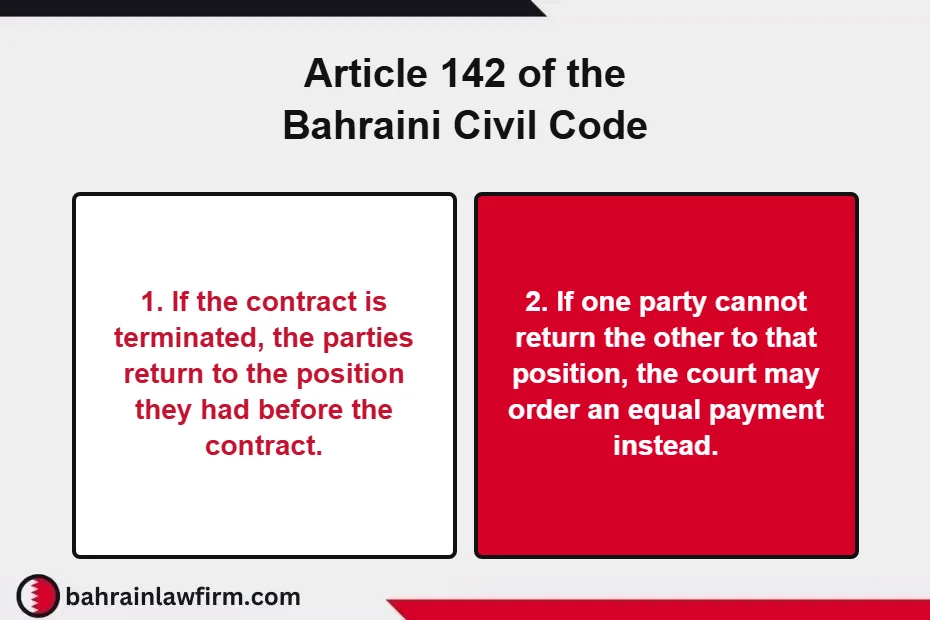
Article 142 sets the rule that, after termination, the parties return to their position before the contract. If one party cannot return the other to that position, the court may order an equal payment.
The result depends on the contract. For continuing contracts, Article 143 says that termination takes effect only from the time it occurs. This matters for service contracts and staged work, because work already done is not always like money that can be returned.
Before you sign a release or use a termination clause, list the following.
- The sums paid by each party.
- The items or rights each party received.
- The work that was completed.
- The duties not yet performed.
- Guarantees or deposits in place.
- Claims that a party wants to keep.
Does Termination Affect the Rights of Third Parties?
Check third-party rights before you finish, mainly if the subject of the contract or part of it passed to someone else. Under Article 144, termination cannot be raised against a special successor who received his right for value and in good faith.
What Should a Mutual Release Agreement Include?
When you arrange mutual contract termination in Bahrain as a release, keep the agreement clear and free of needless legal phrases. It helps to state the following.
- The original contract, its date and its parties.
- The clear consent of both parties to the release.
- The date from which the release takes effect.
- The sums due or to be returned.
- The items or documents to be handed over.
- The status of work done before the release, and the fate of guarantees and deposits.
- The claims that were settled and the rights that are kept.
Do not treat this list as a fixed form. A supply contract may need to deal with goods already delivered, and a service contract may need to count the stage reached.
Write the settlement in clear words that say whether each party releases the other from named claims or keeps some rights. Avoid general phrases when invoices, guarantees or duties are still open.
A Practical Example of Mutual Termination
A company signs a supply contract for monthly deliveries. The contract says clearly what happens if a set sum is not paid after a notice and a fixed period. Here you start from the clause: did the sum fall due, was the notice sent as agreed, and did the period end?
Now change the case. The parties perform part of the contract and then agree together that the deal no longer suits them, so they fix the value of the work done, what will be returned and what stays due. The focus now moves to the release and the settlement of its effects.
The example shows that mutual contract termination in Bahrain is not one road. The right description stops a termination clause from being mixed with a later agreement.
What Should You Review Before Using a Termination Clause?
- Read the clause together with the duty that you say was breached.
- Check the due date and any grace period.
- Check the way of notice that the contract sets.
- Prove the duties that you performed in return.
- List earlier payments and deliveries, and any rights that passed to a third party.
- Separate the right to ask for termination from a contract that is terminated by itself.
If the contract has no special termination clause and the problem is a breach by the other side, move to the general rules. Our guide on the conditions for contract termination in Bahrain explains them, and you should not apply a clause that does not exist.
How Do You Make a Termination Clause Clearer Before Signing?
Write the clause around an event that can be proven. State the duty, its date, the grace period to correct the breach, the way of notice and the effect that starts after the period ends.
Avoid wide wording such as “the first party may terminate the contract at once for any breach”. It may open a dispute on how serious the breach was.
A review by a contracts lawyer in Bahrain before signing helps fix these points. It matters most if the clause is linked to a penalty clause, staged payments or guarantees that continue after the relationship ends.
How Do You Tell Mutual Termination From Similar Routes?
First decide why the relationship ended. If the term of the contract ended, or a party used a separate right to end it, do not assume that it is a mutual termination. See our guide on the difference between rescission and termination of a contract in Bahrain.
If the problem touches the validity of the contract from its formation, first work out the difference between nullity and termination of a contract before you choose the step.
Frequently Asked Questions About Mutual Termination
Here are short answers to common questions.
What is mutual termination of a contract?
It means an agreement linked to ending a contract, and its form must be identified. It may be an express termination clause that the parties set in advance, or a mutual release that they agree on after the contract is formed.
Can the parties agree to end a contract after signing it?
Yes. The Civil Code lets the parties release each other from the contract by consent after it is formed (Article 148). So the agreement must show the consent of both sides and settle what was already performed.
Does a termination clause remove the need for notice?
Not in every case. Article 141 says that a clause ending the contract by itself on non-performance does not remove the need for notice, outside commercial matters, even if the parties agreed to skip it.
Must a mutual release be made officially?
No rule can be applied to all contracts. The form depends on the type of contract and the special law that governs it, but a clear written agreement helps prove what the parties agreed and settle the effects.
Is everything paid returned after termination?
The law sets a rule of returning the parties to their earlier position, with provisions on impossible return, continuing contracts and third-party rights. So the result depends on the type of contract and what was already performed.
Does a termination clause work as soon as the other party is late?
Not necessarily. Review the wording of the clause, the due date, the agreed grace period and the notice required. Then check that the event named in the contract really happened.
Do the same rules apply to all contracts?
No. Some contracts follow special laws besides the Civil Code. So identify the type of relationship first, and do not apply the rule of one contract to another.
Start dealing with mutual contract termination in Bahrain by identifying the form of the agreement, and not only its name. If the contract has a termination clause, check how clear it is, the event that triggers it and the notice required. If the parties later agree to withdraw, treat the release as a settlement of rights, payments and work already done.
Review your papers before you send a notice or sign a new agreement, and decide what ends and what stays.

A Bahraini lawyer and the founder of a legal consultancy firm established in February 2019. He holds a Higher Degree in Sharia and Law from Al-Azhar University. He has extensive experience in court representation and providing legal advice in criminal, personal status, civil, and commercial matters. He is known for delivering clear, practical, and effective legal advice aimed at protecting his clients’ rights and interests, and has achieved tangible results in notable cases, including commercial litigation and inheritance matters
