

Intellectual property law in Bahrain is the legal framework that protects innovation and creativity. It guarantees that individuals and companies can use their ideas in a lawful way.
The system relies on a group of laws that cover trademarks, patents and copyright. Their aim is to support investment and fair competition.
Registering an intellectual property right also turns an idea into an economic asset that can be invested. This is why knowing your rights and the ways to protect them is a basic step for any project that wants to grow in a competitive market.
Do you want to protect your brand, your invention or your creative work in Bahrain? A mistake at the start can cost you your rights, so talk to a specialist first.
Table of Content
What Is Intellectual Property Law in Bahrain?
Bahrain does not have one single intellectual property code. The system rests on several special laws that cover the different fields of intellectual and commercial activity, including the protection of trademarks.
The three most used laws are the GCC Trademark Law approved by Law 6 of 2014, the Patents and Utility Models Law No. 1 of 2004, and the Copyright Law No. 22 of 2006.
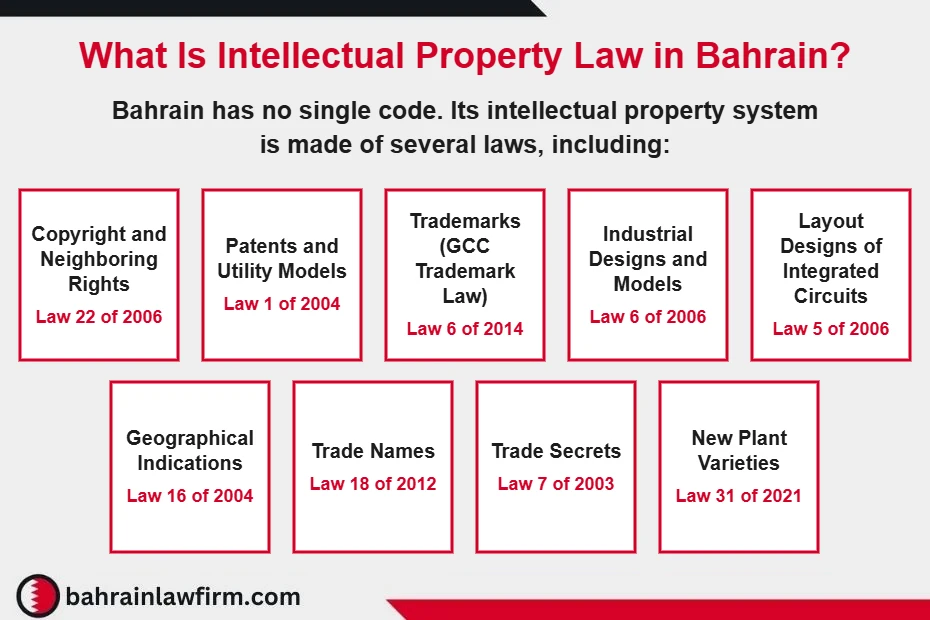
Other laws cover industrial designs and models, layout designs of integrated circuits, geographical indications, trade names, trade secrets and new plant varieties. Together they protect all the main types of intellectual property.
How Each Right Is Protected
Trademarks
Article 2 of the GCC Trademark Law defines a trademark as anything with a distinctive form that is used to tell the goods or services of one business from those of others. It can be a name, a word, a signature, a letter, a number, a symbol, a drawing, a shape, a color, packaging, and even a sound or a smell.
Under Article 17, a registered trademark gives its owner three main protections.
- An exclusive right to use the mark for the registered goods or services.
- The power to stop others from using it without permission.
- Legal protection against the use of the same mark or a similar sign that is likely to confuse the public.
Registering your mark before you start trading is the safest way to avoid disputes later. Protection lasts ten years and can be renewed for similar periods under Article 20. Read our guides on trademark renewal in Bahrain and trademark assignment in Bahrain.
Patents
Article 1 of the Patents Law says that a patent is granted for any invention that is new, involves an inventive step and can be applied in industry. A separate patent may also be granted for a new improvement or addition to an invention that already has a patent.
A patent gives its owner the exclusive right to exploit the invention for a limited time. Under Article 14, the protection lasts twenty years from the date the application is filed in Bahrain. See our guide to patent law in Bahrain.
Copyright
Article 2 of the Copyright Law protects literary, artistic and scientific works from the moment they are created, with no formality needed. This includes books, articles, computer programs, music, films and drawings.
The protection covers moral rights, which link the work to its author, and financial rights, which cover use, publication and distribution. Under Article 37, the financial rights last for the life of the author and seventy years, counted from the start of the calendar year after his death.
General Principles of Protection
Intellectual property law in Bahrain follows a few basic principles, and they apply to every type of right.
- The owner has the exclusive power to use and exploit the right.
- Any unauthorized use or copying is banned.
- Some rights, such as copyright, are protected automatically.
- Each right has a legal period of protection.
- The owner can go to court and claim compensation.
Dealing With Your Rights: Transfer and Licensing
The owner of a right may deal with it in several lawful ways. He can transfer the ownership fully to another party, or give a license to use it in return for a fee.
A trademark can be assigned in whole or in part, and a copyright owner can transfer or license his financial rights under a written contract (Article 8 of the Copyright Law). A permanent right of ownership is different from a temporary right of use, so the contract must say clearly which one it gives.
Special Cases
- Joint ownership: it arises when more than one party shares one right. The parties should set the share of each one, regulate the use by a contract and avoid disputes.
- Private rights and the public domain: a private right belongs to an individual or a company. When protection ends, the work or the invention becomes free for everyone to use.
- Infringement: a dispute starts when someone uses a right without permission. The owner can file a court case, claim compensation and ask to stop the infringement, and early legal action reduces the loss.
Why You Need an Intellectual Property Lawyer
Applying intellectual property law in Bahrain correctly is not always easy. An intellectual property lawyer helps you comply fully with the law and avoid mistakes that can lead to the loss of your rights. The lawyer can help in these ways.
- Giving accurate legal advice from the start of the project.
- Filing court cases when someone infringes your rights.
- Preparing contracts that protect you from risks.
A specialist such as a trademark registration lawyer saves time and reduces legal risks. Ask Bahrain Law Firm for a legal consultation.
Frequently Asked Questions About Intellectual Property
Here are short answers to common questions.
Can software be protected in Bahrain?
Yes. Computer programs, in source code or in machine code, are protected as works under Article 2 of the Copyright Law. No registration is needed, but dated records of your work give extra proof of your rights.
How long does copyright last in Bahrain?
The financial rights last for the life of the author and seventy years, counted from the start of the calendar year after his death (Article 37). Special periods apply to joint, audiovisual, collective and anonymous works.
Does Bahraini law protect intellectual property against foreign copying?
Yes. You can register the rights that need registration, such as trademarks and patents, and you can go to court to claim compensation. GCC cooperation also supports the protection of patents and trademarks.
How do companies protect their trade secrets?
Bahrain has a special law on trade secrets, Law No. 7 of 2003. Companies also sign confidentiality agreements (NDAs), limit access to information and use technical measures such as encryption and VPNs.
Are there fees to register intellectual property rights?
Yes, for the rights that need registration, such as trademarks and patents. The fee depends on the type of right and is set by the official regulations. Copyright needs no registration.
In short, intellectual property law in Bahrain protects innovation and creativity, and it turns ideas into lasting economic assets. A specialist lawyer helps you protect your rights from copying and infringement.

A Bahraini lawyer and the founder of a legal consultancy firm established in February 2019. He holds a Higher Degree in Sharia and Law from Al-Azhar University. He has extensive experience in court representation and providing legal advice in criminal, personal status, civil, and commercial matters. He is known for delivering clear, practical, and effective legal advice aimed at protecting his clients’ rights and interests, and has achieved tangible results in notable cases, including commercial litigation and inheritance matters
