

A lawyer’s attendance with the victim before the Public Prosecution is an important legal step. It helps the investigation stay fair and protects the victim’s rights. A Victim Lawyer at Public Prosecution in Bahrain is more than a legal representative, because he shields the client from any legal overreach.
This article explains the lawyer’s role, the legal basis and the benefits during the investigation.
Were you summoned to the Public Prosecution as a victim, and you worry about losing your rights or facing pressure during the investigation? Do not face this difficult moment alone. Our criminal lawyers can attend with you and protect your rights.
Table of Content
Victim Lawyer at Public Prosecution in Bahrain: The Legal Basis
A lawyer’s presence with the victim during the investigation is an important safeguard. It protects the victim’s rights and helps make sure the procedures follow the law.
The Criminal Procedure Law (Decree-Law 46 of 2002) lets the victim take part in several ways. The victim, the civil claimant and their agents may attend the evidence-gathering procedures whenever possible (Article 50). A person who suffered direct personal harm from the crime may also claim civil rights against the accused during the investigation (Article 22).
For some offenses, such as defamation and insult, a case starts only on a complaint from the victim or his special agent. The complaint is not accepted after three months from the day the victim learned of the crime and the offender (Article 9).
The victim has the right to use the best criminal lawyer while the Public Prosecution investigates. The need is stronger in these cases:
- Legal weakness: the victim is a child, or a person who cannot express his position.
- The nature of the crime: sensitive crimes, such as sexual offenses and domestic violence.
- The need for guidance: the victim does not know the procedures and legal terms.
- Pressure risk: there is a fear that the offender or others may influence the victim or the investigation.
Limits of the Lawyer’s Role With the Victim
A Victim Lawyer at Public Prosecution in Bahrain works within clear limits so that the investigation runs smoothly. For the accused’s lawyer, the law says he may speak only if the prosecutor permits, and a refusal is recorded in the record (Article 134). In practice, the victim’s lawyer works in a similar way:
- No interruption: the lawyer does not answer for the victim or interrupt the prosecutor’s questions.
- Requests and notes: he records his legal objections and the victim’s requests in the official investigation record.
- Questions through the investigator: he does not ask questions directly, but he may ask the prosecutor to put specific questions to the accused.
- Written memoranda: he may submit memoranda and document folders that support the victim’s position and the evidence against the offender.
The lawyer’s main role is to give legal advice and protect his client, without directly steering the procedures.
Benefits of a Lawyer Attending With the Victim
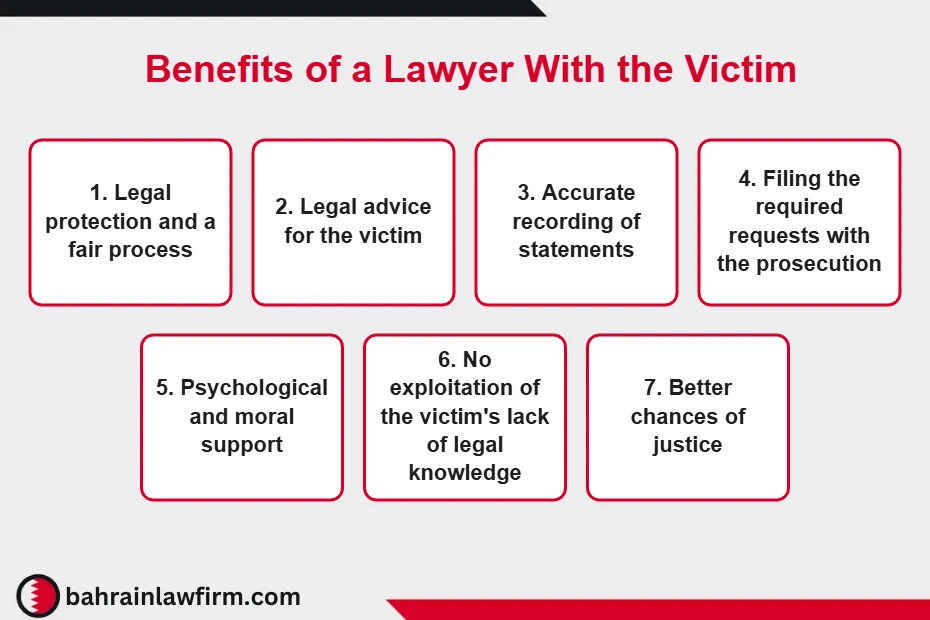
The presence of a lawyer with the victim during the investigation is an important guarantee of justice. Here are the main benefits of having a Victim Lawyer at Public Prosecution in Bahrain.
1. Legal Protection and Safe Procedures
The lawyer checks that every step follows the law, which prevents violations that could harm the investigation. He also watches how the victim is questioned to make sure it is fair and free of pressure or threats.
2. Legal Advice for the Victim
The lawyer explains the victim’s rights, such as submitting evidence, asking for witnesses and claiming compensation. He also explains what the victim can say and what to avoid, so the case is not weakened.
3. Accurate Recording of Statements
The lawyer makes sure the victim’s statements are recorded accurately in the investigation record. This lowers the risk of distortion and helps the victim speak in a clear and organized way.
4. Filing the Required Requests
The lawyer can ask the prosecution for a medical report that proves injuries, or for protection if there are threats. The prosecutor appoints a doctor or another expert when the investigation needs one (Article 128), and he must hear the witnesses the parties ask for unless he sees no benefit (Article 114).
5. Psychological and Moral Support
In sensitive cases such as domestic violence or sexual crimes, a lawyer eases the pressure on the victim. His presence gives the victim a sense of safety.
6. No Exploitation of the Victim’s Lack of Legal Knowledge
Some victims do not know their legal rights, which can expose them to exploitation or pressure. The lawyer defends these rights and keeps the victim in a strong legal position.
7. Better Chances of Justice
By following the procedures closely and presenting strong legal arguments, the lawyer strengthens the victim’s position and raises the chance of getting his rights.
Choose carefully. Read our guide to the best lawyers in Bahrain and pick the lawyer who fits your case.
Why Does the Victim Need a Lawyer During the Investigation?
The law lets the victim appoint a lawyer to represent him. A Victim Lawyer at Public Prosecution in Bahrain matters in several ways that can decide whether the case is dismissed or the offender is sent to trial:
- Correct legal description: the lawyer works to have the act described in the strongest correct legal form, such as proving premeditation in assault cases or the material element in fraud cases, so that the offender faces the full penalty that fits the act.
- The civil claim: this is the most important point for the victim. The civil claim is made by a request recorded in the investigation record, and the prosecution decides on it within three days. The civil claimant must pay the court fees and deposit the security that the prosecution sets (Articles 22 and 27).
- Preventing dismissal: unclear or conflicting statements, caused by stress or shock, may lead the prosecution to dismiss the papers (Article 78). The lawyer organizes the statements and submits the supporting evidence and documents.
- Urgent and protective requests: for example, asking the prosecution to send the victim to the forensic doctor before the injuries fade, to download camera footage before it is erased, or to protect the victim from threats.
If the prosecution dismisses the case, it must notify the victim and the civil claimant. They can file a grievance before the Lesser Court within ten days from the notification, and the court may cancel the order and send the case back for investigation or to the competent court (Article 79).
The absence of a lawyer can also weaken the case, so the agreement with the lawyer must be clear, and the lawyer must be trustworthy.
Frequently Asked Questions
Can a lawyer defend his own family?
Yes, a lawyer can defend his family and relatives as long as there is no conflict of interest. In some sensitive cases, it is better to appoint an independent lawyer to ensure full neutrality.
Does a lawyer have the right to attend the investigation with his client?
Yes. For the accused, the Criminal Procedure Law requires the prosecutor, in felonies, to invite the accused's lawyer before questioning him, except in flagrant or urgent cases, and it lets the lawyer see the investigation at least one day before questioning unless the prosecutor decides otherwise (Articles 134 and 135). For the victim, the law lets the victim, the civil claimant and their agents attend the evidence-gathering procedures whenever possible (Article 50).
Can the victim claim compensation during the investigation?
Yes. A person who suffered direct personal harm from the crime can claim civil rights during the investigation by a request recorded in the investigation record. The prosecution decides on the request within three days, and the claimant must pay the court fees and deposit the security that the prosecution sets (Articles 22 and 27).
What can the victim do if the prosecution dismisses the case?
The prosecution must notify the victim and the civil claimant of the dismissal order. They can file a grievance before the Lesser Court within ten days from the notification, and the court may cancel the order and order an investigation or refer the case to the competent court (Article 79).
In short, the role of a Victim Lawyer at Public Prosecution in Bahrain is not limited to pleading. It extends to protecting the client’s rights and securing justice, and a victim who attends without a lawyer risks having his statements misunderstood or misread.
To claim your right and not lose it, ask a skilled lawyer in Manama to attend with you, or contact Bahrain Law Firm. You can read the official text of the law on the Legislation and Legal Opinion Commission portal.

A Bahraini lawyer and the founder of a legal consultancy firm established in February 2019. He holds a Higher Degree in Sharia and Law from Al-Azhar University. He has extensive experience in court representation and providing legal advice in criminal, personal status, civil, and commercial matters. He is known for delivering clear, practical, and effective legal advice aimed at protecting his clients’ rights and interests, and has achieved tangible results in notable cases, including commercial litigation and inheritance matters
