

Murder is one of the most serious crimes in the Penal Code, because it attacks the right to life. The murder law in Bahrain punishes the person who kills another on purpose with the heaviest penalties, which can reach death in some cases.
To convict, the court must find a clear intent to kill, and this is what separates murder from other crimes that end in death. The elements of the crime, the penalty and the way the crime is proved are all set by law.
A defense lawyer plays a vital role from the first hour of the investigation, because every statement and every piece of evidence can change the result.
Are you facing a murder charge or an investigation in a homicide case? The first hours matter a lot, so do not face them alone.
Table of Content
Elements of the Crime of Murder
The prosecution must prove two main elements under the murder law in Bahrain to convict the accused, the material element and the moral element.
The Material Element
The material element has three parts, and the absence of any one of them prevents a conviction.
- The act: the behavior of the offender that leads to the death of the victim. It can be a positive act, such as firing a gun, or a negative one, such as refusing to give help when the law requires it.
- The result: the death of the victim.
- The causal link: the act must be the direct cause of the death. Article 22 of the Penal Code says that a person is punished only for a crime that is the result of his conduct.
The Moral Element
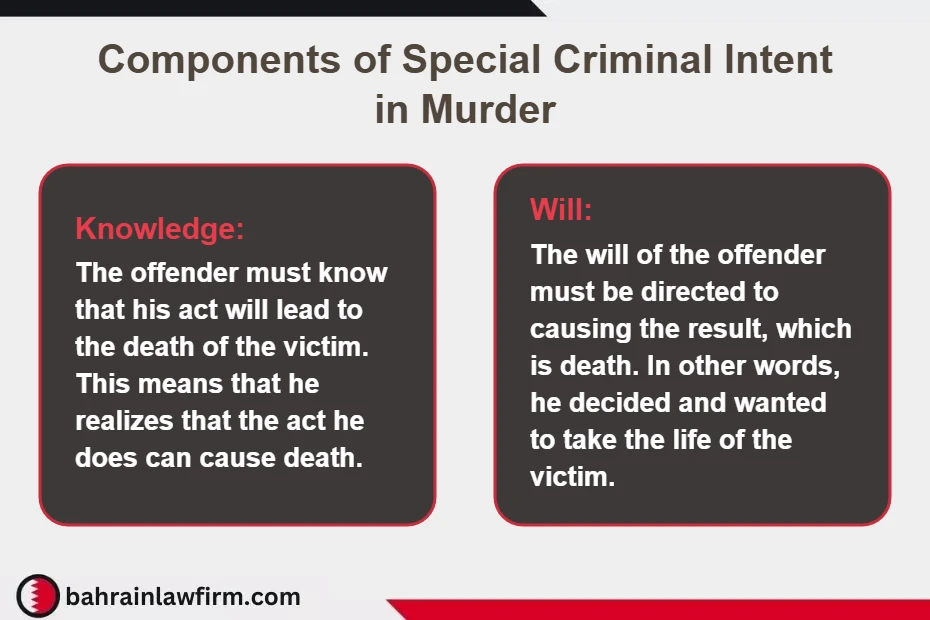
The moral element means the intent to kill, and it has two parts. The first is knowledge, so the offender knows that his act will lead to the death of the victim. The second is will, so he wants this result and aims to end the victim’s life.
Special Criminal Intent in Murder
Special criminal intent is what separates murder from the other deliberate crimes. It means a clear aim in the mind of the offender to end the life of a living person, and not only to do an act that causes death.
Intent is hidden in the mind, so the court infers it from the facts around the crime and from the way the offender acted. These are the most common signs.
- A deadly weapon: using a weapon that kills by its nature and hitting the victim in a vital place is a strong sign of the intent to kill.
- Blows to sensitive areas: such as the head or the chest.
- A confession: a voluntary confession of the intention to kill is direct proof, if it is made under the legal conditions.
A mistake in the identity of the victim does not remove the intent. If the offender wanted to kill a certain person but killed another, he is still responsible for murder, because his aim was to end the life of a human being.
Penalty Under Murder Law in Bahrain: Article 333
Article 333 of the Penal Code sets the penalty. Whoever kills a person on purpose is punished with life or temporary prison. The penalty is death in the cases the article lists.
| Case | Penalty | Article |
|---|---|---|
| Murder with no aggravating circumstance | Life or temporary prison | 333, first paragraph |
| Murder with ambush or premeditation, or linked to another crime, or against an ascendant of the offender, or against a public official because of his duty, or by poison or explosive | Death | 333, second paragraph |
| Assault that leads to death without intent to kill | Prison of up to seven years | 336 |
The last row is not murder, because the offender did not want the death. When the death comes from carelessness, the case moves to the manslaughter penalty in Bahrain.
Aggravating and Mitigating Circumstances
The circumstances of the crime decide where the penalty falls between the lowest and the highest limit.
Aggravating Circumstances
The cases that lead to the death penalty are the ones listed in the second paragraph of Article 333. They are ambush, premeditation, a link to another crime, the killing of an ascendant, the killing of a public official because of his duty, and the use of poison or explosive.
Mitigating Circumstances
The Penal Code treats three things as mitigating excuses: the age of the accused if he is over 15 and under 18, an honorable motive, and a grave and unjust provocation by the victim (Article 70). The court may also reduce the penalty if it sees a reason for mercy (Article 72).
- If a mitigating excuse exists in a felony punished by death, the penalty falls to temporary prison or imprisonment of not less than one year (Article 71).
- If the penalty is life or temporary prison, it falls to the penalty of a misdemeanor (Article 71).
- With mercy, the death penalty may fall to life or temporary prison (Article 72).
Lawful self-defense is different, because it is not a reduction of the penalty. It can remove the criminal responsibility when its conditions are met, as our guide to self-defense law in Bahrain explains.
How Is Murder Proved Before the Court?
The court looks at all the evidence together, and it cannot convict if the causal link is missing or if the intent is in doubt. The main means of proof are these.
- Forensic examination: the autopsy shows the cause of death, the place of the injury and any sign of poison or shots.
- Technical evidence: fingerprints, DNA, traces of weapons and the analysis of the scene.
- Witnesses and confessions: a witness statement that is clear, or a confession made freely under the legal guarantees.
- Inference from the facts: such as planning in advance, blows to sensitive areas or the use of deadly means.
The Role of a Defense Lawyer in Murder Cases
A criminal lawyer in Bahrain protects the rights of the accused during the investigation and the trial. In a case about the murder law in Bahrain, the Major Criminal Court usually hears the case, and the lawyer pleads before it.
- He examines the evidence of the Public Prosecution and challenges weak or unlawfully obtained evidence.
- He builds the defense, such as denying the intent, attacking the causal link or objecting to the legality of a confession.
- He asks for the application of the mitigating excuses and of mercy when the facts allow it.
- He follows the appeal and the challenge before the Court of Cassation when the grounds exist.
- He explains the rights, the next steps and the possible results to the accused and his family.
Without a professional defense, the accused may lose the chance to challenge weak evidence or to use a mitigating excuse that the law gives him.
Frequently Asked Questions About Homicide Cases
Here are short answers to common questions about the murder law in Bahrain.
What is the penalty for murder in Bahrain?
Under Article 333 of the Penal Code, whoever kills a person on purpose is punished with life or temporary prison. The penalty is death if the killing is done with ambush or premeditation, or is linked to another crime, or is committed against an ascendant of the offender or a public official because of his duty, or with poison or explosive.
What are examples of murder?
Examples are shooting a person with the intent to kill, stabbing a person in a vital place, or poisoning a person on purpose. In each case the offender clearly aims to end the life of the victim.
What is the difference between murder and manslaughter?
Murder needs the intent to kill, and it is punished under Article 333. Manslaughter has no intent to kill, because the death comes from carelessness, recklessness or a failure to follow the rules, as in a traffic accident caused by excess speed.
How is murder proved in Bahrain?
It is proved by the evidence that shows the intent of the offender, such as the use of a deadly weapon, blows to sensitive areas or a voluntary confession. The court also uses the autopsy, the technical evidence, the statements of witnesses and the facts around the crime.
Can blood money replace the penalty for murder in Bahrain?
The articles of the Penal Code on murder do not mention blood money. They set the penalty in Article 333, and the family of the victim may claim compensation in a civil claim. Any settlement should be reviewed by a lawyer before it is signed.
In conclusion, the murder law in Bahrain treats the crime with great firmness, and it sets clear elements, penalties and means of proof. Knowing them early helps you protect your rights before the investigation moves forward.
You may also read about the penalty for manslaughter in Bahrain, which explains the cases where death happens without intent.

A Bahraini lawyer and the founder of a legal consultancy firm established in February 2019. He holds a Higher Degree in Sharia and Law from Al-Azhar University. He has extensive experience in court representation and providing legal advice in criminal, personal status, civil, and commercial matters. He is known for delivering clear, practical, and effective legal advice aimed at protecting his clients’ rights and interests, and has achieved tangible results in notable cases, including commercial litigation and inheritance matters
