
A Petition for Reconsideration in Bahrain is an exceptional way to challenge a final court judgment. The law allows it only when the judgment was affected by fraud, forgery, hidden evidence or a similar serious defect. It is not a second appeal, and a court will not accept it just because a party disagrees with the result.
This guide explains the grounds the law recognizes, the time limit, the steps to file and the effect of the petition. It follows Articles 229 to 232 of the Civil and Commercial Procedure Law (Law 12 of 1971). In the text of the law, the remedy is called a request to reconsider the trial.
Did a final judgment go against you because of fraud, forged papers or evidence that was kept from the court? Reconsideration is a narrow exception with a strict deadline. Our litigation lawyers can review your file and tell you whether you have a valid ground.
Table of Content
What Is a Petition for Reconsideration in Bahrain?
A petition for reconsideration is an extraordinary route to challenge a final judgment. It is filed before the same court that issued the judgment, and it asks that court to look again at its own decision.
Article 229 allows it against final judgments, whether they were issued by a court of appeal or by a court of first instance. It is available only for the specific grounds listed in the law.
The main features of this remedy are:
- The judgment must be final.
- A ground set out in the law must exist, such as fraud or forged papers.
- Strict conditions apply, including a short deadline.
Grounds for Reconsideration Under Article 229
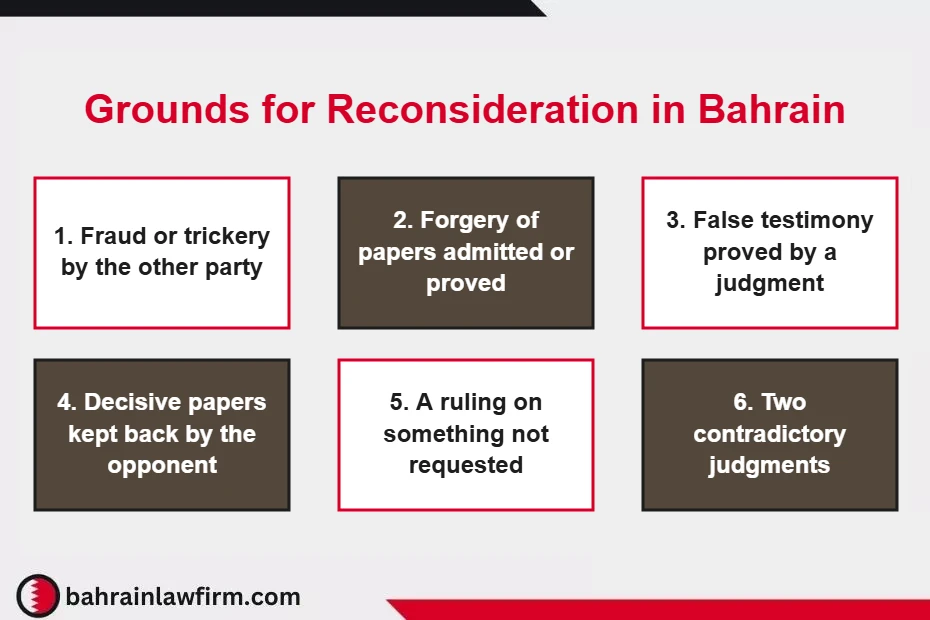
Article 229 lists the grounds. The court accepts a petition only if it rests on one of them:
- Fraud: the other party, or his agent, used fraud or trickery, and it affected the judgment.
- Forgery or false testimony: after the judgment, it was admitted or ruled that the papers it relied on were forged, or the testimony it relied on was found to be false.
- Decisive papers: after the judgment, you obtained decisive papers that the opponent had prevented you from presenting.
- Awarding what was not requested: the judgment granted something that nobody asked for, or more than was asked for.
- Contradictory judgments: the same court issued two judgments in the same case between the same parties that contradict each other, as long as no new matter has appeared.
The graphic below shows these grounds in a simple form. It lists forged papers and false testimony separately, although the law groups them in one ground.
Each ground needs clear proof. A mistake in the court’s reading of the facts or the law is not one of the listed grounds.
Time Limit and Procedure for Filing
The deadline for a Petition for Reconsideration in Bahrain is short. Under Article 230, the petition must be filed within 45 days.
In general, the 45 days run from the date the judgment was issued or notified to you. For fraud, forgery, false testimony and hidden papers, the period starts later: on the day the fraud was discovered, the forgery was admitted or proved, the false witness was convicted, or the withheld paper came to light.
The usual steps are:
- Prepare the petition, with the details of the judgment, the ground relied on and the supporting documents.
- File it with the court that issued the judgment, following the usual procedure for filing a claim.
- Attach proof of the ground, such as the forgery judgment or the papers you obtained.
- Pay the court fees and have the petition registered.
- Count the 45 days from the correct start date, because a late petition is rejected.
Conditions for Accepting the Petition
The court first decides whether the petition is acceptable, and only then does it look at the merits. These conditions usually decide that first step:
- The judgment is final and falls under Article 229.
- The petition is filed with the court that issued the judgment, within the 45-day period.
- One of the listed grounds exists and is proved.
- For decisive papers, you obtained them after the judgment, and the opponent had prevented you from presenting them.
- For forgery or false testimony, the forgery was admitted or proved after the judgment, and the judgment relied on it.
- For contradictory judgments, no new matter has appeared since the first judgment.
These conditions are narrower than many people expect. A petition that only repeats the arguments of the original case is unlikely to succeed.
Legal Effect of the Petition
Under Article 231, the court takes two steps. First it decides whether to accept the petition, and if it does, it examines the merits and either rejects the request or cancels or amends the judgment.
- The judgment may be cancelled or amended if the ground is proved.
- If the ground is two contradictory judgments, the second judgment is cancelled and the first one stands.
- The court examines the case again, and the parties can present their defenses and documents.
- Article 232 does not allow a second petition after the court has ruled on the first one.
Filing a petition does not by itself stop enforcement of the judgment. You can ask the court to order a temporary stay if enforcement would cause serious harm, but you should confirm with a lawyer whether this is possible in your case.
Why You Need a Lawyer for the Petition
Because the grounds are narrow and the deadline is short, a Petition for Reconsideration in Bahrain is easy to lose on a technical point. A lawyer from Bahrain Law Firm can check your file before you spend time and fees.
- Review whether a ground in Article 229 really applies.
- Calculate the 45 days from the correct start date.
- Draft the petition and gather proof such as the forgery judgment.
- Represent you before the court.
- Protect you from procedural mistakes that could cost you the right to file.
If you are still within the time to appeal, ask our appeal lawyers which route fits your case. A strong petition also needs a well-written pleading, so read our guide on types of legal memoranda to see how written submissions are organized.
Frequently Asked Questions
What are the grounds for a petition for reconsideration in Bahrain?
Article 229 of the Civil and Commercial Procedure Law lists five grounds: fraud by the other party that affected the judgment; forgery or false testimony proved after the judgment; decisive papers that the opponent kept you from presenting; a judgment that awarded something not requested or more than requested; and two contradictory judgments in the same case between the same parties.
What are the conditions for accepting the petition?
The judgment must be final, and the petition must be filed with the court that issued it within 45 days. One of the grounds in Article 229 must exist and be proved, and the supporting documents must be attached. For contradictory judgments, no new matter may have appeared.
What is the difference between an appeal and a petition for reconsideration?
An appeal is an ordinary challenge that sends the case to a higher court. A petition for reconsideration is an extraordinary route filed before the court that issued the final judgment, and it is accepted only on the grounds listed in Article 229. A general complaint that the court made a mistake is not enough.
What is the time limit for a petition for reconsideration in Bahrain?
The time limit is 45 days under Article 230. It generally runs from the date the judgment was issued or notified. For fraud, forgery, false testimony or hidden papers, it starts from the day the fraud was discovered, the forgery was admitted or proved, the false witness was convicted, or the withheld paper came to light.
Does filing a petition stop enforcement of the judgment?
Not automatically. You can ask the court to order a temporary stay of enforcement if it would cause serious harm, but you should confirm with a lawyer whether this is possible in your case.
What is the difference between a request to correct a judgment and a petition for reconsideration?
A request to correct a judgment fixes clerical or calculation mistakes and does not change the substance of the ruling. A petition for reconsideration challenges the judgment itself and is limited to the grounds in Article 229.
A Petition for Reconsideration in Bahrain can correct a serious injustice, but only when the narrow grounds in the law are met within 45 days. You can read the official text of the law on the Legislation and Legal Opinion Commission portal.
To discuss your judgment, contact Bahrain Law Firm and send us the judgment and your documents.

A Bahraini lawyer and the founder of a legal consultancy firm established in February 2019. He holds a Higher Degree in Sharia and Law from Al-Azhar University. He has extensive experience in court representation and providing legal advice in criminal, personal status, civil, and commercial matters. He is known for delivering clear, practical, and effective legal advice aimed at protecting his clients’ rights and interests, and has achieved tangible results in notable cases, including commercial litigation and inheritance matters
