
A stay of execution is a legal procedure that many people do not know about. If you need legal clarity, or you are looking for someone to guide you in the right direction, you have come to the right place.
Because legal awareness is our duty, this guide explains the stay of enforcement pending cassation in Bahrain in detail, with the key points you are looking for.
Keep reading with Bahrain Law Firm.
Is a judgment being enforced against you while your challenge in cassation is still pending? Time matters, because cassation does not stop enforcement on its own. Our lawyers can review your file and advise whether to ask the court for a stay.
Table of Content
How Stay of Enforcement Pending Cassation in Bahrain Works
The rules differ by type of case. As a general rule, a challenge in cassation does not stop the enforcement of the judgment challenged, but the Court of Cassation may order a stay on the conditions that the law sets.
Civil and Commercial Matters
In civil and commercial matters, the Court of Cassation may temporarily stay enforcement of a judgment if the challenge petition asks for it and enforcement is feared to cause serious harm that cannot be repaired. When it orders a stay, it may require a bond or order whatever it sees as protecting the right of the respondent. The stay order also covers the enforcement steps that the winning party took on the basis of the judgment challenged, from the date the stay was requested (Article 10 of the Court of Cassation Law).
Criminal Matters
In criminal matters, Article 1 of Law 9 of 2009 provides that, except for death sentences, a challenge in cassation does not stop enforcement of the judgment challenged. The Court of Cassation may still order a stay until it decides the challenge, if the memorandum of grounds asks for it and the court sees a reason (Article 41 of the Court of Cassation Law). When it orders a stay, it may also require a bond or other measures that make sure the challenger does not flee.
Under Article 41 bis, the clerks’ department attaches the case file with all its papers. It then presents the file, with the memorandum of grounds that includes the stay request, to the president of the court within seven days of the memorandum. The president sets a hearing quickly, within 30 days of the presentation, and the Public Prosecution is notified to hear the stay request.
If the court orders a stay, it must set a hearing for the challenge within three months of the order. The clerks’ department notifies the Public Prosecution, the challenger’s lawyer and the other parties at least three days before the hearing.
Enforcement Files in Civil and Commercial Matters
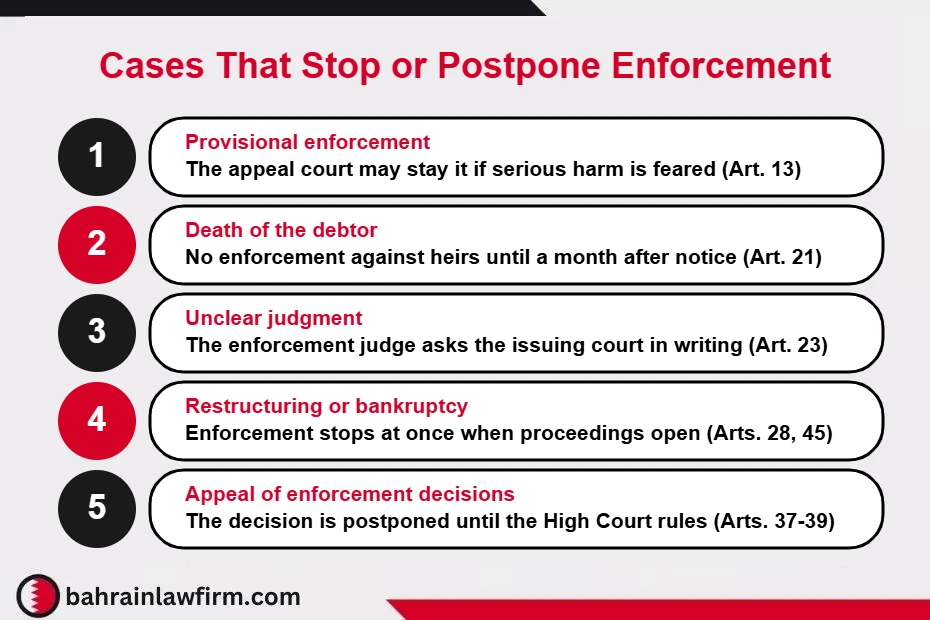
In civil and commercial enforcement files, the Enforcement Law (Decree-Law 22 of 2021) lists cases where enforcement is stopped or postponed. The main cases are these.
- Stay of provisional enforcement: the court hearing the appeal or the grievance may, at the request of those concerned, stay provisional enforcement if serious harm is feared from enforcement and the grounds against the judgment or order make its cancellation likely (Article 13).
- Death of the debtor: if the debtor dies, loses capacity or the capacity of the person acting for him ends, enforcement against his heirs or successors is not allowed until one month after they are notified of the enforcement request (Article 21).
- An unclear judgment: if the judgment is vague or unclear, the enforcement court judge may not interpret it and must ask the issuing court in writing before enforcing it (Article 23).
- Restructuring and bankruptcy proceedings: enforcement stops at once if these proceedings are opened against an individual merchant who is the debtor (Article 28), or against a commercial company that is the debtor (Article 45).
- Appeal of the enforcement judge’s decisions: appealing his decision on a grievance against attachment steps, the decision awarding a sale or the distribution of sums postpones the decision appealed, except for attachment steps, until the High Court decides it (Articles 37, 38 and 39).
If you hold a judgment in your favor that has not yet been enforced, you can take your file to a judgment enforcement lawyer to review the right steps for your case. A lawyer can also advise on the stay of enforcement pending cassation in Bahrain if the other side challenges the judgment.
Frequently Asked Questions About Staying Enforcement
Here are short answers to common questions.
Does cassation stop the enforcement of a judgment?
No. As a rule, a challenge in cassation does not stop enforcement, but the Court of Cassation may order a stay. In civil matters this is possible if the petition asks for it and enforcement is feared to cause serious harm that cannot be repaired (Article 10). In criminal matters it is possible if the memorandum of grounds asks for it and the court sees a reason (Article 41). Death sentences are an exception to the rule.
How long does it take to decide a request to stay enforcement?
In a criminal challenge that includes a stay request, the clerks' department presents the file to the president of the court within seven days of the memorandum. The president sets a hearing quickly, within 30 days of the presentation, and the Public Prosecution is notified. If the court orders a stay, it sets a hearing for the challenge within three months of the order (Article 41 bis). In civil matters, Article 10 of the Court of Cassation Law sets no deadline for deciding a stay request.
In conclusion, we hope this guide gave you the legal information you need about the stay of enforcement pending cassation in Bahrain. We covered the points many people search for, mainly whether cassation can stop the enforcement of a judgment and how long a stay request takes to decide.
You may also want to read about the stay of execution of a sentence in Bahrain, how a stay works before the petition for reconsideration in Bahrain, and the stay of execution of a judgment in Bahrain in civil cases.

A Bahraini lawyer and the founder of a legal consultancy firm established in February 2019. He holds a Higher Degree in Sharia and Law from Al-Azhar University. He has extensive experience in court representation and providing legal advice in criminal, personal status, civil, and commercial matters. He is known for delivering clear, practical, and effective legal advice aimed at protecting his clients’ rights and interests, and has achieved tangible results in notable cases, including commercial litigation and inheritance matters
