

Challenging a court of appeal judgment in Bahrain is possible only through the routes that the law sets. This guide explains those routes, the grounds, the deadlines and the steps to follow.
The court of appeal reviews judgments of the first instance courts in order to correct legal or procedural mistakes. Even so, a party may need to challenge its judgment if he believes it harmed his rights or ignored essential legal facts.
Our team at Bahrain Law Firm explains each point in simple terms.
Did the court of appeal uphold the judgment against you, and do you feel the door of justice has closed? The Court of Cassation may be your last chance to correct the course. Our appeal lawyers can study the judgment at once, look for legal errors and prepare a strong challenge before the deadline.
Table of Content
Challenging a Court of Appeal Judgment in Bahrain Under the Law
Challenges to judgments in Bahrain fall under three laws. In civil and commercial matters it is the Civil and Commercial Procedure Law (Decree-Law 12 of 1971), in criminal matters the Criminal Procedure Law (Decree-Law 46 of 2002), and for challenges in cassation the Court of Cassation Law (Decree-Law 8 of 1989). Each one sets the procedures and deadlines for filing.
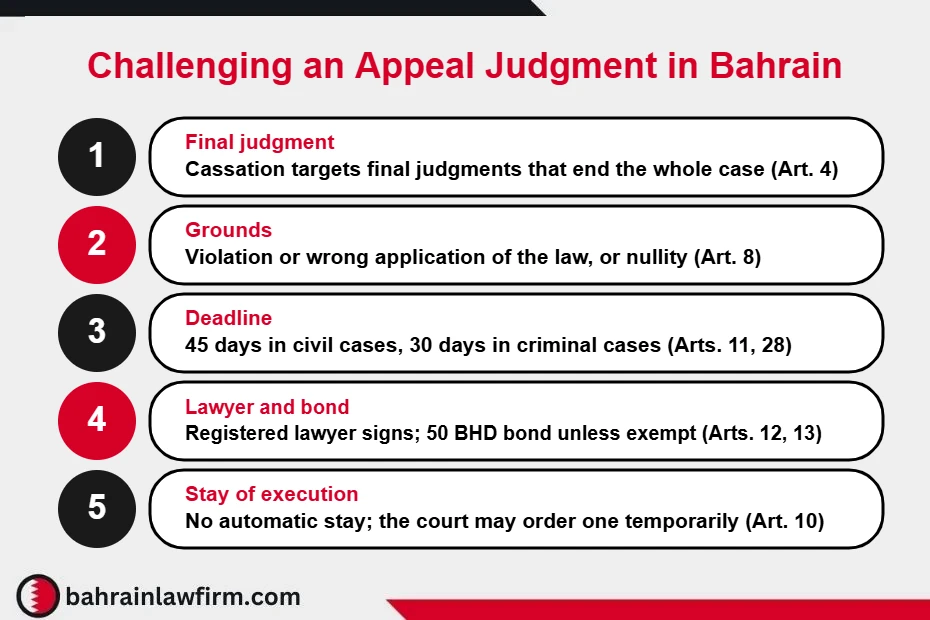
Under Article 4 of the Court of Cassation Law, the parties may challenge in cassation the final judgments that end the whole case. A judgment issued before ruling on the merits cannot be challenged unless it prevents the case from moving forward.
Cassation is the main route against final judgments of the court of appeal. It must rest on a ground set by law: a violation of the law, a mistake in applying or interpreting it, or a nullity in the judgment or in the procedures that affected it (Articles 8 and 27).
Types of Challenges Available
The law gives two main routes for challenging a court of appeal judgment in Bahrain, and each has its own grounds and procedures.
Reconsideration of the Judgment
The parties may ask for reconsideration of final judgments issued by courts of appeal on one of these grounds (Article 229 of the Civil and Commercial Procedure Law).
- Fraud or deceit by the opponent or his agent that affected the judgment.
- An admission after the judgment that the documents it relied on were forged, a ruling that they were forged, or a judgment based on testimony that a court later ruled to be false.
- The party obtaining, after the judgment, decisive documents that his opponent had prevented him from submitting.
- A judgment that awards something the parties did not ask for, or more than they asked for.
- Two contradictory judgments from the same court between the same parties in the same case, as long as no material appeared that could by law have led to a different judgment.
The request goes to the court that issued the judgment within the appeal period in Article 216, subject to Article 230 on when that period starts. If the request is accepted, the court examines the merits and then rejects the request, cancels the judgment or amends it (Article 231).
Challenge Before the Court of Cassation
A challenge before the Court of Cassation is the route against final judgments of the court of appeal when one of these grounds exists.
- A violation of the law, a mistake in applying or interpreting it, or a nullity in the judgment or in the procedures that affected it (Article 8, civil and commercial matters).
- A final judgment in a dispute that goes against an earlier judgment between the same parties that already became res judicata (Article 9).
- In criminal matters, the same grounds apply to felony and misdemeanor judgments of the High Court of Appeal or of the High Court sitting as an appeal court. Both the Public Prosecution and the convicted person may challenge (Article 27).
Conditions for Accepting the Challenge
For challenging a court of appeal judgment in Bahrain to be accepted, these conditions must be met.
- The judgment must be final, end the whole case and come from the court of appeal (Article 4).
- The challenge must be filed on time: 45 days in civil and commercial matters (Article 11) and 30 days from the date of the judgment in criminal matters (Article 28).
- The challenger must be a party to the case and have a real interest in amending or cancelling the judgment.
- The challenge must be filed through a lawyer registered before the Court of Cassation (Articles 3 and 12).
In civil matters the period starts from the date of a judgment given in the presence of the parties. If the losing party missed all the hearings set for the case, it starts from the date he is notified of the judgment (Article 11).
A challenge in cassation does not stop execution of the judgment. The Court of Cassation may still order a temporary stay if the petition asks for it and execution could cause serious harm that cannot be repaired (Article 10).
Steps to File a Challenge in Cassation
In civil and commercial matters, challenging a court of appeal judgment in Bahrain before the Court of Cassation goes through these steps.
- Prepare the petition. It is signed by a lawyer registered before the Court of Cassation. It states the names, capacities and domiciles of the parties, the judgment challenged and its date, the grounds, and the requests, whether to quash the judgment in whole or in part. A petition that does not meet these requirements is void, and the court rules so on its own motion. Grounds not stated in the petition cannot be raised unless they concern public order (Article 12).
- File the petition. It goes to the case registration department of the Court of Cassation within 45 days (Article 11). The challenger must attach proof of a 50-dinar bond paid to the Ministry of Justice treasury, unless he is exempt from fees, and the department will not accept the petition without it (Article 13). He must also attach copies for each respondent, the lawyer’s power of attorney, an explanatory memorandum and the supporting documents, unless they are already in the case file (Article 14).
- Registration and exchange of memoranda. The department records the challenge on the day of filing, the clerks’ department adds the case file and the respondent is served with a copy (Article 15). The respondent may file a defense memorandum within ten days of notice, and the challenger may reply within ten days after that (Article 16).
- Examination. The file goes to the technical office and then to the president of the court, who appoints a rapporteur judge. The court, sitting in chambers, decides whether the challenge deserves a ruling on the merits. If it is inadmissible in form, void in its procedures or not based on the grounds in Articles 8 and 9, the court declares it inadmissible by a decision that cannot be challenged, orders the challenger to pay the costs and confiscates the bond. Otherwise it sets a hearing (Article 21). The court decides after reading the papers without oral pleading, once the rapporteur reads a report on the grounds and the replies (Article 22). If it sees a need for oral pleading, it may hear the lawyers of the parties who filed memoranda in their names (Article 23).
- Judgment. The court may declare the challenge inadmissible or reject it, with costs and loss of all or part of the bond (Article 24). It may also accept the challenge and quash the judgment in whole or in part (Article 24). After quashing, it may send the case back to the court that issued the judgment to decide again. It may decide the merits itself if the case is ready for a full ruling without new procedures, or if this is the second challenge (Article 25).
Cassation in Criminal Matters
In criminal matters, challenging a court of appeal judgment in Bahrain starts with a report at the clerks’ department of the court, made by the challenger or his agent within 30 days from the date of the judgment. A convicted person in prison may make the report there. A memorandum of grounds must be filed in the same period, signed by a lawyer registered before the Court of Cassation if the convicted person is the challenger (Article 28).
A bond of 50 dinars must be paid unless the challenge comes from the Public Prosecution or from a person sentenced to a custodial penalty, or the Minister of Justice has granted an exemption (Article 29). A challenge by a convicted person sentenced to a custodial penalty lapses if he does not surrender for execution before the day of the hearing (Article 31).
When a Challenge Is Rejected
Before challenging a court of appeal judgment in Bahrain, check that your case does not fall into one of these situations.
- The legal deadline was missed (45 days in civil and commercial matters, 30 days in criminal matters).
- The challenger has no real legal interest in challenging the judgment.
- The petition lacks its essential details or was not signed by a lawyer registered before the Court of Cassation. It is then void, and the court rules so on its own motion (Article 12).
- The bond, or proof of exemption, was not provided when the challenge was filed (Articles 13 and 29).
- The challenge targets a judgment issued before ruling on the merits that does not prevent the case from moving forward (Article 4).
- A criminal challenge by a convicted person sentenced to a custodial penalty lapses if he does not surrender for execution before the hearing day (Article 31).
Why a Lawyer Matters in a Challenge
An experienced lawyer can prepare a complete petition and study the reasons of the judgment closely to find its legal weak points. Consult a specialized appeal lawyer or a top lawyer in Bahrain as early as possible.
Checking the deadlines is just as important, because a challenge filed late is rejected in form. For any plan to challenge a court of appeal judgment in Bahrain, the best protection is to act as soon as the judgment is issued.
Frequently Asked Questions About Challenging Appeal Judgments
Here are short answers to common questions.
When does a challenge become necessary?
A challenge becomes necessary if the judgment violated the law, applied or interpreted it wrongly, or suffered a nullity in the judgment or in the procedures that affected it. The route is then a challenge in cassation. Fraud, forgery or decisive documents withheld by the opponent are grounds for a request for reconsideration instead (Article 229 of the Civil and Commercial Procedure Law).
Can every court of appeal judgment be challenged?
No. Cassation is allowed against final judgments that end the whole case. A judgment issued before ruling on the merits can be challenged only if it prevents the case from moving forward (Article 4 of the Court of Cassation Law). The challenge must also rest on a ground set by law.
What is the deadline for a challenge before the Court of Cassation?
It is 45 days in civil and commercial matters. It starts from the date of a judgment given in the presence of the parties, or from the date the losing party is notified if he missed all the hearings set for the case (Article 11 of the Court of Cassation Law). In criminal matters it is 30 days from the date of the judgment (Article 28).
In conclusion, challenging a court of appeal judgment in Bahrain is an important legal means of securing justice and correcting judicial errors.
We hope this guide was useful. For more details, contact us and book a legal consultation.
You may also want to read our guides on annulment of an appeal judgment in Bahrain, the difference between appeal and cassation in Bahrain and appeals in labour cases in Bahrain.

A Bahraini lawyer and the founder of a legal consultancy firm established in February 2019. He holds a Higher Degree in Sharia and Law from Al-Azhar University. He has extensive experience in court representation and providing legal advice in criminal, personal status, civil, and commercial matters. He is known for delivering clear, practical, and effective legal advice aimed at protecting his clients’ rights and interests, and has achieved tangible results in notable cases, including commercial litigation and inheritance matters
