

The difference between appeal and cassation in Bahrain is the focus of our study. It sets out the main legal information about appealing judgments, how the Court of Cassation hears them, and the procedures that apply.
So what is the difference, and how do the court and the law deal with it? That is what we cover here.
Has a judgment been issued against you, leaving you unsure of the right legal step and afraid of choosing a wrong path that costs you your rights? Let us pin down the exact path for you.
Table of Content
The difference between appeal and cassation in Bahrain
This page explains the difference between appeal and cassation in Bahrain in terms of the competent court, the grounds of challenge, the deadline and the effect, based on the procedural laws.
Appeal:
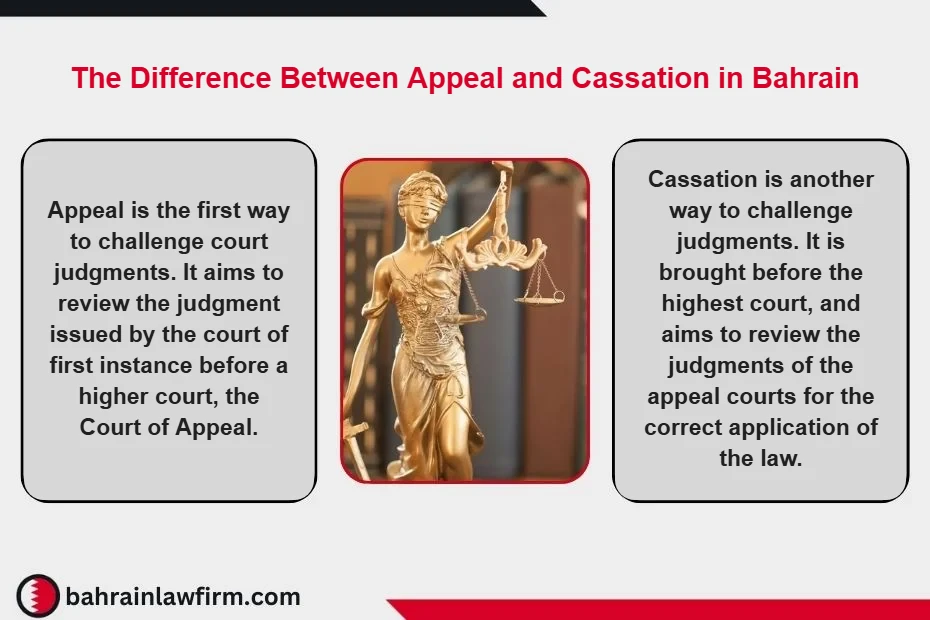
In the difference between appeal and cassation in Bahrain, appeal is the first way to challenge court judgments. It aims to review the judgment issued by the court of first instance before a higher court, the Court of Appeal.
All judgments issued by the general, commercial and labour courts can be appealed, except some judgments that are final by law. Appeal procedures:
- Filing the appeal: the appeal deadline in civil and commercial cases is forty-five days from the date the judgment is issued (Article 216 of the Civil and Commercial Procedure Law), thirty days in Sharia cases (Article 59 of the Sharia Courts Procedure Law), and fifteen days in criminal cases.
- Filing the appeal memorandum: the appellant must file the appeal memorandum with the competent court, setting out the grounds of appeal and the legal defenses.
- Hearing the appeal: the Court of Appeal reviews the first-instance judgment on both the law and the facts, and upholds, amends or cancels it as it sees fit.
Effects of appeal: Suspension of the first-instance judgment’s enforcement until the appeal is decided, unless the judgment is immediately enforceable under the law.
Cassation:
The difference between appeal and cassation in Bahrain is clearest here: cassation is an extraordinary way of challenge brought before the Court of Cassation, the highest court in Bahrain’s judicial hierarchy. It does not re-examine the facts. It reviews whether the law was applied correctly and the procedures in the challenged judgment were sound.
Under its law, issued by Decree-Law No. 8 of 1989, the Court of Cassation hears challenges to final judgments that end the whole dispute in civil, commercial, personal status (non-Muslims and Sharia) and criminal matters (Article 4); the reconsideration of final criminal judgments imposing a penalty in felonies and misdemeanors (Article 5); and the designation of the competent court when jurisdiction is disputed between the civil and Sharia judiciaries or between two Sharia circuits (Article 6).
Cassation is not allowed against judgments issued before the ruling on the merits unless they prevent the case from proceeding.
Court of Cassation: when can you challenge and how long do you have?
Grounds for challenge by cassation
Litigants may challenge judgments issued by the High Civil or Sharia Court of Appeal, or by the High Civil or Sharia Court sitting as an appeal court, in two cases: where the judgment is based on a violation of the law or an error in applying or interpreting it, or where there is a nullity in the judgment or in the procedures that affected the judgment (Article 8). A challenge may also be brought against any final judgment that decided a dispute contrary to another judgment previously issued between the same parties that acquired the force of res judicata (Article 9).
In criminal matters, the challenge may be brought by the Public Prosecution and the convicted person in the cases set out in Article (27).
Deadline for challenge by cassation
- Civil, commercial and Sharia matters: Forty-five days (Article 11), running from the date of an in-person judgment. If the losing party failed to attend all the hearings, the period runs from the date he is notified of the judgment. If the judgment is by default, the period starts only from the day an objection to it is no longer admissible, or from the day the objection is dismissed because the objector failed to attend.
- Criminal matters: The challenge is made by a report in the court clerk’s office within thirty days from the date of the judgment, with a memorandum of grounds filed within the same period, signed by a lawyer registered in the register of lawyers before the Court of Cassation (Article 28).
How is the challenge filed?
- The petition is submitted to the court’s case registration section, signed by a lawyer registered in the register of lawyers before the Court of Cassation, otherwise the challenge is void. It states the challenged judgment and its date, the grounds and the appellant’s requests, and no grounds other than those stated may be relied on except those relating to public order (Article 12). Only lawyers registered in this register are accepted to plead before the court (Article 3), and the details are on the page about lawyers before the Court of Cassation in Bahrain.
- The petition must be accompanied by proof of depositing a guarantee of fifty dinars in the Ministry of Justice treasury, from which those exempt from fees are exempt (Article 13), together with copies of the petition for the number of respondents, the lawyer’s power of attorney, an explanatory memorandum of the grounds, and the supporting documents (Article 14).
- The respondent may file a defense memorandum within ten days of being notified of the petition (Article 16).
Effect of the challenge and what follows
A challenge by cassation does not suspend enforcement of the judgment. But the Court of Cassation may order a temporary stay if requested in the petition and enforcement is feared to cause serious harm that cannot be remedied. A divorce judgment is excepted and is not enforced until the challenge periods have passed or the cassation judgment is issued (Article 10).
The practical steps are in how to stop an enforcement file until cassation is decided.
The court examines in chambers whether the challenge deserves a ruling on its merits. If it finds it inadmissible because of a defect in form or because it is not based on the grounds in Articles 8 and 9, it decides not to admit it by a decision that cannot be challenged, orders the appellant to pay the costs and confiscates the guarantee (Article 21).
If it accepts the challenge, it quashes the judgment in whole or in part (Article 24). If the quashing is for breach of jurisdiction rules, it is limited to that question and the court designates the competent court. Otherwise it refers the case back to the court that issued the judgment to decide it again, bound by the cassation ruling on the legal point.
If the matter is ready to be decided in full, or the challenge is brought for the second time, the court must decide the merits itself (Article 25).
Frequently asked questions about the difference between appeal and cassation in Bahrain
Related questions:
Is there cassation after appeal?
Yes. A challenge by cassation may be brought against judgments issued by the High Civil or Sharia Court of Appeal, or by the High Court sitting as an appeal court, where the judgment is based on a violation of the law or an error in applying or interpreting it, or where a nullity in the judgment or the procedures affected it, under Article (8) of the Court of Cassation Law.
What is cassation?
Cassation is a way of challenge brought before the Court of Cassation, the highest court in Bahrain's judicial hierarchy. The court does not re-examine the facts. It reviews whether the law was applied correctly and the procedures in the challenged judgment were sound, and it quashes the judgment in whole or in part if it accepts the challenge, under its law issued by Decree-Law No. 8 of 1989.
How long do you have to challenge by cassation in Bahrain?
The deadline for cassation in civil and Sharia matters is forty-five days from an in-person judgment, and it runs from notification of the judgment if the losing party failed to attend all the hearings (Article 11). In criminal matters, the challenge is made by a report in the court clerk's office within thirty days of the judgment, with the memorandum of grounds (Article 28).
Does a cassation challenge stop enforcement of the judgment?
As a rule in civil and Sharia matters, a cassation challenge does not stop enforcement. The Court of Cassation may order a temporary stay if requested in the petition and enforcement is feared to cause serious harm that cannot be remedied (Article 10). A divorce judgment is excepted and is not enforced until the cassation challenge periods have passed or the Court of Cassation rules.
Who can file a cassation challenge?
The challenge is filed by a petition signed by a lawyer registered in the register of lawyers before the Court of Cassation, otherwise it is void (Article 12), and only lawyers registered in this register are accepted to plead before the court (Article 3). A guarantee of fifty dinars must be deposited with the petition unless the appellant is exempt (Article 13).
That brings us to the end of our article on the difference between appeal and cassation in Bahrain, which set out the main differences between appeal and cassation under Bahraini law. To have your judgment reviewed and assess the chances of challenging it, you can contact a cassation lawyer in Bahrain at our office to book a consultation.
To go deeper into these routes, see the comparison in the difference between appeal and challenge, the explanation of the appeal period in Bahraini law, and the steps for appealing labour cases, including arbitrary dismissal claims.
Official references
- Civil and Commercial Procedure Law (Decree-Law No. 12 of 1971) and its amendments: Legislation and Legal Opinion Commission (unofficial English translation)
- Sharia Courts Procedure Law (Decree-Law No. 26 of 1986) and its amendments: Legislation and Legal Opinion Commission
- Court of Cassation Law (Decree-Law No. 8 of 1989) and its amendments, Articles 3, 4, 5, 6, 8, 9, 10, 11, 12, 13, 14, 16, 21, 24, 25, 27 and 28: Legislation and Legal Opinion Commission.

A Bahraini lawyer and the founder of a legal consultancy firm established in February 2019. He holds a Higher Degree in Sharia and Law from Al-Azhar University. He has extensive experience in court representation and providing legal advice in criminal, personal status, civil, and commercial matters. He is known for delivering clear, practical, and effective legal advice aimed at protecting his clients’ rights and interests, and has achieved tangible results in notable cases, including commercial litigation and inheritance matters
