

Someone you trusted with money or property takes it for himself. You may think that the only result is a prison term for the offender, while your own money stays lost.
In fact, the law gives the injured person a way to ask for compensation. This guide explains the civil claim for embezzlement in Bahrain from the first report to the judgment.
Were you hurt by an embezzlement and fear that the case will end with the offender’s prison term, without getting your money back? Do not let your rights get lost in the courts.
Table of Content
What Is the Crime of Embezzlement?
Embezzlement is a crime against property. It happens when a person who holds money or property because of a job, a position or the owner’s trust treats it as his own, without any right.
The penalty depends on who commits the act. Article 194 of the Penal Code punishes a public official who embezzles money or papers that he held because of his job with a prison term. The penalty is life imprisonment for collectors, their deputies, trustees of deposits and cashiers who received the money in that capacity.
In these felonies, Article 201 adds restitution and a fine equal to the value of the money, with a minimum of BD 100. For a worker or a board member of a private legal entity, Article 424 sets imprisonment of up to 10 years and orders the return of the embezzled item.
The crime has three main features.
- A trusted person: the act comes from a person who holds the money because of his job or position.
- Acting as the owner: the offender treats the money as his own, without any right.
- Harm: the real owner of the money suffers a loss.
Embezzlement is different from theft, because the offender held the money lawfully before he turned it into his own. Our guide to the difference between embezzlement and theft in Bahrain explains this in more detail. For the elements of the crime, read our guide to the type of possession required in embezzlement.
Civil Claim for Embezzlement in Bahrain: Steps and Rules
Article 22 of the Criminal Procedure Law lets anyone who suffered a direct and certain personal harm from a crime claim civil rights against the accused. This can be done while evidence is collected, during the investigation, or before the court that hears the criminal case.
A civil claim for embezzlement in Bahrain can be made at any stage until the decision to close the pleading is issued. It is not accepted before the appeal court, so timing matters.
The usual steps are as follows.
- Prepare the claim: set out the facts of the crime, your capacity as the injured person, the harm you suffered and the compensation you ask for.
- File it at the right stage: during the investigation, you ask by a request that is recorded in the minutes, and the Public Prosecution decides within three days whether to accept you as a civil claimant. Before the court, you file it as the Civil and Commercial Procedures Law requires.
- Notify the defendant and submit your evidence: attach the papers that prove the embezzlement and the harm.
- Pay the fees and the deposit: under Article 27, the civil claimant pays the court fees and deposits in advance the amount that the Public Prosecution or the court sets for experts and witnesses.
- Follow the hearings: under Article 32, the judgment on the criminal case must also decide the compensation that you claim.
If the compensation needs a special inquiry that would delay the criminal case, the court sends the civil claim to the competent civil court without costs. If the Public Prosecution refuses to accept you, this does not stop you from claiming before the criminal court or the civil court (Article 29).
What Does a Civil Claim Petition Include?
A petition for a civil claim for embezzlement in Bahrain is a legal paper that the injured person gives to the court. It asks for compensation for the harm caused by an employee who embezzled money or property that he held because of his job.
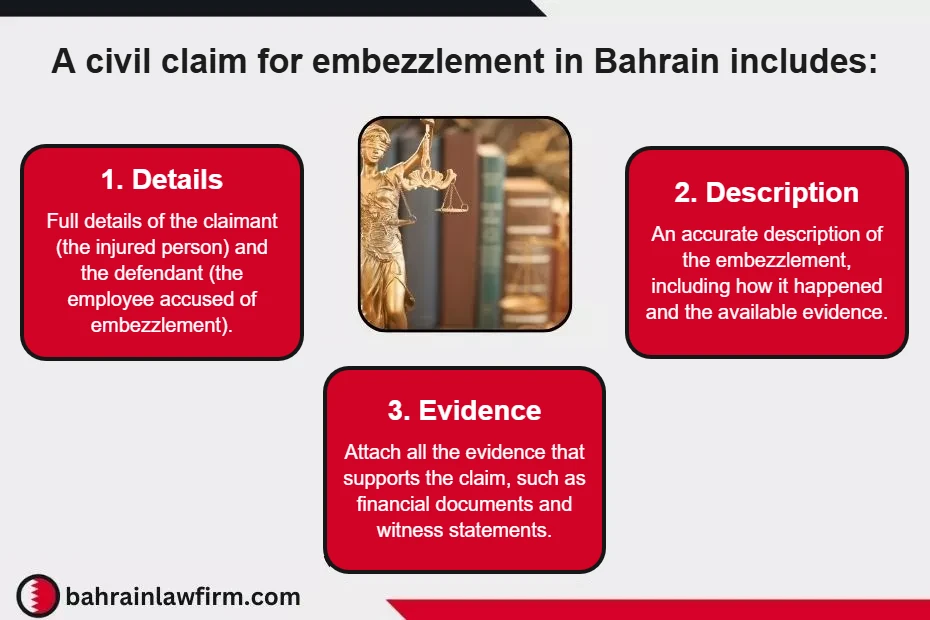
The petition should include these items.
- Details of the parties: full details of the claimant (the injured person) and the defendant (the accused employee).
- Description of the crime: an accurate account of how the embezzlement happened and what evidence exists.
- Evidence: all the proof that supports the claim, such as financial documents and witness statements.
The criminal court may itself order the return of the embezzled item. The civil claim adds the compensation for the harm that you suffered.
Sample Civil Claim Petition
Here is a general model that you can adapt. Fill in the details in brackets, and ask a lawyer to review it before you file it.
To the Honourable Judge of the [Name of the competent court].
Subject: civil claim for compensation arising from embezzlement.
Claimant: [name], [address], [ID number].
Defendant: [name], [address], [ID number].
Facts: on [date], the defendant, who worked as [job] at [name of the institution], embezzled the amount of [amount] from the funds of the institution. The embezzlement was discovered through [how it was discovered, such as an audit or an internal report].
Evidence: the audit report dated [date], the statements of the witnesses [names], and the financial documents that prove the embezzlement.
Requests: the claimant asks the court to order the defendant to return the embezzled amount of [amount]. The claimant also asks for compensation of [amount] for the material and moral harm, and for the defendant to pay the fees and costs.
This model is only a skeleton. The competent court, the form of the request and the amount depend on your case, so ask a criminal lawyer in Bahrain to check it.
How Do You File a Complaint Against an Employee Who Embezzled?
Start by collecting proof that the employee held the money because of his job and then took it. Then follow these steps.
- File an official report: go to the police station or the Public Prosecution. Article 46 of the Criminal Procedure Law requires judicial police officers to accept the reports and complaints that reach them, and you can also use the Submit a Report service on the national portal.
- Explain the facts precisely: hand in the documents that support your claim.
- Ask for the criminal case to move: if you suffered a financial loss, apply to join the case as a civil claimant.
- Follow the procedures: keep in touch with the authorities, and appoint a lawyer if you need one to keep the steps correct.
Make the complaint in time and base it on strong proof. This helps the authorities move the case with confidence, and it also supports a civil claim for embezzlement in Bahrain later.
When Does an Embezzlement Case Lapse?
A criminal case lapses with time. Article 18 of the Criminal Procedure Law sets 10 years for felonies and three years for misdemeanors, counted from the day of the crime, unless the law says otherwise.
The type of crime follows the penalty that the Penal Code sets for it (Article 13). So the period for your case depends on the article that applies to the act.
For a felony of embezzlement that a public official commits, the period starts only when his capacity ends, unless the investigation began before that. Investigation, accusation and trial steps interrupt the period, and a new period starts from the day of the interruption (Article 20).
The criminal case also ends by the death of the accused, by a final judgment, by a waiver from the person who has the right to it, by a general amnesty or by the repeal of the law (Article 17). A related crime, breach of trust under Article 395 of the Penal Code, has its own rule: the period starts from the day the victim learns of the act and the offender, unless an investigation began before.
Does the Right to Compensation Lapse Too?
The time limit of a civil claim for embezzlement in Bahrain follows different rules from the criminal case. Article 180 of the Civil Code says that a claim for a wrongful act is not heard after three years from the day the injured person learns of the harm and of the person responsible, or after 15 years from the act, whichever comes first.
If the claim arises from a crime, it can still be heard as long as the criminal case remains alive, even if these periods have passed.
Frequently Asked Questions About Civil Claims in Embezzlement Cases
Here are short answers to common questions.
Can I file a civil claim before the criminal court for embezzlement?
Yes. Under Article 22 of the Criminal Procedure Law, a person who suffered a direct personal harm from the crime can claim civil rights against the accused before the court that hears the criminal case. This can be done until the decision to close the pleading, and it is not accepted before the appeal court.
What are the steps of a civil claim in an embezzlement case?
Prepare the petition with the facts, the evidence and your requests. File it at the right stage, pay the fees and any deposit, and follow the hearings. The court decides on the compensation in the same judgment, or sends it to the civil court if it needs a special inquiry.
Can I still claim compensation if the criminal case has lapsed?
The civil right has its own period. Article 180 of the Civil Code sets three years from the day you learn of the harm and of the person responsible, or 15 years from the act. The text protects the claim only while the criminal case remains alive, so ask a lawyer to check your dates.
Who pays the fees of a civil claim in a criminal case?
Under Article 27 of the Criminal Procedure Law, the civil claimant pays the court fees and deposits in advance the amount that the Public Prosecution or the court sets for experts, witnesses and others. A further deposit may be required during the procedures.
What if the Public Prosecution refuses to accept me as a civil claimant?
Under Article 22 you can appeal the decision before the Higher Criminal Court sitting in chambers within three days. Article 29 also says that the refusal does not stop you from claiming before the criminal court or the civil court.
In short, a civil claim for embezzlement in Bahrain lets the injured person ask for compensation in the criminal case or before the civil court. It needs a clear petition, strong proof and attention to time limits.
For help with your petition, speak to a lawyer for embezzlement cases in Bahrain.
If you are the accused, you may also read about the defenses in embezzlement cases.

A Bahraini lawyer and the founder of a legal consultancy firm established in February 2019. He holds a Higher Degree in Sharia and Law from Al-Azhar University. He has extensive experience in court representation and providing legal advice in criminal, personal status, civil, and commercial matters. He is known for delivering clear, practical, and effective legal advice aimed at protecting his clients’ rights and interests, and has achieved tangible results in notable cases, including commercial litigation and inheritance matters
