
Buying a product that fails after a week, or paying for a service that never arrives as promised, is stressful. The consumer protection law in Bahrain gives buyers clear rights before and after they sign or pay, and it sets duties and penalties for sellers and service providers.
This guide to the consumer protection law in Bahrain explains what the law protects, where and how to file a complaint, what you can ask for, and when it makes sense to bring in a lawyer.
The rules come from Law No. 35 of 2012 on Consumer Protection and its executive regulations, issued by Ministerial Resolution No. 66 of 2014. The official Arabic text is published on the Legislation and Legal Opinion Commission website.
Sold a faulty product and refused a refund? The law is on your side, and we walk you through it.
Table of Content
What Are Your Rights Under the Consumer Protection Law in Bahrain?
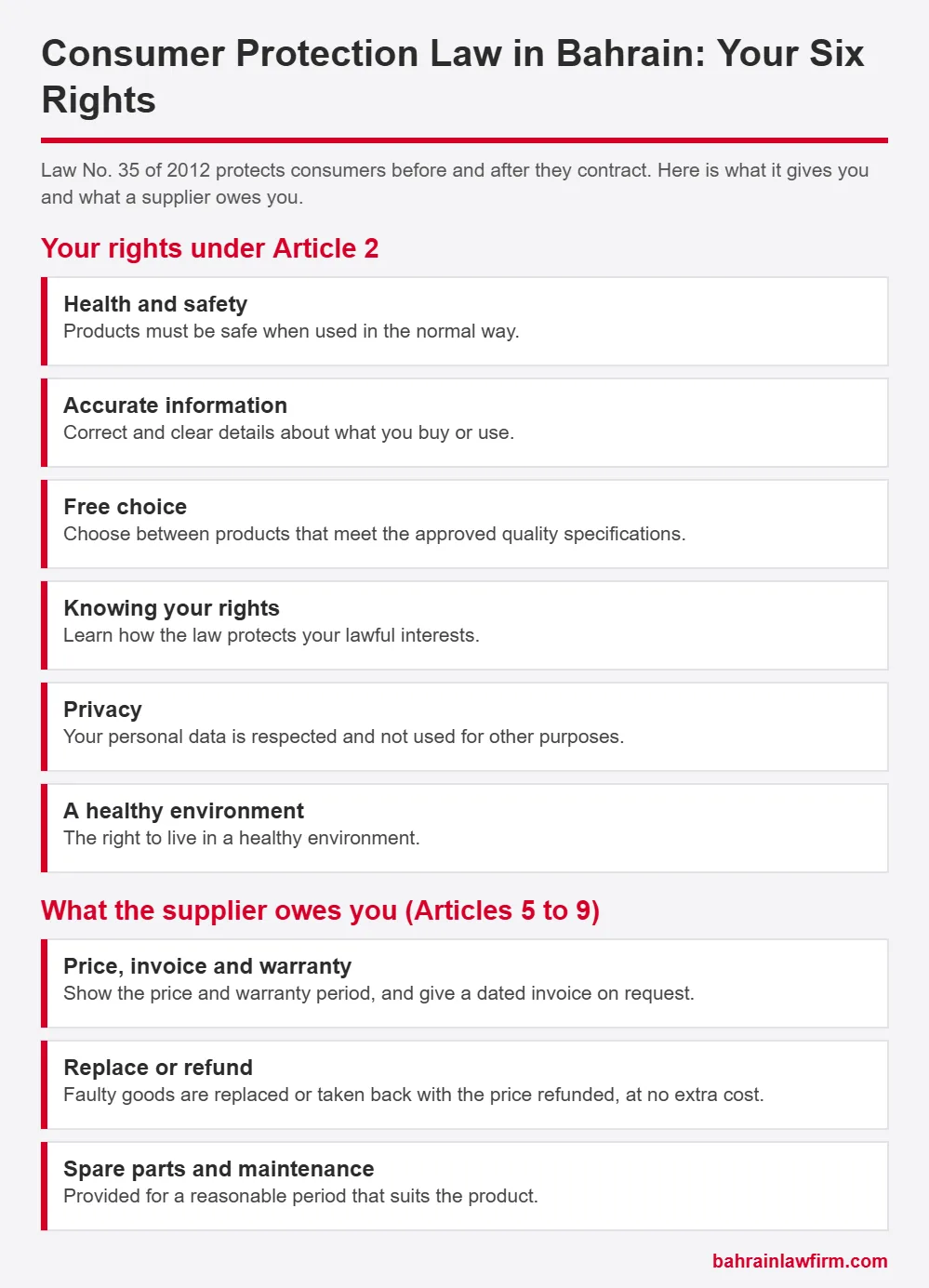
Article 2 of the law lists six rights that every consumer can rely on, before and after signing a contract:
- Health and safety: products must be safe when used in the normal way.
- Accurate information: you are entitled to correct and clear details about what you buy or use.
- Free choice: you can choose between products that meet the approved quality specifications.
- Knowing your rights: you should be able to learn how the law protects your lawful interests.
- Privacy: your personal data must be respected and cannot be used for other purposes.
- A healthy environment: you have the right to live in a healthy environment.
The law covers goods and services, including services of professionals such as doctors, engineers, lawyers, accountants and insurers. The party it holds responsible is the “supplier”, defined as any seller, wholesaler, retailer, commercial agent, manufacturer or service provider.
What Must a Supplier Do?
The law turns these rights into concrete duties. In short, a supplier must:
- show the price, identify the product and state the warranty period, and give you a dated invoice on request (Article 5);
- give correct information and avoid anything that creates a false or misleading impression (Article 6);
- stop selling a product that has a defect harmful to health or safety, warn consumers, and replace it or refund its value at no extra cost if you ask (Article 7);
- replace faulty goods or take them back and refund the price, or, for services, refund the fee, make up the shortfall or perform the service again, with no additional cost (Article 8);
- supply spare parts and maintenance for a reasonable period, unless you agreed otherwise in writing after being told they are unavailable (Article 9).
Article 7 also bans invoice wording or shop signs saying that products cannot be returned or exchanged, and Article 10 makes void any contract term that exempts the supplier in advance from these duties.
How Do You File a Consumer Complaint in Bahrain?
When you feel your rights have been breached, follow these steps.
1. Prepare Your Complaint
Gather your personal details (name, address, phone number and ID) and describe the transaction, contract or product in dispute. Attach the supporting documents: the purchase invoice, the contract, the guarantee and proof of payment, plus any emails, text messages or BenefitPay records that show the deal. State clearly what you want, such as a replacement, a refund or additional compensation.
2. Choose Where to File
Complaints go to the Consumer Protection Directorate at the Ministry of Industry and Commerce, which the law tasks with receiving consumers’ complaints and investigating them (Article 11). The national portal lists the service as registering and addressing consumer complaints, with channels that include email, the contact centre, a visit in person and the Tawasul app.
3. Follow the Review Process
The Directorate reviews the complaint, may question the supplier, and tries to reach an amicable settlement where possible. If the dispute concerns the supplier’s duties to replace, refund or redo the service, Article 8 sends it to the Directorate, which issues a decision that is binding on both parties under the procedures set by the Minister.
4. Follow Up on Execution
Keep track of your complaint with the Directorate. If the supplier still refuses to comply, ask a lawyer whether the decision can be enforced directly or whether you need to file a claim before the competent court, including a claim for damages.
If you face a consumer problem, contact the office of Lawyer Abdulrahman Khalifa and ask for an experienced commercial lawyer in Bahrain through the WhatsApp button at the bottom of the screen.
What Are the Most Common Consumer Disputes?
Most disputes under the consumer protection law in Bahrain fall into a few patterns:
- Defective or non-conforming goods: you can ask for a replacement or a refund under Article 8.
- Late delivery: the supplier misses the agreed date without a legal reason, so the remedy comes from the contract and the general rules on civil liability.
- Misleading advertising: promoting a product with qualities it does not have breaches Article 6, and deliberately false statements can be a crime under Article 18.
- Hidden fees: shipping costs or service charges that were not stated when the contract was made conflict with the duty to announce the price clearly.
- Poor after-sales service: refusing repairs, delaying replies or loading extra costs on you can breach the maintenance duty in Article 9.
- Trade fraud and monopoly practices: selling fake goods, hoarding products or manipulating prices without justification.
- Online shopping: shops that ignore return rules or hide product information.
Disputes are most frequent in electronics, repair services and vehicles, where contracts are complex and some suppliers do not meet their duties.
What Compensation Can a Harmed Consumer Get?
The consumer protection law in Bahrain gives you practical remedies, not just principles. Depending on your case, you can ask for:
- Replacement or refund of goods: when the goods are defective or do not match the approved specifications or the purpose of the contract (Article 8).
- Refund, correction or a repeat of a service: when the service is defective or incomplete (Article 8).
- Repair: the law does not list repair, but it is often available under the warranty or the agreement, so check your terms.
- Damages for extra losses: financial loss, lost profit or moral harm can be claimed in court under the general civil liability rules, and you must prove them.
Separately, the supplier faces criminal penalties. A breach of Articles 3 to 9 is punishable by a fine of up to BD 10,000 (Article 20). Fraud or false statements about a product carry imprisonment and/or a fine of up to BD 5,000 (Article 18).
Importing goods known to be harmful carries at least one year in prison and a fine of up to BD 10,000 (Article 19). Anti-competitive agreements or harmful trade practices can lead to up to five years in prison and a fine of at least BD 5,000, or either penalty (Article 21).
The court can also order confiscation or destruction of the goods and publication of the judgment, and a repeat offence within three years brings the maximum penalty and a suspension of up to three months or removal from the commercial register (Article 22). The Minister can also warn a supplier and, if it does not comply, close the business for seven days to three months (Article 23). These penalties do not replace your own claim for a refund or damages.
Keep the evidence that proves the harm: the invoice, photographs of the defect, messages with the supplier and any repair reports. A complete file makes the complaint stronger.
When Should You Consult a Consumer Protection Lawyer?
Some disputes are simple, but others call for a lawyer in Bahrain who knows consumer cases. Consider legal help when:
- the amount you are claiming is large or includes serious financial loss;
- the case raises complex legal points or needs case law to interpret the text;
- the supplier refuses to negotiate or to comply with the administrative decision;
- the sector is regulated, such as financial services, insurance or telecommunications;
- the complaint has moved from the Directorate to the courts;
- proving the damage or linking it to the supplier’s act is difficult;
- you want full representation before official bodies or the courts.
In these situations a lawyer who knows the consumer protection law in Bahrain can draft the complaint or claim correctly, advise you on your facts, prepare a full evidence file and arguments, and follow the case until judgment or settlement.
Frequently Asked Questions About the Consumer Protection Law in Bahrain
Can I get a refund if I bought a faulty product from a shop?
Yes. Under Article 8 of the Consumer Protection Law, the supplier must replace faulty goods, or take them back and refund the price, at your request and at no extra cost, when the goods are defective or do not match the approved specifications or the purpose of the contract. Keep the original invoice and proof of payment, photograph the defect and make your request in writing.
Is there a time limit for filing a consumer complaint?
The law does not set one deadline for all complaints. Act as soon as you find the defect or the breach, and within the warranty period shown on your invoice. Court claims, including claims for damages, are subject to the general limitation rules, so delay can weaken both your rights and your evidence.
Does the law protect online purchases from Bahraini shops?
The law defines a supplier as anyone who provides products, and it does not exclude online sellers. A Bahrain-based online shop is therefore expected to meet the same duties on price, information, warranty and defective goods as a physical shop. Buying from a foreign website is harder to enforce, so speak to a lawyer before you pay.
What can I do if the supplier ignores the Directorate's decision?
A decision issued under Article 8 is binding on both parties. If the supplier does not comply, a lawyer can advise whether to enforce it directly or to file a claim before the competent court, including a claim for damages. The Minister can also warn the supplier and close the business for between seven days and three months under Article 23.
The consumer protection law in Bahrain is more than a legal framework. It is a practical guarantee of fair and transparent dealings. We covered your main rights, how to file a complaint, the common disputes, the remedies available and when a lawyer is worth the cost.
If a situation breaches your rights as a consumer, a careful legal step taken with an experienced civil law attorney can decide whether you recover what you are owed. If your complaint also involves personal data, read our guide on the Personal Data Protection Law in Bahrain, and feel free to reach us through the Contact Us page.

A Bahraini lawyer and the founder of a legal consultancy firm established in February 2019. He holds a Higher Degree in Sharia and Law from Al-Azhar University. He has extensive experience in court representation and providing legal advice in criminal, personal status, civil, and commercial matters. He is known for delivering clear, practical, and effective legal advice aimed at protecting his clients’ rights and interests, and has achieved tangible results in notable cases, including commercial litigation and inheritance matters
