
A company owner delivered goods in several batches and asked his customer to pay. He had the invoices, a few emails, and screenshots of WhatsApp chats about prices and payment dates.
The customer denied the amount. He also said the chats were incomplete.
The question changed. It was no longer “Did the deliveries happen?” It became “What can we show the court, and how strong is each document?”
That is why Evidence Law in Bahrain matters. A right can be real and still lose force because of a missing paper, a cut-off message, or a request for proof that does not say what the court should look for.
This guide explains the burden of proof, paper and electronic documents, witnesses, experts, admissions and oaths. It also gives you practical steps to organise your dispute file.
Want to know which evidence you are missing before you act? Message the office through the WhatsApp button at the bottom of the screen.
Worried about losing your money because the other side disputes your invoices or WhatsApp chats? Do not let gaps in your proof weaken your case.
Table of Content
What Is Evidence Law in Bahrain?
This law sets out how the parties to a civil or commercial dispute prove facts and rights before the Bahraini courts. It says when writing or witnesses are accepted, how documents are weighed, when the court may appoint an expert, and who has to bring the proof.
The main text is Decree-Law No. 14 of 1996 on Evidence in Civil and Commercial Matters, issued in May 1996. The Legislation and Legal Opinion Commission publishes the text and its amendments on its website.
Law No. 12 of 2026 later replaced Articles 61 and 62, which deal with proof by witnesses.
What Is the Difference Between Having a Right and Proving It?
Keep the two ideas apart from the start.
- Having a right: you are owed a debt, compensation or a contract obligation.
- Proving the right: you show accepted evidence of where the obligation came from, how much it is, and that it is due.
An invoice may prove the amount claimed. On its own, it does not always prove that the other side received the goods or agreed to the price. An email can back up the invoice, and a bank transfer can prove part of a payment.
So judge your evidence as a whole. Do not count pages and assume that more is better.
Who Carries the Burden of Proof?
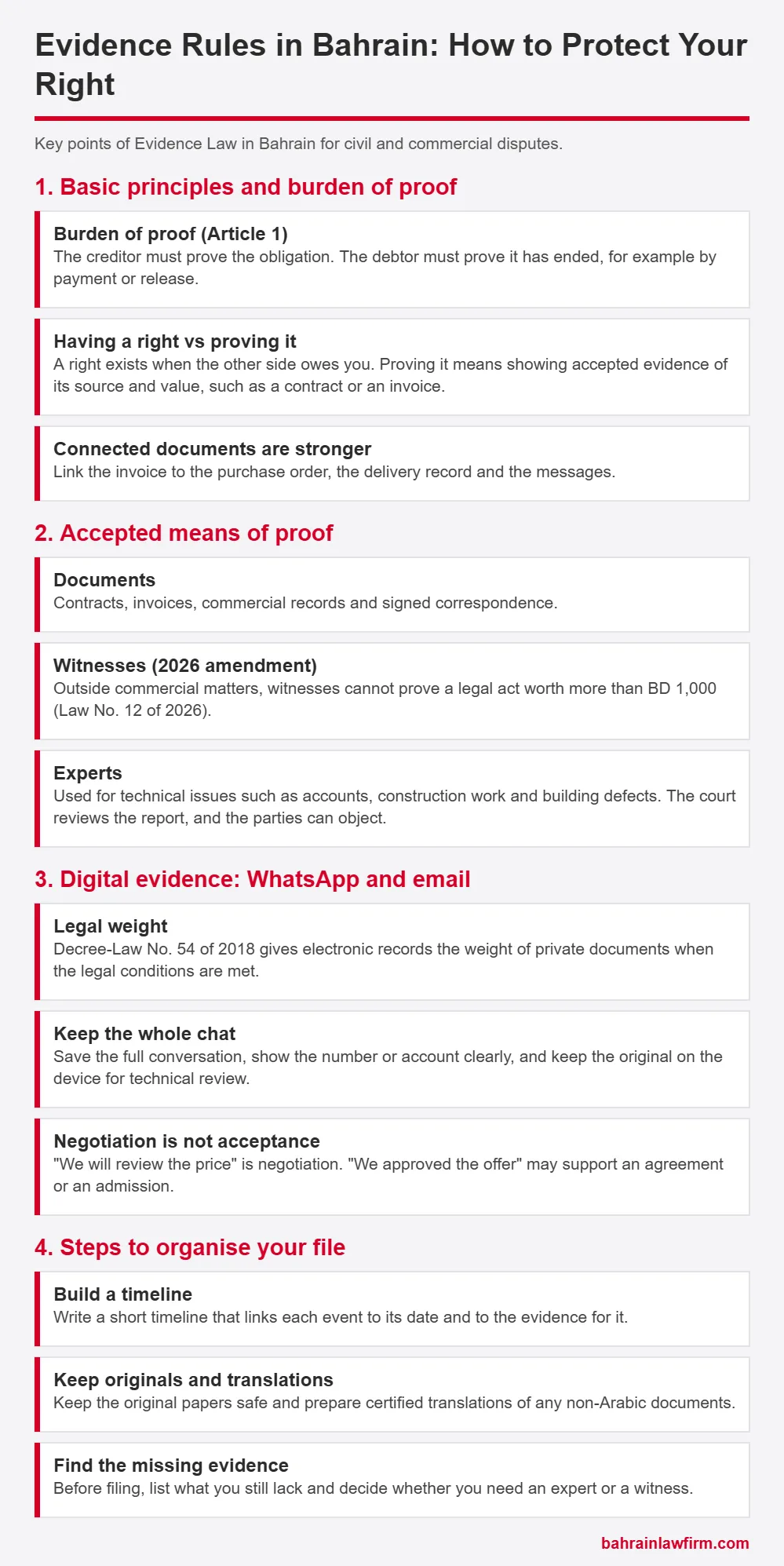
Start with the basic rule in Evidence Law in Bahrain. Article 1 says the creditor must prove the obligation, and the debtor must prove that it has ended.
In simple terms, a person who claims a debt has to show:
- where the debt came from;
- how much it is;
- who owes it;
- when it fell due;
- that it was not paid, if that is disputed.
The other side may say it paid, was released from the debt, or set the debt off against another one. Then it must bring the evidence for that defence.
The burden can move during the case. Suppose the claimant files a contract, invoices and delivery records, and the defendant then says it paid.
The argument is no longer about whether the obligation existed. It is about proof of payment.
Which Means of Proof Are Accepted?
Evidence Law in Bahrain covers several means of proof, and no single one fits every dispute. The main ones are:
- official and ordinary documents;
- electronic records and messages;
- witness evidence;
- admissions;
- questioning of the parties;
- the oath;
- presumptions;
- site inspection and recording the condition of property;
- court-appointed experts.
Pick the means that matches the fact you need to prove. A contract can show the relationship, and an invoice shows the amount.
A delivery record shows that the work was done. An expert report can give the final figure once the accounts are reviewed.
How Do Contracts and Invoices Prove a Right?
Writing gives your case a clear starting point. It includes the contract, the purchase order, the invoice, the receipt, the statement of account, meeting minutes and the demand letter.
A document is stronger when it shows:
- the names and capacity of the parties;
- a description of the goods or services;
- the price and how it was calculated;
- the date of delivery or performance;
- the payment terms;
- a signature or another sign of approval;
- proof that the other side received it.
Do not assume that sending an invoice means it was accepted. Tie it to a purchase order, a delivery record, an email that confirms approval, or a part payment that shows the parties dealt on those terms.
The other side may dispute a signature, deny that a document came from them, or attack a copy when the original is missing. So keep the originals, file the copies in order, and never write notes on the original papers.
Are WhatsApp Messages and Emails Valid Evidence?
Yes, they can carry real weight. But not every screenshot has the same strength.
Electronic communications fall under Decree-Law No. 54 of 2018 on Electronic Communications and Transactions, issued on 28 November 2018. Under it, an electronic record that meets the legal conditions carries the same evidential weight as a private document.
To weigh a record, the law looks at how reliably it was created, stored and sent. It also looks at how reliably the integrity of the information was kept, and at any other factor that bears on that integrity. In practice, check your electronic evidence on three levels.
1. Link the Message to Its Sender
Show the phone number, email address or account, and tie it to a person or a company. The other side may deny that the account is theirs, or say that someone else used it.
2. Keep the Whole Conversation
Do not rely on a cropped picture. Keep the dates, the names of the participants, the order of the messages and any attached files. If the other side seriously disputes the data, a technical examination may be needed.
3. Decide What the Message Proves
Separate negotiation from acceptance. “We will review the price” does not prove final approval. “We approved the offer and will pay on Thursday” may support an agreement or an admission, depending on the context.
Professional tip: Keep the original chat on the device and export it when you can. Do not delete messages or rename accounts once a dispute begins.
Not sure your invoices and chats would hold up in court? A right is not enough unless your evidence convinces the judge.
When Are Witnesses Accepted as Evidence?
Law No. 12 of 2026 changed a key rule in Evidence Law in Bahrain: the money limit in Article 61. Outside commercial matters, a legal act worth more than BD 1,000, or of unspecified value, cannot be proved or ended by witnesses. It must be proved in writing, unless the parties agreed otherwise or another provision says so.
The amendment took effect on the day after it was published in the Official Gazette.
Article 62 adds a second barrier. Even below BD 1,000, witnesses cannot be used to prove something that contradicts or goes beyond a written document. The same applies to the part of a right that must be proved in writing, and to what remains of a claim that was reduced from above the limit.
Commercial matters are treated more flexibly, so several means of proof can be used. The exception is where the law requires writing, as it can in a payment claim arising from a construction contract.
When you ask the court to hear a witness, name the fact the witness saw first-hand. “We ask to hear witnesses” is not enough. Say whether the witness will speak about a delivery, a meeting, an oral agreement, or the state of the site on a certain date.
When Does a Case Need an Expert?
Ask for an expert when the dispute turns on a technical point that documents alone cannot settle. Examples include:
- reviewing a partnership’s accounts;
- valuing construction work;
- inspecting building defects;
- analysing electronic systems or records;
- matching payments to invoices;
- putting a figure on technical damage.
An expert’s report is not a judgment. Read it carefully, compare its figures with the documents, and note any document it ignored. Then file a specific objection that explains the error and its effect, instead of a general line such as “we do not accept the report.”
The court is not bound by the report. It treats it as technical evidence and decides how much weight to give it.
How to Organise Your Evidence File Before Filing a Case
Turn scattered papers into a clear story. Evidence Law in Bahrain rewards a file where every event is tied to a specific piece of proof, as in any money claim for unpaid dues.
Start with these steps:
- Write a short timeline of the events.
- Set out the amount claimed and how you calculated it.
- Separate what has been paid from what has not.
- Arrange contracts, invoices and transfers by date.
- Save electronic messages in full.
- Note which fact each document proves.
- Identify the missing evidence before you act.
- Keep the originals and certified translations.
- Check the deadlines and procedures that apply to your case.
- Avoid emotional messages to the other side that could hurt your position.
When Do You Need a Lawyer for Evidence Disputes?
Ask for a legal assessment when the other side denies a signature, the chats are incomplete, the invoices do not match the statement of account, or the case needs an expert.
Evidence Law in Bahrain is technical, and small mistakes in how you file proof can be costly. A lawyer in Bahrain can help you to:
- work out who carries the burden of proof;
- find the points in your case that have no support;
- choose the right evidence requests;
- organise documents and written pleadings;
- object to the other side’s evidence;
- review the expert’s task and report;
- understand the risks of asking for an oath or challenging a document.
No lawyer can guarantee the result of a case. But good legal help improves how the facts are presented, cuts mistakes in filing evidence, and shows you the risks before you decide.
Frequently Asked Questions about Evidence Law in Bahrain
What does Evidence Law in Bahrain cover?
It is the Bahraini law that regulates the burden of proof, the means of proof, the weight of documents, witnesses, admissions, oaths, presumptions, site inspection and experts in civil and commercial disputes.
Is an invoice enough to prove a debt?
It can be, together with supporting evidence such as a contract, a purchase order, a delivery record, correspondence or earlier payments. It depends on the facts of each dispute.
Are WhatsApp chats accepted in court in Bahrain?
They can be. A chat can carry evidential weight when you can show who sent it, that its content is intact, and how it relates to the facts. A single screenshot does not always do the job on its own.
What is the limit for proof by witnesses in Bahrain?
Since the 2026 amendment, a legal act worth more than BD 1,000 cannot be proved by witnesses outside commercial matters, subject to exceptions and special provisions.
Is the court bound by an expert's report?
No. The report is technical evidence, and the court decides how much weight to give it. The parties can file specific technical objections to it.
Can I prove a debt without a signed contract?
Transfers, invoices, admissions, messages and part performance may support the existence of the obligation. You still need to check the legal limits and the nature of the transaction.
Who has to prove that a debt was paid?
The creditor proves the original obligation. The debtor must provide evidence of payment, release, or any other reason the debt has ended.
Evidence Law in Bahrain decides how a claim moves from one side’s story to facts backed by accepted proof. So do not collect papers at random. Tie the contract to the invoice, the invoice to the delivery, and the delivery to the messages or payments.
Keep electronic evidence complete, check the witness limit after the 2026 amendment, and treat an expert report as a technical file that needs close reading.
To have your contracts, invoices, chats or an expert report reviewed and decide the right next step, contact our office through the WhatsApp button at the bottom of the screen.
Official References
- Decree-Law No. 14 of 1996 on Evidence in Civil and Commercial Matters: official text and unofficial English translation, Legislation and Legal Opinion Commission
- Law No. 12 of 2026 amending Articles 61 and 62 of the Evidence Law: official text, Legislation and Legal Opinion Commission
- Decree-Law No. 54 of 2018 on Electronic Communications and Transactions: official text and unofficial English translation, Legislation and Legal Opinion Commission

A Bahraini lawyer and the founder of a legal consultancy firm established in February 2019. He holds a Higher Degree in Sharia and Law from Al-Azhar University. He has extensive experience in court representation and providing legal advice in criminal, personal status, civil, and commercial matters. He is known for delivering clear, practical, and effective legal advice aimed at protecting his clients’ rights and interests, and has achieved tangible results in notable cases, including commercial litigation and inheritance matters
