
At an industrial company in the Kingdom of Bahrain, an employee faced the sudden termination of his employment contract without prior notice. Feeling that he had been treated unfairly, he decided to pursue his legal rights. To protect his position and recover what he was entitled to, he first needed to understand the Labour Court Litigation Process in Bahrain.
Do you feel overwhelmed by labour court procedures and worry that one procedural mistake could affect your financial entitlements? Handling litigation on your own can involve unnecessary risk. procedures alone.
Table of Content
Labour Court Litigation Process in Bahrain
Understanding the Labour Court Litigation Process in Bahrain is important for both employees and employers. It helps the parties deal with labour disputes properly while protecting their respective rights and obligations.
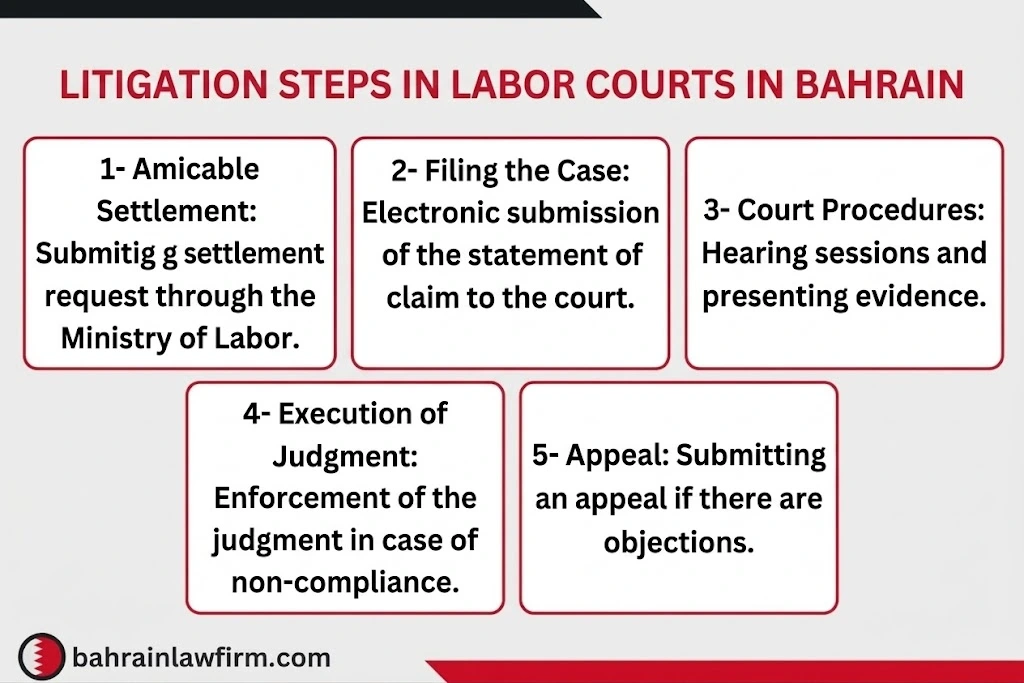
Step One: Attempt an Amicable Settlement through the Ministry of Labour
Before going to court, the parties are generally encouraged to try to resolve the dispute amicably through the Ministry of Labour. An individual labour dispute settlement request may be submitted through the Ministry’s online services. The process includes:
Logging in using the eKey.
- Selecting the Labour Relations Directorate services.
- Choosing the “Individual Labour Dispute Settlement” service.
- Completing the required information and submitting the request.
The Ministry seeks to resolve the dispute within the applicable period. If no settlement is reached, the employee may receive the necessary certificate or documentation allowing the matter to proceed before the competent labour court.
Step Two: File the Labour Claim before the Competent Court
After obtaining the required documentation from the Ministry of Labour, the employee may file a labour claim before the competent court. This generally involves:
- Preparing the statement of claim: It should explain the dispute, the remedies or financial claims being requested, and the legal grounds supporting them.
- Submitting the claim electronically: Labour claims, supporting documents, and written submissions may be filed through the relevant electronic government and judicial services.
Step Three: Court Proceedings
The High Civil Court hears labour disputes under the procedures applicable to such cases. The proceedings may include:
- Court hearings: The parties present their arguments, evidence, and supporting documents.
- Appointment of experts: Where necessary, the court may appoint an expert to examine specific financial, technical, or employment-related issues and submit a report.
- Issuing the judgment: Once the court has reviewed the submissions and completed the required procedures, it issues its judgment.
Step Four: Enforcement of the Judgment
If the court issues a judgment in favour of the employee, the employer must comply with it. If the judgment is not carried out voluntarily, the employee may approach the court’s enforcement department and request the appropriate enforcement measures.
Step Five: Appeal
If either party objects to the judgment, that party may have the right to file an appeal before the High Civil Court of Appeal, subject to the applicable rules and legal time limits.
The appeal should explain the reasons for challenging the judgment and set out the legal grounds and arguments supporting the request for review.
Frequently Asked Questions about Labour Court Litigation
What is the time limit for filing a labour claim after termination of the employment contract?
The time limit for filing a labour claim after the employment contract ends is one year from the date of termination. After this period, the right to bring the claim may lapse.
Are there any fees for filing a labour claim?
Labour claims filed by an employee against an employer are exempt from court fees.
Can a labour claim be filed without first going to the Ministry of Labour?
No. An attempt must first be made to reach an amicable settlement through the Ministry of Labour before referring the dispute to the court.
What happens if the employer does not attend the court hearings?
The court may continue hearing the case and may issue a judgment in the employer’s absence if the employee’s claims are sufficiently proven.
Can the parties negotiate a settlement after court proceedings have started?
Yes. The parties may reach a settlement at any stage of the court proceedings.
Understanding the Labour Court Litigation Process in Bahrain helps employees and employers protect their rights and deal with labour disputes in an organised way.
Where possible, starting with an amicable settlement can help resolve the dispute without further litigation. If settlement efforts do not succeed, the claimant may continue with the legal procedures before the competent courts.
To protect your rights and obtain specialised legal advice, you may contact a lawyer in Bahrain through the WhatsApp button at the bottom of the screen.
For further reading: Best Labour Lawyer in Bahrain.

A Bahraini lawyer and the founder of a legal consultancy firm established in February 2019. He holds a Higher Degree in Sharia and Law from Al-Azhar University. He has extensive experience in court representation and providing legal advice in criminal, personal status, civil, and commercial matters. He is known for delivering clear, practical, and effective legal advice aimed at protecting his clients’ rights and interests, and has achieved tangible results in notable cases, including commercial litigation and inheritance matters
