
Have you missed loan payments and are worried your bank might take legal action?
Want to understand the details first? Keep reading to learn more.
Table of Content
What Is the Penalty for Non-Payment of a Loan in Bahrain Under the Law?
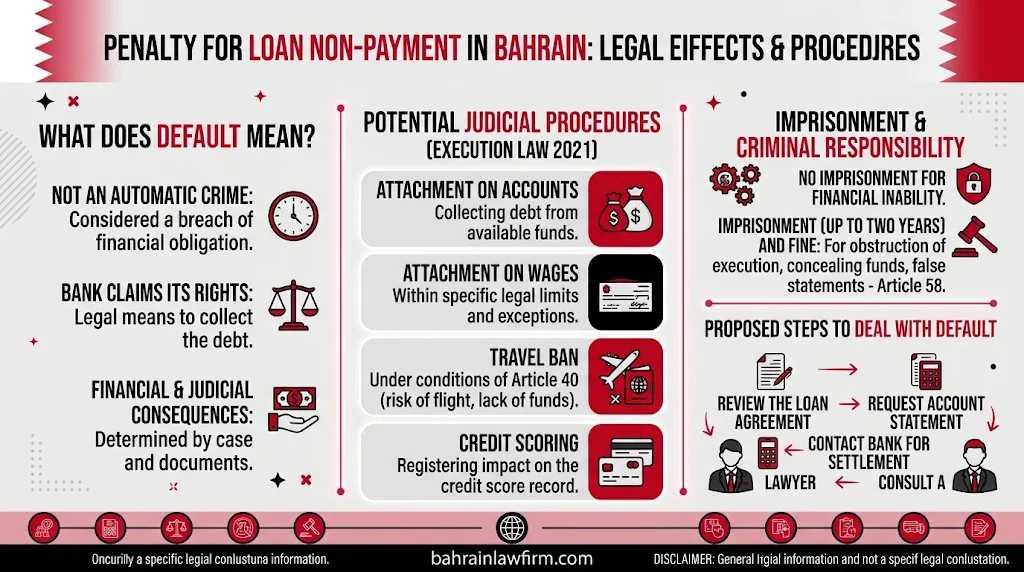
Failing to repay a bank loan is generally considered a breach of a financial obligation, not a separate criminal offense simply because a payment is late. Bahraini law gives banks legal ways to recover unpaid debts while setting clear rules for the measures they can take against borrowers.
The Law of Execution in Civil and Commercial Matters, issued under Decree-Law No. 22 of 2021, regulates the procedures that may be taken when a valid enforceable instrument is available.
The possible consequences depend on the loan agreement, supporting documents, and any ongoing legal proceedings. They may include:
- Demanding overdue installments or other amounts due under the loan agreement.
- Taking enforcement action against assets that can legally be seized.
- Requesting a travel ban when the legal requirements are met.
- Affecting the borrower’s credit record under the applicable rules.
Missing loan payments alone does not result in a criminal penalty. Criminal liability only arises when a person commits an act that the law defines as a criminal offense and the required legal conditions are satisfied.
Can You Go to Jail for Not Repaying a Bank Loan in Bahrain?
Bahrain’s Execution Law does not impose imprisonment simply because a borrower cannot repay a debt. However, it does make certain deliberate acts that obstruct enforcement criminal offenses. These include hiding assets to prevent debt recovery or giving false information to the court.
Under Article 58 of the Execution Law, the Penalty for Non-Payment of a Loan may include imprisonment for up to two years, a fine ranging from BHD 500 to BHD 100,000, or either penalty, if one of the specific offenses listed in that article is proven. These penalties do not apply simply because someone loses their job or cannot afford their loan installments.
It is important to distinguish between a borrower facing genuine financial difficulties and someone who deliberately breaks the law during enforcement proceedings.
What Does a Bank Do When a Borrower Stops Paying Loan Installments?
Banks usually start by contacting the borrower about overdue payments and reviewing the loan account. If the missed payments continue and both parties cannot reach an agreement, the bank may decide to take legal action.
The exact steps depend on the loan agreement, any guarantees or security provided, and whether the bank already has an enforceable instrument.
- Requesting payment: The bank contacts the borrower to discuss overdue installments and request payment.
- Reviewing financial obligations: The bank calculates the outstanding amounts and determines its rights under the loan agreement.
- Exploring a settlement: Both parties may discuss rescheduling installments or agreeing on another repayment arrangement.
- Taking legal action: The bank may file a court claim or begin enforcement proceedings if the legal conditions are met.
Can a Bank Demand Repayment of the Entire Loan?
A loan agreement may allow the bank to demand the remaining balance if the borrower breaches certain terms, including missing scheduled payments. However, the entire loan does not automatically become payable in every case. The acceleration clause and the conditions for applying it must first be reviewed.
Checking the loan agreement and bank statements helps establish the correct outstanding balance. This is especially important if the borrower has already paid some installments or disputes certain fees.
What Legal Proceedings Can Follow a Loan Default?
Bahrain’s Execution Law sets out the procedures available to recover debts supported by an enforceable instrument. Not every measure applies to every case. The available options depend on the type of debt, the borrower’s assets, and the legal conditions that must be satisfied.
| Legal Measure | When Is It Used? | Possible Consequence |
|---|---|---|
| Bank Account Attachment | When an enforceable instrument exists and the legal requirements for attachment are met | Recovering the debt from funds that may legally be seized |
| Salary Attachment | Subject to legal limits and exemptions | Deducting the portion of salary that the law allows to be attached |
| Travel Ban | When the requirements of Article 40 are satisfied | Restricting travel through a court order |
| Credit Record Entry | When the borrower’s assets are insufficient under Article 42 | Recording an entry that may affect the borrower’s credit history |
When Can a Travel Ban Be Issued Because of an Unpaid Loan?
Article 40 of the Execution Law allows an Execution Court judge to issue a travel ban at the creditor’s request if there is reason to believe the debtor may leave the country to avoid enforcement and their known assets are not enough to repay the debt.
The debtor may challenge the order within seven days of receiving notice or becoming aware of it, in accordance with the same article.
Legislative Update: Law No. 31 of 2026 introduced amendments to the rules on travel bans and certain provisions concerning criminal liability during enforcement. The law was published on June 18, 2026, and is scheduled to take effect six months after publication. Therefore, these amendments should not be treated as effective on November 11, 2026.
Can a Bank Seize Your Salary or Property?
Bahrain’s Execution Law allows certain funds, salaries, and real estate to be seized to recover debts. However, it also protects specific assets and amounts to help debtors meet their basic living needs.
Article 15 identifies the assets that cannot be seized and sets limits on the attachment of wages and salaries. Having an unpaid loan does not mean the bank can take your entire salary or seize everything you own.
Have you received a court claim or are you worried that your assets may be seized because of an unpaid loan?
You can also continue reading to learn more about your rights and available options.
What Rights Do Borrowers Have When a Bank Demands Repayment?
Borrowers have the right to review the amounts claimed by the bank and check whether those amounts are supported by the loan agreement. They can also use the legal procedures available to challenge improper actions or file objections when the law allows.
Taking the following steps can help protect their legal position:
- Request a detailed statement showing the original loan amount, installments already paid, and remaining balance.
- Review the fees, interest, and late-payment terms stated in the loan agreement.
- Keep payment receipts and all correspondence with the bank.
- Check court notices and pay attention to objection deadlines.
Article 37 of the Execution Law allows certain attachment measures to be challenged on specific grounds. These include seizing property that does not belong to the debtor or exceeding the legal limits on attachment.
Such disputes may arise during debt recovery and judgment enforcement proceedings in Bahrain. The available procedures depend on the circumstances and legal status of each case.
How Can You Handle an Unpaid Loan Before It Reaches Court?
Contacting your bank early can help explain why you have fallen behind and open the door to possible solutions. Asking for a settlement does not guarantee that the bank will accept your proposal. Still, it gives both sides an opportunity to discuss repayment before the dispute becomes more serious.
- Review your loan agreement: Check payment deadlines, guarantees, and the terms that apply if you miss an installment.
- Calculate what you owe: Compare the bank’s account statement with your payment receipts.
- Explain your circumstances: Provide documents showing reduced income or job loss if they are relevant to your request.
- Ask for a written solution: Discuss a new repayment schedule or settlement based on what you can realistically afford.
- Keep a record of the agreement: Make sure you have a clear copy stating the amount, payment dates, and how the agreement affects any existing claims.
If enforcement proceedings have already started, do not assume that negotiations alone will stop them. Article 26 of the Execution Law provides for ending enforcement proceedings when the debt has been fully paid or when a settlement agreement between the parties is submitted.
When Should You Consult a Lawyer About a Bank Loan in Bahrain?
Getting legal advice becomes especially important when a loan problem goes beyond a routine payment demand. This is particularly true if you disagree with the amount claimed or if court proceedings have already started.
A lawyer can review your loan agreement and supporting documents, identify possible objections, and explain the deadlines for raising them. They can also assess whether negotiating with the bank may be a practical alternative to continuing the dispute.
Disputes about whether a financial claim is valid or how much is actually owed involve different legal questions from enforcement proceedings. Enforcement generally begins once the required enforceable instrument is available.
For this reason, it is important to distinguish between filing a financial claim before the Bahraini courts and the later procedures used to recover the debt.
FAQ About Non-Payment of a Loan in Bahrain
What Happens If I Miss One Loan Payment?
The bank may contact you to request the overdue installment, and additional consequences may apply under the terms of your loan agreement. However, missing a single payment does not automatically lead to a court judgment or a travel ban. Review your loan agreement and contact the bank to confirm the outstanding amount and discuss how to resolve the missed payment.
Can a Borrower Be Banned From Traveling Due to an Unpaid Loan?
Yes, a court may issue a travel ban if the conditions set out in Bahrain's Execution Law are met. These include concerns that the debtor may leave the country to avoid enforcement and that their known assets are insufficient to cover the debt. A travel ban is not automatically imposed simply because a loan installment is overdue. The Ministry of Justice also provides an online service to check whether any travel ban orders have been issued.
Does Failing to Repay a Loan Affect Your Credit Record?
Missing loan payments may affect your credit record under the applicable banking reporting rules. Article 42 of the Execution Law also provides for an entry in the debtor's credit record when their assets are insufficient to repay a debt covered by an enforceable instrument. This court-related measure is different from the reporting of missed payments to credit reporting agencies.
Can You Arrange an Installment Plan With the Bank for Overdue Loan Payments?
You can ask the bank to reschedule your loan payments or negotiate a settlement. However, approval depends on the bank's agreement and the applicable terms. Make sure any new arrangement is documented in writing, including the installment amounts and payment dates. If legal proceedings are already underway, the agreement should also explain how those proceedings will be handled.
The Penalty for Non-Payment of a Loan in Bahrain and its legal consequences depend on the borrower’s actions and the procedures involved. Being unable to repay a loan is not the same as deliberately committing a criminal offense to obstruct enforcement.
Before taking any action, review your loan agreement and outstanding balance carefully. Seek legal advice if you receive a court claim or become involved in a dispute with your bank.
Legal Disclaimer: This article provides general legal information based on Bahraini legislation. It does not constitute legal advice for any specific case, and reading it does not create a lawyer-client relationship. Legal procedures and outcomes may vary depending on the loan agreement, the circumstances of the case, and the laws in force when the relevant action is taken.
Official Legal Sources

A Bahraini lawyer and the founder of a legal consultancy firm established in February 2019. He holds a Higher Degree in Sharia and Law from Al-Azhar University. He has extensive experience in court representation and providing legal advice in criminal, personal status, civil, and commercial matters. He is known for delivering clear, practical, and effective legal advice aimed at protecting his clients’ rights and interests, and has achieved tangible results in notable cases, including commercial litigation and inheritance matters
