
Theft harms its victim in money and in peace of mind. A person who is robbed often feels fear and frustration. Bahrain protects people and their property with firm penalties.
This guide explains the theft penalty in Bahrain under the Penal Code, from simple theft to theft with force. Our team at Bahrain Law Firm explains the legal framework in simple terms.
Accused in a theft case that threatens your freedom, or robbed and looking to recover your rights? Do not leave your future to chance. Our criminal defense team acts fast to protect you.
Table of Content
How Does Bahraini Law Define Theft?
Article 373 of the Penal Code (Decree-Law No. 15 of 1976) defines theft as taking movable property that belongs to another person, with the intent to own it. The crime needs three things: the act of taking, property owned by someone else, and the intent to own it.
What Is the Theft Penalty in Bahrain?
The penalty depends on how the theft was committed. Simple theft is punished by imprisonment for up to two years (Article 381). The theft penalty in Bahrain rises when there are aggravating circumstances such as night, weapons, force or a group.
The court may replace the prison term with a fine of up to BD 10 only if the stolen items are crops that were not yet removed from the ground. An attempt at a misdemeanor theft is punished with half the penalty of the completed crime (Article 382).
Anyone who takes part in a theft also answers for other crimes that happen as a likely result of their part, even if they did not plan them (Article 383).
Penalties for Aggravated Theft
Article 380 punishes theft with imprisonment of at least three months in several cases. These include theft in a place of worship or a home, in a means of transport, a station, a port or an airport, at night, by climbing or breaking in, or by a person who carries a weapon. The article also covers theft by two or more people, by an employee from the place where they work, and theft of livestock or riding animals.
Since 2025, it also covers theft of mobile phones, laptops, tablets and other electronic devices. If such a device is stolen to get the information, data or photos on it, the minimum penalty is imprisonment of at least one year (Law No. 3 of 2025).
If more than one of these circumstances is present, the penalty is doubled at its limits. Theft of property owned by a government body or public institution is also an aggravating circumstance. Where a public employee takes money entrusted to them, other offences such as embezzlement may apply instead.
Theft With Force or Weapons (Articles 374 to 378)
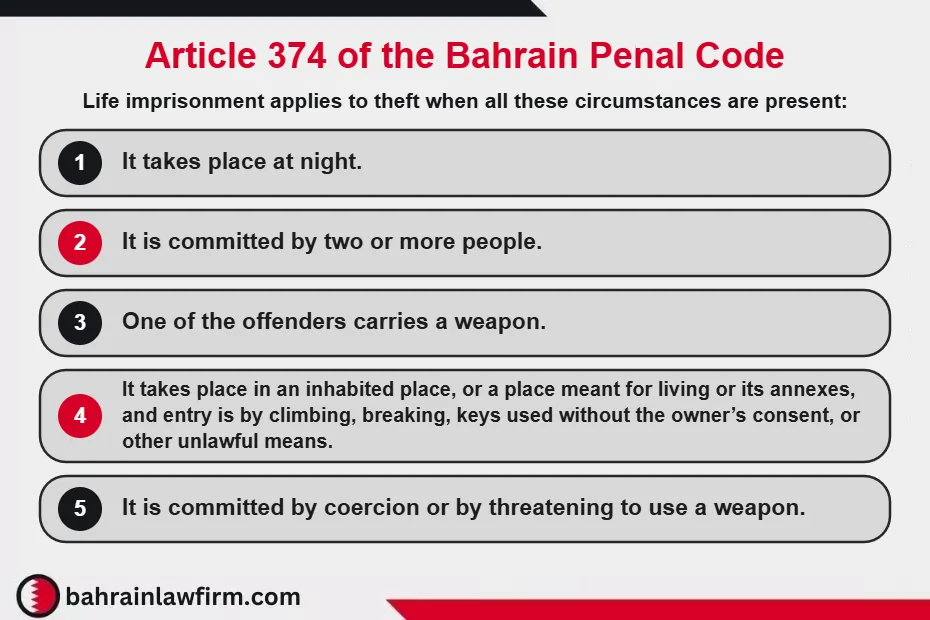
Article 374 punishes theft with life imprisonment when five circumstances come together. They are night, two or more offenders, an armed offender, an inhabited place entered by unlawful means, and force or a threat with a weapon. The graphic below shows them.
Article 376 punishes theft by force, or by a threat to use a weapon, with imprisonment. This applies whether the aim was to take the property, keep it or escape with it. The penalty is life or temporary imprisonment if the force causes injuries, and death or life imprisonment if it leads to a person’s death.
Article 375 applies to theft on a public road or in land, sea or air transport. It carries life or temporary imprisonment when two or more people commit it and one is armed or force is used, or when an armed person commits it at night or by force. Article 377 punishes with imprisonment a night theft by two or more people when one is armed, and the same applies to an armed person who steals alone at night in an inhabited place.
Theft of army weapons or ammunition is also punished with imprisonment under Article 378, and with life imprisonment if force or a threat with a weapon is used.
Related Offences
Inciting a person under 18 to steal is punished by imprisonment of up to two years, even if the theft does not happen (Article 384). Using a car, a motorbike or another movable machine without the owner’s permission is punished by up to one year in prison and a fine of up to BD 100, or one of them (Article 385).
What to Do If You Are Robbed or Accused of Theft
If you were robbed, report it to the nearest police station and bring proof of ownership of the stolen items. The police receive security reports and complaints. Keep photos, receipts and any camera footage.
If you are accused, do not sign any statement before you speak to a lawyer. A criminal lawyer can study the file, challenge the evidence and argue for the lightest legal description of the act.
Frequently Asked Questions About Theft in Bahrain
When does theft become a felony in Bahrain?
Theft becomes a felony when it is committed with force, a threat with a weapon, or other serious circumstances set out in Articles 374 to 378. The court looks at how the theft was carried out, who took part and where it happened.
What is the punishment for stealing in Bahrain?
Simple theft is punished by imprisonment for up to two years (Article 381). Aggravated theft carries at least three months of imprisonment (Article 380), and theft with force or weapons can carry life imprisonment (Article 374).
Is attempted theft punishable in Bahrain?
Yes. An attempt at a misdemeanor theft is punished with half the penalty of the completed crime (Article 382). A person who takes part in a theft also answers for crimes that are a likely result of their part (Article 383).
In conclusion, the theft penalty in Bahrain reflects the state’s care to protect individuals and society. It ranges from imprisonment of up to two years for simple theft to life imprisonment for the most serious cases.
This guide explained the main penalties. For more help, speak to an experienced criminal lawyer in Bahrain.

A Bahraini lawyer and the founder of a legal consultancy firm established in February 2019. He holds a Higher Degree in Sharia and Law from Al-Azhar University. He has extensive experience in court representation and providing legal advice in criminal, personal status, civil, and commercial matters. He is known for delivering clear, practical, and effective legal advice aimed at protecting his clients’ rights and interests, and has achieved tangible results in notable cases, including commercial litigation and inheritance matters
