

Legal Review: This content has been prepared and reviewed by the legal team at Abdulrahman Khalifa Law Firm.
Last Updated: 31 August 2026.
Category: Bahrain Corporate Law.
Establishing a Real Estate Company in Bahrain is a key investment step within a regulated market built on transparency, ownership protection, and accurate real estate documentation. The sector operates within a legal framework covering registration, surveying, valuation, ownership transfer, licensing, and government services.
A successful real estate company requires more than selecting a trade name; it involves choosing the appropriate activity, preparing a properly drafted Memorandum of Association (MOA), and obtaining the required licences. This guide explains the main requirements, incorporation procedures, MOA provisions, costs, and the importance of legal support before starting operations.
Are you planning to invest in Bahrain’s profitable real estate market but concerned about Real Estate Regulatory Authority (RERA) licensing requirements and capital conditions?
Book a Consultation for Establishing Your Real Estate EntityYou may first review the article to understand real estate regulations and permitted activities.
Table of Content
What Does Establishing a Real Estate Company in Bahrain Mean?
for real estate purposes means creating an independent legal entity to conduct real estate-related activities, such as purchasing properties, selling them, managing them, developing them, marketing them, or arranging real estate transactions, in accordance with the laws and requirements applicable in the Kingdom of Bahrain.
The incorporation process is not limited to obtaining official documents. It also includes accurately defining the business activity, selecting the appropriate legal structure, organising the relationship between shareholders, determining management powers, and connecting the company with the technical and regulatory procedures applicable to the real estate sector.
Difference Between a Real Estate Company and a Real Estate Brokerage Company
A real estate company is a broad concept that may include property development, land acquisition, project construction, property management, or investment in real estate assets.
A real estate brokerage company, on the other hand, mainly focuses on facilitating transactions between sellers and buyers or landlords and tenants in exchange for an agreed commission or fee.
This distinction directly affects the type of licence required, the contracts used, legal responsibilities, and the nature of dealings with clients and government authorities.
See also:
Requirements for Establishing a Real Estate Company in Bahrain
The requirements for establishing a real estate company vary depending on the type of activity, project size, and nature of shareholders. However, there are several essential requirements that should be considered before starting the process.
1. Shareholder Requirements
Shareholders must have the required legal capacity to establish the company and conduct commercial activities. If foreign shareholders are involved, attention must be given to the regulations related to foreign ownership of real estate in Bahrain, particularly the legally designated ownership areas.
The shareholders’ ownership interests must also be clearly stated in the MOA, together with identifying who has authority to manage, sign, and represent the company before government authorities, banks, and clients.
2. Business Activity Requirements
The real estate activity must be accurately specified in the Commercial Registration (CR) and the MOA. Selecting a general or unclear activity may delay licensing procedures or result in difficulties with future transactions.
It is important to distinguish between activities such as:
- Real estate brokerage.
- Real estate development.
- Property management.
- Real estate valuation.
- Real estate surveying.
- Topographic surveying.
- Marine surveying.
- Purchasing real estate maps and requesting surveying information.
Each activity may require different licensing conditions, professional qualifications, technical standards, or supporting documents.
3. Commercial Registration Requirements
The official existence of the company begins through registration with the competent authority. As part of the process of Establishing a Real Estate Company in Bahrain, the Commercial Registration (CR) must include the correct real estate activity without combining unrelated activities, as this will later affect licensing procedures and transactions with the Survey and Land Registration Bureau (SLRB) and the Real Estate Regulatory Authority (RERA).
The company should also have a clear and suitable business address that matches the nature of the activity, especially if it will provide services requiring direct interaction with clients or technical authorities.
4. Real Estate Licence Requirements
The company should not commence real estate activities before obtaining the appropriate licence. Obtaining a Commercial Registration does not necessarily mean that the company is authorised to carry out all real estate activities without additional approvals.
Therefore, during the process of Establishing a Real Estate Company in Bahrain, the company must verify RERA requirements, comply with applicable technical standards such as BPMS where required, and use approved government channels for inspection, registration, and documentation.
Real Estate Company Formation Procedures in Bahrain
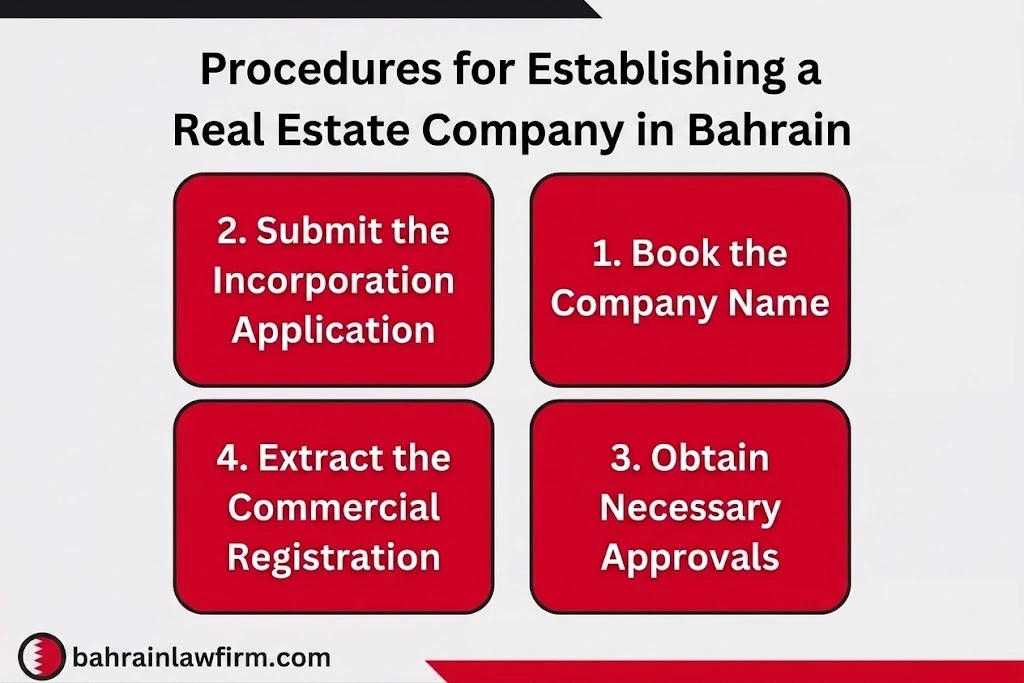
The process of Establishing a Real Estate Company in Bahrain involves several connected steps. Completing each step correctly reduces the possibility of rejection or delays in the following stages.
1. Define the Real Estate Activity
The first step is to accurately determine the activity the company will conduct. Will it operate as a brokerage company, development company, property management company, valuation company, or provide surveying services?
This step affects all subsequent matters, including the legal structure, MOA, required licences, fees, operational contracts, and even the method of marketing services to clients.
2. Choose the Appropriate Legal Structure
After determining the activity, the company must select the legal structure suitable for the investment size, number of shareholders, and nature of risks. A With Limited Liability company (W.L.L.) is a common option for many real estate activities because it helps separate the company’s financial liability from the shareholders’ personal liability within the limits established by law.
Larger real estate projects, particularly those requiring significant financing or broader investment partnerships, may require a different legal structure, such as a joint stock company, depending on the nature and requirements of the project.
3. Preparing the MOA
The Memorandum of Association (MOA) is the document that regulates the company’s structure and operations from the beginning. It should not be treated as a general template only; rather, it should accurately reflect the nature of the real estate activity.
The MOA should include:
- The company name.
- The company registered office.
- The company duration.
- The specific real estate purpose of the company.
- The share capital and shareholders’ interests.
- The powers of the manager or board of directors.
- The decision-making mechanism.
- The method of distributing profits and losses.
- The limits of dealing with real estate assets.
- The mechanism for withdrawal or transfer of shares.
- The dispute resolution method.
- The authorised person responsible for dealing with government authorities and electronic services.
For real estate companies, it is important to include provisions relating to asset valuation, handling ownership documents, compliance with technical standards in surveying or sales activities, and reviewing operational contracts.
4. Notarising the MOA
After preparing the MOA, it must be notarised according to the approved legal procedures so that it becomes an official document that can be relied upon before government authorities, banks, shareholders, and clients.
As part of the process of Establishing a Real Estate Company in Bahrain, reviewing the MOA before notarisation helps reduce future disputes, particularly in companies with multiple shareholders or those dealing with high-value real estate assets.
5. Registration in the Commercial Registration (CR)
After completing the required documentation, the company proceeds with registration in the Commercial Registration system. The real estate activities must be accurately recorded, as any error in describing the activity may later lead to licence rejection or delays in transactions.
6. Obtaining the Appropriate Real Estate Licence
The licensing stage follows CR registration. During this stage, the company must verify the requirements of the Real Estate Regulatory Authority (RERA) or other competent authorities depending on the nature of the activity.
The company should not commence operations or promote real estate services before confirming that all required licences have been obtained.
7. Activating Government Electronic Services
After Establishing a Real Estate Company in Bahrain, digital government services can be used to facilitate daily operations. These include:
- The “Watha’iq” service for submitting real estate registration and ownership transfer applications and tracking requests.
- The “T’akkad” service for verifying that a property is free from restrictions preventing disposal, such as mortgages or seizures.
- The fees calculator service for estimating transaction-related fees.
- Real estate map purchase services and requests for surveying information.
- Requesting surveying quotations when surveying services are required.
Using these services reduces risks and helps the company make decisions based on official data before completing any transaction.
Real Estate Company MOA Template
Below is a general template for a Establishing a Real Estate Company in Bahrain:
First Party: Mr. __________, nationality __________, date of birth ___ / ___ / _____, personal address __________, National ID __________, residence __________, and the number of shares owned in the company: __________.
Second Party: Mr. __________, nationality __________, date of birth ___ / ___ / _____, personal address __________, National ID __________, residence __________, and the number of shares owned in the company: __________.
- Company Name: __________ and trade name: __________.
- Registered Office: The company’s registered office shall be located at __________, and it shall have the right to establish branches inside and outside Bahrain.
- Share Capital: The company’s share capital consists of an amount of __________ Bahraini Dinars, divided into __________ shares, of which __________ has been contributed equally by the two shareholders and deposited with the bank in accordance with applicable procedures.
- Company Management: The management of the company shall be undertaken by the shareholder __________, who shall represent the company in its dealings with third parties and before courts. The other shareholder shall have the right to review management decisions and object where applicable.
- Financial Year: The company’s first financial year shall commence from the date of registration and continue until the end of the Gregorian calendar year. Subsequent financial years shall consist of twelve Gregorian months.
- Distribution of Profits and Losses: Profits and losses shall be distributed among shareholders according to their ownership percentages in the company.
- As both shareholders have contributed the capital equally at 50%, the distribution ratio shall also be 50% for each shareholder.
First Shareholder Signature: __________
Second Shareholder Signature: __________
It should be noted that this template is a general example and should not be adopted without review by an experienced and specialised lawyer in Bahrain.
Essential Clauses in a Real Estate Company MOA
The MOA should contain clear provisions covering both commercial and real estate aspects. The most important clauses include:
1. Company Purpose
The company purpose must be clearly defined, such as real estate brokerage, property management, development, or surveying services, without general wording that may create licensing difficulties.
2. Shareholders’ Interests and Capital
The MOA should specify each shareholder’s interest, the method of capital contribution, and whether there are any in-kind contributions such as land, property, or assets related to the project.
3. Manager’s Powers
In real estate companies, it is important to determine whether the manager has authority to sell properties, mortgage them, sign brokerage agreements, open bank accounts, or represent the company before the Survey and Land Registration Bureau (SLRB) and RERA.
4. Disposal of Real Estate Assets
The MOA should clearly specify the circumstances in which a real estate asset may be sold, mortgaged, or transferred, and whether such actions require approval from all shareholders or a specified majority.
5. Exit and Transfer of Shares
One of the most common causes of shareholder disputes is the absence of a clear exit mechanism. Therefore, the MOA should regulate pre-emption rights, valuation of shares, transfer procedures, and handling of inheritance matters upon the death of a shareholder.
6. Dispute Resolution
The shareholders may determine the method of resolving disputes, whether through competent courts or arbitration, according to their agreement and applicable legal rules.
7. Compliance with Technical Standards
If the company conducts activities related to surveying, valuation, or real estate data, the MOA should include compliance with national standards such as BPMS, the General Survey Manual, or valuation guidelines according to the nature of the activity.
Establishing a Real Estate W.L.L.
A With Limited Liability company (W.L.L.) is one of the common legal structures used in real estate activities, especially where multiple shareholders wish to organise liability and management clearly.
Why Do Many Investors Prefer a W.L.L.?
A W.L.L. helps regulate the relationship between shareholders and separates company obligations from personal obligations within the limits established by law. It also provides flexibility in management and ownership distribution, making it suitable for many small and medium-sized real estate projects.
What Should Be Regulated in Its MOA?
In a real estate W.L.L., the manager’s powers should be precisely defined, particularly regarding the following matters:
- Purchasing properties in the company’s name.
- Selling real estate assets.
- Mortgaging properties.
- Signing development or property management agreements.
- Appointing brokers or agents.
- Opening bank accounts.
- Representing the company before government authorities.
Failure to clarify these matters may create disputes between shareholders or hinder the completion of transactions.
When Is a W.L.L. Not Sufficient?
A W.L.L. may not be the most suitable structure for large-scale real estate projects requiring significant financing or the participation of a large number of investors. In such cases, another legal structure, such as a joint stock company, may be considered depending on the nature and requirements of the project.
Cost of Establishing a Real Estate Company in Bahrain
There is no single fixed cost for Establishing a Real Estate Company in Bahrain, as the total cost varies depending on the type of activity, legal structure, licences required, number of shareholders, nature of real estate transactions, and the technical services required.
Why Is It Difficult to Determine a Fixed Amount?
The cost of establishing a real estate brokerage company differs from the cost of establishing a real estate development company. Likewise, the cost of a company providing surveying services differs from a property management company.
The total cost may include fees related to the Commercial Registration (CR), real estate licences, MOA preparation and notarisation, surveying services, maps, certificates, or real estate registration and ownership transfer procedures.
Main Cost Elements
Potential cost elements include:
| Cost Type | Description |
|---|---|
| Commercial Registration Fees | Fees related to establishing and officially registering the company. |
| Real Estate Licensing Fees | Vary depending on the activity and the requirements of the regulatory authority. |
| MOA Preparation and Notarisation Fees | Related to preparing and officially documenting legal documents. |
| Real Estate Registration Fees | May apply when transferring ownership or registering documents. |
| Surveying Service Fees | Such as requesting surveying quotations or obtaining survey certificates. |
| Maps and Data Fees | Such as purchasing real estate maps or requesting surveying information. |
| Legal Fees | When engaging a lawyer to prepare documents and complete legal procedures. |
How Can a Lawyer Assist with Establishing a Real Estate Company?
Hiring a lawyer specialised in corporate and real estate matters is not limited to preparing documents. It involves creating a legal structure that protects the investment from the beginning.
- Selecting the Appropriate Legal Structure:
A lawyer helps determine whether a W.L.L. is suitable or whether the project requires another legal structure. This assessment considers the number of shareholders, investment size, business activity, and future expansion plans. - Preparing a Strong MOA:
A lawyer prepares an MOA that addresses the specific details of the real estate activity rather than relying on general provisions. This includes management powers, property transactions, valuation, exit arrangements, dispute resolution, and compliance with technical and regulatory requirements. - Reviewing Real Estate Documents:
Before contributing a property as an in-kind share or purchasing an asset in the company’s name, a lawyer reviews ownership documents, restrictions, property status, fees, and the possibility of registration or transfer. - Completing Licensing Procedures:
A lawyer assists in preparing applications, supporting documents, and communicating with competent authorities, reducing the possibility of rejection due to incomplete information or unclear activities. - Protecting the Company After Incorporation:
The lawyer’s role does not end after issuing the Commercial Registration. A real estate company requires sale agreements, brokerage contracts, property management agreements, leases, development agreements, and shareholder arrangements, all of which require careful legal review to reduce risks.
When Do You Need a Lawyer Before Establishing a Real Estate Company?
You may particularly need legal assistance in the following situations:
- When there is more than one shareholder.
- When there is a foreign investor.
- When establishing a brokerage or real estate development company.
- When contributing a property as part of the company’s capital.
- When using a ready-made MOA template.
- When special licences are required.
- When intending to purchase or sell properties in the company’s name.
- When there are plans for future expansion or introducing new investors.
The higher the value of the assets or the more complex the activity, the greater the importance of obtaining legal review before incorporation.
Frequently Asked Questions About Establishing a Real Estate Company in Bahrain
The most common questions include:
Can Foreigners Establish a Real Estate Company in Bahrain?
Foreign investors may engage in real estate activities subject to the applicable legal requirements. They must comply with regulations concerning foreign ownership areas and the permitted activities.
Is a Commercial Registration Sufficient to Conduct Real Estate Activities?
A Commercial Registration (CR) is not sufficient in all cases. Certain real estate activities require additional licences or operational approvals from the competent authorities, particularly the Real Estate Regulatory Authority (RERA).
What Is the Most Important Step Before Establishing a Real Estate Company?
The most important step is accurately defining the real estate activity, as the activity affects the legal structure, MOA, required licences, fees, and necessary contracts.
Does a Real Estate Brokerage Company Need Specific Client Agreements?
Yes. A real estate brokerage company should use clear agreements that define the scope of work, commission, authorisation period, obligations of the parties, and the method of calculating and claiming fees.
Is There a Fixed Cost for Establishing a Real Estate Company in Bahrain?
There is no fixed cost, as fees vary depending on the activity, licences, surveying services, notarisation requirements, and registration or ownership transfer procedures. A fees calculator may be used to estimate certain transaction-related fees.
Why Should the T’akkad Service Be Used?
The T’akkad service helps verify that a property is free from restrictions preventing disposal, such as mortgages or seizures. This reduces risks before purchasing, marketing, or completing a transaction.
Should BPMS Be Included in the MOA?
If the company conducts activities related to surveying, measurement, or the sale of real estate units, it is important to include compliance with the national Building and Property Measurement Standards (BPMS) to reduce technical disputes and ensure data accuracy.
This concludes our guide on Establishing a Real Estate Company in Bahrain, where we explained the key procedures for forming real estate companies, their legal structures, essential MOA provisions, licensing requirements, and the importance of proper legal planning before starting operations.
For further details and assistance with establishing your real estate company in Bahrain, you may contact a specialised corporate lawyer who can provide tailored legal guidance based on your business structure and objectives.
You may also be interested in: Company Formation in Bahrain.

A Bahraini lawyer and the founder of a legal consultancy firm established in February 2019. He holds a Higher Degree in Sharia and Law from Al-Azhar University. He has extensive experience in court representation and providing legal advice in criminal, personal status, civil, and commercial matters. He is known for delivering clear, practical, and effective legal advice aimed at protecting his clients’ rights and interests, and has achieved tangible results in notable cases, including commercial litigation and inheritance matters
