

The project started on a strong footing. The founders secured funding and signed an important commercial agreement. However, when it was time to move forward, they discovered that the company’s constitutional documents did not clearly state who had the authority to sign on its behalf. The bank refused to carry out certain instructions, one of the partners challenged the agreement, and the entire project came to a halt despite the strength of the business idea.
The problem was not the market or the product. It arose because the legal framework had not been drafted carefully before key decisions were made.
This is why the role of a Corporate Lawyer in Bahrain is not limited to filing lawsuits after a dispute has already arisen. The real value of legal support starts much earlier—by organising the relationship between partners, reviewing contracts, defining authority, and identifying risks that may not be obvious at the beginning.
Do you own a company and want to put its legal affairs in order? Organise your company’s legal position early by contacting Abdulrahman Khalifa Law Office.
Contact a corporate lawyer who can assist with your case now
Table of Content
What Does a Corporate Lawyer in Bahrain Do?
A Corporate Lawyer in Bahrain works as part of the company’s decision-making process rather than being someone who is called only when a crisis occurs. Bringing a Corporate Lawyer in Bahrain in early helps connect commercial decisions with the legal rules governing the company, its activities, its partners, and the parties it deals with.
1. Preventing Legal Problems Before a Decision Is Made
The lawyer reviews contracts before they are signed, identifies unclear obligations, and checks whether penalties, termination clauses, and guarantees are balanced. The Corporate Lawyer in Bahrain also considers how a proposed decision may affect partners, creditors, management, and government authorities.
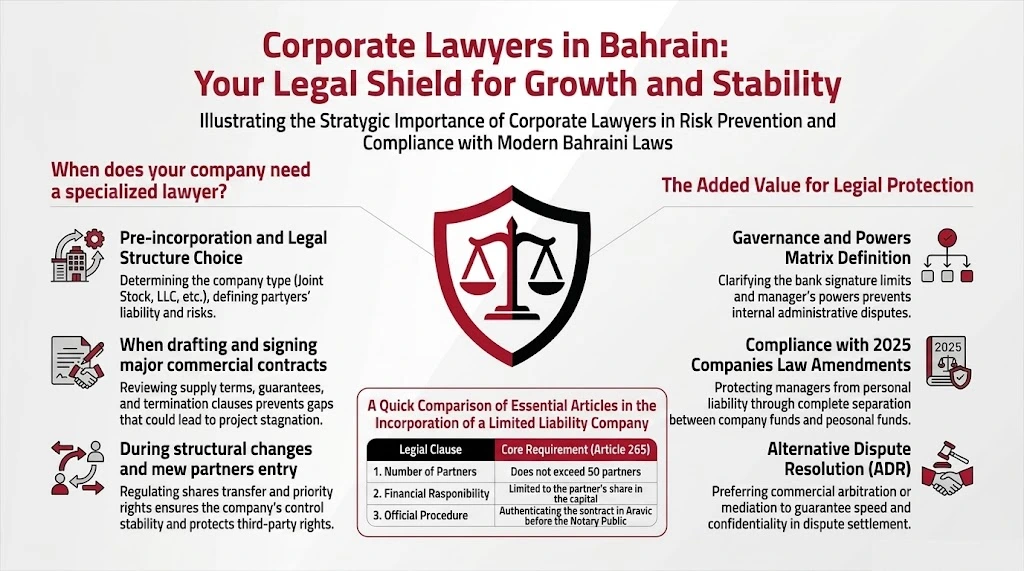
A lawyer also helps founders choose the most suitable legal form for their business. Article (2) of the Commercial Companies Law identifies the legal forms under which a company may be established, including a General Partnership, Limited Partnership, Joint Stock Company, Partnership Limited by Shares, Limited Liability Company, Single Person Company, and Holding Company.
The 2025 amendment removed the Joint Venture Company as one of the company forms listed under this Article and repealed the chapter that previously regulated it.
The decision does not depend on the number of partners alone. The Corporate Lawyer in Bahrain also considers the nature of the business, the level of risk, the financing structure, the limits of partners’ liability, and any plans for investors to enter or exit the company.
2. Representing the Company in Transactions and Disputes
The Corporate Lawyer in Bahrain negotiates commercial contracts, reviews exchanged drafts, and documents the amendments agreed between the parties. The lawyer also confirms that anyone signing on behalf of the company has clear and properly documented legal authority to do so.
When a disagreement arises, the Corporate Lawyer in Bahrain reviews the documents, correspondence, and meeting minutes before deciding on the most appropriate course of action. Direct negotiations may sometimes be more useful than court proceedings, while certain contracts may require the dispute to be referred to arbitration instead of litigation.
3. Ongoing Legal Adviser
The legal adviser monitors the company’s obligations throughout its operations and reviews important decisions before they are formally approved. The lawyer may also attend partners’ meetings or board meetings, draft minutes, and make sure that objections and resolutions are recorded accurately.
This role becomes particularly important in limited liability companies. The law requires an LLC to have a General Assembly consisting of all partners, which must meet at least once every year within the four months following the end of the financial year, while complying with the applicable rules on notice and voting.
When Does Your Company Need a Specialist Lawyer?
A company does not need to wait until it receives a legal notice or becomes the subject of a lawsuit. Legal support becomes particularly important at certain stages where a decision could have a long-term effect on the company’s ownership, management, or obligations.
1. Before Establishing the Company
Consult a lawyer before selecting the legal form of the company or distributing ownership interests. At this stage, the lawyer reviews the proposed activity, ownership structure, management authority, financing method, and whether the business requires specific approvals or licences.
The Corporate Lawyer in Bahrain also checks that the Memorandum of Association complies with the legal requirements. Article (6) requires the company’s Memorandum of Association and any amendments to be prepared in Arabic and notarised before a Notary Public. Otherwise, the memorandum or amendment may be void in accordance with the conditions set out in the Article.
2. Before a Partner Joins or Leaves the Company
A transfer of ownership interests can affect control of the company and the rights of the remaining partners. The lawyer therefore reviews the terms of sale, rights of first refusal or redemption, the method used to value the interest, and any continuing obligations following the partner’s exit.
In a limited liability company, the law regulates the sale of ownership interests and requires the remaining partners to be informed of the offer and its terms. A transfer also does not become effective against the partners or third parties until the required registration and publication procedures have been completed.
3. Before Signing Important Contracts
Request a legal review before signing a long-term supply contract, agency agreement, technology services agreement, financing arrangement, or significant commercial lease.
The lawyer focuses on the scope of work, delivery dates, payment arrangements, limitations of liability, guarantees, force majeure, termination rights, governing law, and the method used to resolve disputes.
4. When Changing Management or Share Capital
Decisions involving the appointment or removal of a manager, changes to signing authority, or an increase or reduction in capital require a review of the company’s constitutional documents, previous resolutions, and the legal requirements governing the amendment.
A verbal agreement between partners is not enough. The decision must be properly documented, drafted, and registered whenever the law requires it so that it can be relied upon before banks, government authorities, and third parties.
5. When a Dispute Arises
Seek the assistance of a lawyer in Bahrain as soon as serious warning signs appear. These may include a partner failing to meet an obligation, objecting to a management decision, a client refusing to pay, or a supplier claiming that the company has breached a contract.
Early legal involvement helps preserve evidence and prevents the company from sending messages or making admissions that could weaken its position later.
6. During Restructuring or Liquidation
A restructuring requires a review of contracts, debts, guarantees, employees, and assets. Liquidation, on the other hand, involves much more than simply closing the commercial registration. It includes appointing a liquidator, identifying rights and obligations, settling debts, and distributing any remaining assets in accordance with the law.
The Commercial Companies Law identifies several grounds for dissolving a company. These include the expiry of its term, completion of the purpose for which it was established, loss of a substantial part of its assets to the extent that continuing the business is no longer viable, or the adoption of a resolution to dissolve the company by the required majority.
Main Legal Services Provided by a Corporate Lawyer in Bahrain
The type of legal service depends on the company’s stage of development. In general, corporate legal work centres on company formation, documentation, contracts, governance, and structural changes.
Company Formation and Choosing the Legal Structure
The lawyer explains the differences between the legal structures listed in Article (2) and considers how each one fits the nature of the business. For example, the liability of a partner in a General Partnership differs significantly from the liability of a partner in a Limited Liability Company.
Article (261) defines a Limited Liability Company as a company with no more than fifty partners, where each partner is liable only to the extent of their share in the company’s capital, subject to the applicable exceptions and any personal liability that may arise from fraud or misuse of the company.
Professional Opinion: The Commercial Companies Law does not set a single fixed price covering the establishment of every type of company. The actual cost varies depending on the company type, business activity, licences, government fees, notarisation, business premises, and professional fees. For that reason, a written quotation should clearly list each cost separately.
Preparing and Reviewing the Memorandum of Association
The lawyer prepares a Memorandum of Association that reflects the partners’ actual agreement rather than relying on general wording. It should clearly address the company’s capital, ownership interests, management, profits, transfers of interests, and the process for making decisions.
For a limited liability company, Article (265) requires certain essential information to be included, such as the names and nationalities of the partners, the company’s registered office, its name, its purposes, its capital, the interests contributed by each partner, and the conditions governing their transfer.
Drafting Corporate and Commercial Contracts
This service may cover supply agreements, service contracts, distribution agreements, agency agreements, technology development contracts, licensing arrangements, confidentiality agreements, investment agreements, and shareholders’ agreements.
The lawyer does more than improve the wording. A well-drafted contract allocates risk, identifies events of default, and provides practical procedures for notices, remedies, termination, and compensation.
Amending Company Documents
The lawyer prepares resolutions to change the company’s name, business activity, management, capital, or ownership percentages and checks that each amendment is consistent with the Memorandum of Association and the law.
The Corporate Lawyer in Bahrain also assists with completing notarisation, registration, and publication whenever required. Certain amendments cannot be relied upon against third parties until the necessary legal procedures have been completed.
Corporate Governance and Compliance
The lawyer prepares an authority matrix that clearly identifies who can approve a decision, who may sign, the financial limit attached to each authority, and which decisions are reserved for the partners or the Board of Directors.
Legal support may also cover meeting minutes, conflict-of-interest policies, approval of transactions with related parties, document retention, and reporting material changes.
Read also: The role of a Private Notary in Bahrain in notarising corporate documents and agreements.
Restructuring and Liquidation
The lawyer examines available alternatives before a company brings its operations to an end. Changing the ownership structure, combining certain operations, or renegotiating with creditors may sometimes be more suitable than liquidation.
When Company Liquidation in Bahrain becomes necessary, the lawyer assists in preparing the relevant resolution, defining the liquidator’s authority, reviewing claims and ongoing contracts, and preparing a plan for settling outstanding obligations.
Reviewing the Memorandum of Association: What Does the Lawyer Look For?
The lawyer reviews the Memorandum of Association to identify issues that may not be obvious when the business first starts. The document is tested against practical scenarios, such as a dispute between partners, one partner wanting to leave, or a deadlock that prevents the company from making decisions.
Authority and Powers
- Define the manager’s authority clearly.
- Set limits for borrowing and financing.
- Regulate bank signing authority.
- Define the authority to enter into contracts.
- Regulate the power to hire employees.
- Set controls for disposing of company assets.
- Distinguish between decisions the manager may make independently and decisions that require partners’ approval.
Ownership Percentages
- Confirm that ownership percentages reflect each partner’s actual contribution.
- Make sure contributions in kind are clearly documented.
- Define the current and future financial obligations of each partner.
- Separate ownership rights from management rights.
- Clarify whether a partner may hold an ownership interest without taking part in the company’s daily management.
Distribution of Profits
- Set the timing for profit distributions.
- Identify the body responsible for approving the financial statements.
- Determine which reserves must be set aside before profits are distributed.
- Take the company’s debts and outstanding obligations into account.
- Regulate decisions to reinvest profits.
- Reduce the risk of disputes between partners over immediate distribution or retention of profits.
Partners Joining and Leaving the Company
- Set the conditions for selling or transferring ownership interests.
- Regulate rights of first refusal for the remaining partners.
- Create a practical mechanism for a partner’s exit.
- Define circumstances where a partner may be required to leave.
- Address the effect of a partner’s death or incapacity.
- Regulate the consequences of bankruptcy proceedings, insolvency, or legal incapacity.
- Identify obligations that continue after a partner leaves.
- Regulate the continuation of the company with the remaining partners in accordance with legal requirements.
- Register the agreement in the Commercial Register whenever registration is required for it to be effective against third parties.
Decision-Making Process
- Set the quorum required for meetings to be valid.
- Specify the majority required for each type of decision.
- Regulate major decisions that require special approval.
- Address situations where votes are tied.
- Provide a solution when two partners holding equal interests reach a deadlock.
- Allow disputes to be referred to an independent expert where appropriate.
- Allow a casting vote within clearly defined limits where suitable.
- Create a reciprocal buy-sell mechanism where management deadlock continues.
Dispute Resolution
- Determine whether disputes fall under the jurisdiction of Bahrain’s courts or arbitration.
- State whether negotiation must take place before the dispute is escalated.
- Provide for mediation where appropriate.
- Define the scope of the arbitration clause.
- Specify the seat of arbitration.
- Specify the language of arbitration.
- Identify the procedural rules that apply.
- Make sure the dispute resolution clause is clear and enforceable.
- Specify the law governing the contract.
Drafting Commercial Contracts
A template can be useful as a starting point, but it cannot understand the nature of the company’s business, the bargaining strength of each party, or the risks specific to a particular transaction. Problems often arise when a template contains terms that do not fit how the agreement will be performed in Bahrain or overlooks an important issue altogether.
Supply Agreements
The agreement should define product specifications, inspection procedures, delivery arrangements, transfer of risk, rejection of defective goods, delays, and warranties.
Service Agreements
The lawyer defines the required deliverables and the standards for accepting the work instead of relying on broad wording that is difficult to measure. The agreement should also address intellectual property, data, and confidentiality.
Shareholders’ and Partners’ Agreements
A shareholders’ or partners’ agreement can deal with matters that the Memorandum of Association alone may not cover in enough detail, including future funding, investor rights, reserved matters, and exit arrangements.
Confidentiality and Non-Compete Clauses
Confidential information should be defined precisely, along with the duration of the obligation, relevant exceptions, and the process for returning or destroying documents.
A non-compete restriction should be drafted in a way that is proportionate to the legitimate interest it is intended to protect rather than as an overly broad restriction that may be difficult to defend.
Governing Law
Defining the governing law and the agreed court or arbitration forum helps prevent an early dispute over which authority has jurisdiction. This becomes particularly important in contracts involving a foreign party or agreements performed in more than one country.
The Difference Between Drafting, Reviewing, and Notarising
Drafting creates a contract from the beginning based on the objectives of the transaction. Reviewing examines an existing draft and recommends changes. Notarisation formally authenticates the document or signatures in accordance with official procedures, but it does not automatically correct weak or unsuitable contractual terms.
Read also: The role of a trademark Corporate Lawyer in Bahrain in protecting a company’s trade name and intangible assets.
Corporate Governance and Management Liability
Good governance protects the company by turning verbal understandings into written rules that can be referred to when needed. It also helps a manager show that a decision was made after considering the available information.
Documenting Decisions
Meeting minutes should record attendance, quorum, matters discussed, resolutions, and objections. They should not be prepared as a purely formal exercise long after the meeting has taken place.
Conflicts of Interest
A manager or Board member should disclose any interest they have in a transaction, and the effect of that disclosure on discussion and voting should be clearly determined. In certain circumstances, the law also requires disclosure of competing businesses, memberships, and related interests.
Record Keeping
The company should keep its contracts, resolutions, financial statements, partners’ records, authorisations, and material correspondence in an organised manner.
The 2025 amendment also confirmed the right of the ministry responsible for commercial affairs to request documents, records, balance sheets, and business results from the Board of Directors, managers, the person exercising actual management of the company, or the auditors.
Manager Liability
A company’s separate legal personality does not provide absolute protection in cases involving fraud, mixing company funds with personal funds, failing to separate personal interests from the interests of the company, or creating obligations while knowing that the company cannot meet them.
Article (18 bis) imposes personal liability against an individual’s private assets in specific circumstances. These include providing incorrect information about the company’s capital, using the company for an unlawful purpose, treating company funds as personal funds, and failing to separate personal interests from the interests of the company. The 2025 amendment also expanded the scope of certain provisions to cover the “person exercising actual management of the company,” rather than limiting responsibility to the individual holding the formal title.
How Does a Corporate Lawyer in Bahrain Help Resolve Disputes?
An effective solution starts with understanding the dispute properly. A lawyer should not choose litigation or arbitration before reviewing the contract, establishing the facts, assessing the evidence, and understanding the company’s commercial objective.
- Reviewing documents: The lawyer collects contracts, annexes, invoices, meeting minutes, correspondence, delivery records, and payment evidence. The lawyer then creates a timeline that highlights the strengths and weaknesses of the case.
- Negotiation: Effective negotiation identifies the main demands, the minimum acceptable outcome, and the available alternatives. A dispute may be resolved through an amendment to the contract, a payment plan, or the exit of a partner without disrupting the business.
- Mediation: Mediation allows the parties to discuss a settlement with the help of a neutral third party while keeping the final decision to accept or reject the settlement in their own hands. From a practical perspective, mediation can be particularly suitable when preserving the commercial relationship is important.
- Litigation: Court proceedings may be appropriate when the dispute requires a binding judgment, a precautionary measure, or recovery of a right that the other party refuses to settle. The lawyer prepares the claim, evidence, and requested remedies according to the nature of the dispute and the relevant jurisdiction.
- Arbitration: Arbitration in Bahrain is governed by Arbitration Law No. (9) of 2015. Legislative Decree No. (30) of 2009 also regulates the Bahrain Chamber for Dispute Resolution for economic, financial, and investment disputes, subject to subsequent amendments. Whether arbitration can be used generally depends on the existence of a valid arbitration agreement that covers the dispute in question.
No single dispute resolution method is suitable for every case. The right choice depends on the wording of the contract, the value of the dispute, its technical nature, the company’s need for confidentiality or speed, and the location of the other party’s assets.
Frequently Asked Questions About a Corporate Lawyer in Bahrain
Is a Lawyer Required When Setting Up a Company?
The fact that some applications can be submitted electronically does not mean the documents should go without legal review. Early legal advice can help determine the appropriate legal structure, ownership shares, management powers, and exit arrangements before registration.
What Is the Difference Between a Corporate Lawyer and In-House Legal Counsel?
A corporate lawyer may provide independent legal support during company formation, contract drafting, or disputes. In-house legal counsel, on the other hand, handles the company’s day-to-day legal matters. Small businesses may also retain an external law firm on a regular basis instead of hiring a full-time legal adviser.
Does a Limited Liability Company Always Protect Its Partners?
As a general rule, a partner’s liability is limited to the value of their share in the company. However, this protection may not apply in cases involving fraud, commingling of funds, misuse of the company, or other circumstances where the law imposes personal liability.
Can a Standard Shareholders’ Agreement Template Be Used?
A standard template may be used as a starting point, but it should be adapted to reflect ownership percentages, roles, funding arrangements, exit terms, share valuation, and dispute resolution. A generic template may itself become a source of conflict if it does not accurately reflect the parties’ actual agreement.
When Is Arbitration Better Than Court Litigation?
Arbitration may be suitable for international or technical contracts, particularly where the parties prefer to appoint arbitrators with specialist expertise. However, it is not automatically the better option. Cost, duration, enforceability, and the nature of the dispute should all be considered.
Does Changing a Manager’s Powers Require a Formal Procedure?
Changing a manager’s powers may require a resolution from the competent body within the company, amendments to corporate documents or authorisations, and then notarisation, registration, or updates with banks and relevant authorities, depending on the circumstances.
Working with a Corporate Lawyer in Bahrain gives a company the opportunity to identify legal risks before they develop into disputes. The lawyer’s role begins with selecting the appropriate legal structure and drafting the Memorandum of Association, then extends to contracts, corporate governance, meetings, changes in ownership, restructuring, and dispute resolution.
Legal review has become even more important following the 2025 amendments to the Commercial Companies Law, particularly in relation to removing the Joint Venture Company as a recognised legal form, extending certain obligations to the person exercising actual management of the company, and strengthening the obligation to provide documents to the competent authority when requested.
Review your company’s contracts and management authority before making your next important decision. Simply click the WhatsApp button at the bottom of the screen and book a consultation with a Corporate Lawyer in Bahrain at Abdulrahman Khalifa Law Office.
To learn more about Bahrain’s company law, read: Bahrain Commercial Companies Law.

A Bahraini lawyer and the founder of a legal consultancy firm established in February 2019. He holds a Higher Degree in Sharia and Law from Al-Azhar University. He has extensive experience in court representation and providing legal advice in criminal, personal status, civil, and commercial matters. He is known for delivering clear, practical, and effective legal advice aimed at protecting his clients’ rights and interests, and has achieved tangible results in notable cases, including commercial litigation and inheritance matters
