
A claim involving Bankruptcy under Bahraini Commercial Law Bahrain Law is governed by the Reorganization and Bankruptcy Law No. (22) of 2018, as amended. The law provides a legal framework for dealing with financially distressed companies and traders while seeking to preserve asset value and reorganize the debtor whenever possible instead of moving directly to liquidation.
In this guide, we explain Bankruptcy under Bahraini Commercial Law Bahrain Law from a practical perspective, starting with the persons subject to the law, moving through the requirements for filing a bankruptcy petition and the court procedures, and ending with objections to the petition and what happens after an order to commence proceedings is issued.
Are debts piling up against your company, while legal claims from creditors threaten your personal and professional stability? Reaching a safer outcome requires a carefully planned legal strategy.
Consult a Bankruptcy Lawyer NowOr read the guide below to understand the bankruptcy options available under commercial law, step by step.
Table of Content
What Is Bankruptcy under Bahraini Commercial Law Bahrain Law?
In Bahrain today, bankruptcy matters are governed by the Reorganization and Bankruptcy Law No. (22) of 2018, as amended.
The system does not assume that every financially distressed debtor must cease business. Instead, it seeks to preserve assets, regulate the rights of the parties, and reorganize the debtor whenever this remains a viable option.
A bankruptcy case may therefore result in either the debtor’s reorganization or liquidation, depending on its financial and economic position and the decision reached by the court under the law.
Who Is Subject to the Bankruptcy Law in Bahrain?
The Reorganization and Bankruptcy under Bahraini Commercial Law primarily applies to debtors who qualify as traders, including:
- Commercial companies established in the Kingdom of Bahrain, including certain companies wholly or partly owned by the State.
- Individual traders who carry on commercial activities and whose principal place of business is in Bahrain.
However, the law does not apply in the same way to every person or entity. Key exceptions include persons licensed by the Central Bank of Bahrain and certain entities governed by special regulatory regimes.
For this reason, determining whether the debtor is actually subject to Bahrain’s bankruptcy legislation is an essential first step before considering whether the requirements for filing a petition have been met.
When Can a Bankruptcy Petition Be Filed in Bahrain?
Bankruptcy proceedings may generally begin in two main ways:
- A petition filed by the debtor.
- A petition filed against the debtor by one creditor or a group of creditors.
Each route has its own legal and procedural basis. It is also important to distinguish between the mere existence of an outstanding debt and a financial condition that legally justifies the commencement of bankruptcy proceedings. The law requires specific financial indicators rather than an ordinary unpaid claim alone.
When Should the Debtor File a Bankruptcy Petition?
The law allows the debtor to petition for the commencement of bankruptcy proceedings in two main situations:
Inability to Pay Debts
The debtor may file a petition if it is unable to pay its debts within thirty days from their due date, or if it is reasonably expected that the debtor will be unable to pay those debts when they become due.
An inability to pay may be presumed where the debtor fails to settle a debt on time, provided that the debt is not wholly subject to a legitimate dispute or a set-off covering the amount claimed.
Liabilities Exceed the Value of Assets
A bankruptcy petition may also be filed when the debtor’s financial liabilities exceed the value of its assets.
This situation differs from a temporary cash-flow problem because it concerns the debtor’s overall financial position and requires a comparison between its assets and liabilities.
What Documents Are Required When the Debtor Files a Bankruptcy Petition?
Showing financial distress alone is not enough. The petition and its supporting documents must be prepared in a way that allows the court to properly assess the debtor’s position.
Important information and documents include:
- Details of the debtor and its legal representative.
- The Commercial Registration number and other required identification details.
- A report describing the debtor’s financial position and the nature of its assets.
- Financial statements and business-related financial information.
- A list of creditors and debtors.
- Details of rights, debts, and security interests, where applicable.
- Documents supporting the petition.
- Confirmation of whether the petition seeks reorganization or liquidation.
If any required document cannot be submitted, the reason should be explained in the petition.
How Does the Court Review a Bankruptcy Petition Filed by the Debtor?
Before approving the commencement of proceedings involving Bankruptcy under Bahraini Commercial Law Bahrain Law, the court reviews several important matters, including:
- Whether the debtor is subject to the Reorganization and Bankruptcy Law.
- Whether the person filing the petition is legally authorized to do so.
- Whether the debtor is unable to pay its debts or whether its liabilities exceed the value of its assets.
- Whether the petition meets the legal requirements.
If the documents appear to satisfy these requirements, the court issues its interim order in accordance with the time limits and procedures set by law.
If the petition is incomplete, the court may notify the debtor of the missing requirements and give it an opportunity to complete or correct the filing.
Can Creditors Object to a Petition Filed by the Debtor?
Yes. Creditors may legally object to an interim order approving the commencement of bankruptcy proceedings if they believe that the debtor has not met the legal requirements for filing the petition.
The objection must be submitted within the period specified by law from the date notice of the commencement of proceedings is given.
This is not the only stage at which competing rights arise during bankruptcy proceedings. Different rights and obligations apply to each party throughout the case. For a broader explanation, see our guide on Creditor and Debtor Rights in Corporate Bankruptcy.
When Can a Creditor File a Bankruptcy Petition Against a Debtor?
A bankruptcy petition is not limited to the debtor. A creditor may also be entitled to request the commencement of bankruptcy proceedings.
A creditor may file a bankruptcy petition in either of the following circumstances:
Failure to Pay After Written Notice
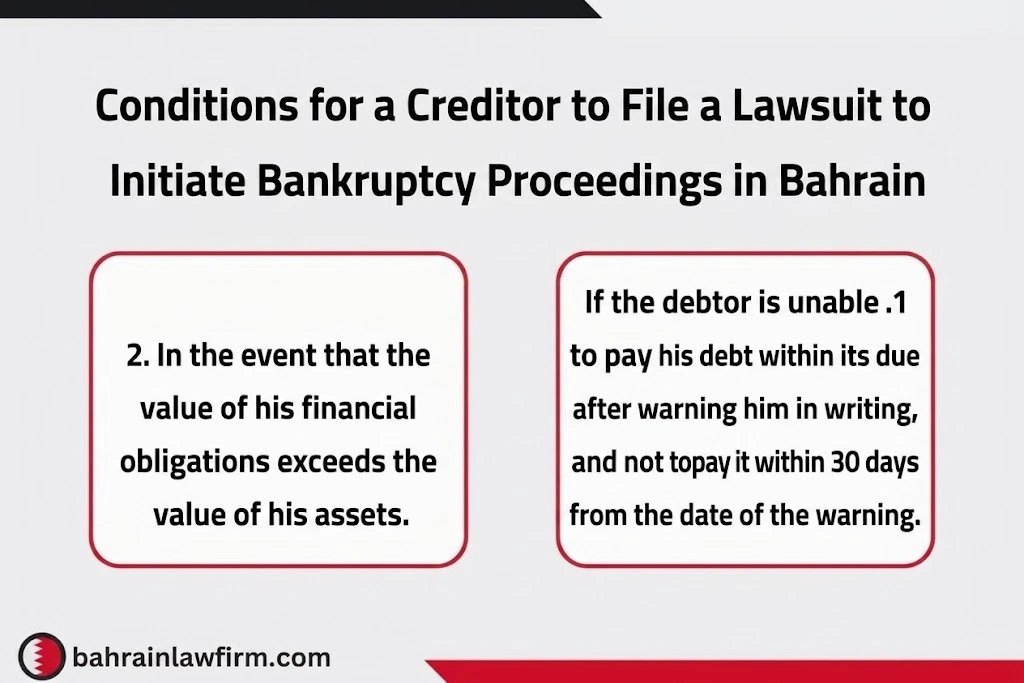
A creditor may file a petition if the debtor fails to pay a debt when it becomes due after receiving written notice and does not make payment within thirty days from the date of that notice.
The debt relied upon must not, as a whole, be subject to a legitimate dispute or set-off that would prevent it from being used as evidence of the debtor’s inability to pay.
Liabilities Exceed the Value of Assets
A creditor may also rely on the fact that the debtor’s financial liabilities exceed the value of its assets, provided this can be established in accordance with the applicable procedures.
Are Three Creditors Required to File a Bankruptcy Petition?
Not in every case.
If the total value of the creditors’ claims is less than BHD 20,000, the law requires the bankruptcy petition to be filed by at least three creditors.
This point is important when assessing whether a creditor is entitled to file a petition. It should not be assumed that every creditor may independently commence bankruptcy proceedings regardless of the amount of the claim and the surrounding circumstances.
What Documents Are Required When a Creditor Files a Bankruptcy Petition?
Important information and supporting documents include:
- Details of the debtor and its Commercial Registration number, where available.
- Details of the creditor or creditors.
- Details and value of the debt.
- Documents proving the debt.
- A copy of the written notice where the petition is based on failure to pay after notice.
- The debtor’s response to the notice, if any.
- Other documents supporting the petition.
- A statement identifying the type of proceeding requested based on the circumstances of the case.
Documents proving the debt are particularly important because bankruptcy proceedings are not an automatic substitute for every debt recovery claim, especially where the existence or amount of the debt is itself subject to a serious and legitimate dispute.
Can the Debtor Object to a Petition Filed by a Creditor?
Yes. The debtor may object to a creditor’s petition to commence bankruptcy proceedings within the period specified by law.
If the objection is filed on time, the court considers the position of the debtor and the creditors together with the evidence submitted by both sides.
If the debtor does not submit an objection within the prescribed period, the court may decide whether to commence the proceedings based on the petition and the documents and information filed with it.
What Happens If the Court Rejects a Bankruptcy Petition Filed by a Creditor?
If the court rejects a petition filed by creditors, its decision may also affect costs or compensation, depending on the circumstances of the case.
In certain cases, creditors may be ordered to pay costs and expenses incurred by the debtor. Compensation may also be considered where it is established that the petition was filed in bad faith or without proper legal grounds.
For this reason, the requirements and supporting documents should be carefully assessed before bankruptcy proceedings are used as a legal measure against a debtor.
How to File a Bankruptcy Petition in Bahrain Step by Step
The initial process can generally be summarized as follows:
- Confirm whether the debtor is subject to Bahrain’s bankruptcy legislation.
- Identify the legal basis of the petition.
- Determine whether the petition will be filed by the debtor or by a creditor.
- Prepare the required documents and financial information.
- Identify the type of proceeding being requested.
- File the bankruptcy petition.
- Allow the court to review whether the legal requirements have been met.
- Address any objections that are filed.
- Await the court’s decision to commence the proceedings or reject the petition.
These steps will not be identical in every case. The nature of the company, its financial position, the amount of debt, and the number of creditors can all affect the process.
Where the matter concerns a commercial company and requires a legal assessment before the appropriate procedure is selected, a Corporate Bankruptcy Lawyer in Bahrain can review the position and help determine the most suitable route.
What Are the Main Issues That Arise in Bankruptcy Cases?
Bankruptcy under Bahraini Commercial Law may involve a range of issues, including:
- Whether the debtor is subject to the law.
- Whether the debtor is unable to pay its debts.
- Valuation of assets and liabilities.
- Objections to the commencement of proceedings.
- Validity of creditors’ claims.
- Rights of the debtor and creditors.
- Requests for reorganization or liquidation.
- Management of the bankruptcy estate.
- Precautionary measures.
- The role of the bankruptcy trustee.
The legal strategy therefore changes depending on whether the interested party is the debtor, a creditor, a secured creditor, or another person holding rights connected to the debtor’s assets.
Does a Company Stop Operating as Soon as a Bankruptcy Petition Is Filed?
Not necessarily.
Filing a bankruptcy petition, or even obtaining approval to commence proceedings, does not automatically mean that the business must stop operating.
One of the objectives of the reorganization and bankruptcy system is to preserve the value of the business and its assets and to pursue reorganization where this remains possible.
For this reason, commencing bankruptcy proceedings should not be confused with liquidation, which may occur at a later stage.
Does Filing a Bankruptcy Petition Mean the Debtor Has Been Declared Bankrupt?
No. This is one of the most important distinctions to understand.
A bankruptcy petition is the judicial process through which a party asks the court to commence bankruptcy proceedings. A declaration of bankruptcy, however, relates to a later legal stage and outcome. Filing the petition alone does not mean that the debtor has already been declared bankrupt.
To understand that stage separately, you can read our guide on Declaration of Bankruptcy in Bahrain, including its requirements and publication procedures.
We do not go into detail about declaration procedures here so that this article remains focused on the bankruptcy petition itself, how it is filed, and how the court considers it.
Does Bankruptcy Mean the Company Must Be Liquidated?
Not necessarily. Under Bankruptcy under Bahraini Commercial Law Bahrain Law, liquidation is not the only possible outcome whenever financial distress occurs.
The debtor’s financial and economic position may allow it to reorganize, address its liabilities, and continue operating. Liquidation follows a different path and becomes appropriate when it is considered the more suitable solution.
If the main concern is specifically the procedures for closing and liquidating a company, see our separate guide on Steps for Company Liquidation in Bahrain.
This article therefore remains focused on the bankruptcy petition, while the other article addresses liquidation procedures as a separate topic.
Difference Between a Bankruptcy Petition and a Debt Recovery Claim
Under the rules governing Bankruptcy under Bahraini Commercial Law Bahrain Law, a debt recovery claim primarily seeks to establish the creditor’s right and obtain an order requiring the debtor to pay.
A bankruptcy petition, by contrast, seeks to commence a collective legal process for dealing with the debtor’s financial position when the conditions specified under the Reorganization and Bankruptcy Law are met.
The existence of an outstanding amount alone is therefore not enough to justify bankruptcy proceedings, especially where the debt is subject to a legitimate dispute concerning its existence or amount.
FAQ About Bankruptcy under Bahraini Commercial Law Bahrain Law
Some of the questions commonly asked include:
What Is Commercial Bankruptcy?
Commercial bankruptcy refers to a serious disruption in a trader’s financial position that leaves them unable to meet their financial obligations and, as a result, unable to pay their debts when due.
When Can a Debtor File a Bankruptcy Case Before the Court?
A debtor may file a bankruptcy case before the court in the following situations:
1. If the debtor is unable to pay debts due within 30 days of their maturity date.
2. If the debtor expects to be unable to pay those debts when they become due.
3. If the value of the debtor’s financial liabilities exceeds the value of their assets.
When Can a Creditor File a Bankruptcy Case?
A creditor may file a bankruptcy case when the conditions specified by law are met. These may include the debtor’s failure to pay after receiving the required notice, or where the debtor’s liabilities exceed the value of their assets.
Is Any Delay in Paying a Debt Enough to File for Bankruptcy?
No. The nature of the debt must be considered, including whether it is subject to a legitimate dispute, along with the other legal requirements for opening bankruptcy proceedings.
Does Filing a Bankruptcy Case Mean Bankruptcy Has Been Declared?
No. Filing the case marks the beginning of the judicial process, while the declaration of bankruptcy takes place at a later stage of the proceedings.
Does Filing a Bankruptcy Case Immediately Stop the Company’s Operations?
Not necessarily. The effect of the bankruptcy proceedings depends on the stage reached in the case and the decisions issued by the court.
In conclusion, when considering Bankruptcy under Bahraini Commercial Law Bahrain Law, a bankruptcy petition requires more than simply proving that debts exist. It is necessary to determine whether the debtor is subject to the Reorganization and Bankruptcy Law, whether the conditions relating to inability to pay have been met, the value of the debtor’s assets and liabilities, and which type of proceeding is most appropriate for its financial position.
The strategy followed by a creditor also differs from that of a debtor, whether when filing the petition, objecting to it, or protecting legal rights during the bankruptcy proceedings.
You can contact a Corporate Bankruptcy Lawyer in Bahrain to review the documents, assess the legal and financial position, and determine the appropriate course of action before filing a petition or deciding how to respond to one.
For more details, read: Reasons for Company Liquidation in Bahrain and the Lawyer’s Role.

A Bahraini lawyer and the founder of a legal consultancy firm established in February 2019. He holds a Higher Degree in Sharia and Law from Al-Azhar University. He has extensive experience in court representation and providing legal advice in criminal, personal status, civil, and commercial matters. He is known for delivering clear, practical, and effective legal advice aimed at protecting his clients’ rights and interests, and has achieved tangible results in notable cases, including commercial litigation and inheritance matters
