
Many people confuse bankruptcy declaration with simply filing a bankruptcy case or starting proceedings before the court. Bahrain’s Reorganization and Bankruptcy Law, however, treats each of these stages differently.
Filing a bankruptcy case starts the court process. Opening bankruptcy proceedings may then lead either to reorganization or liquidation, depending on the debtor’s financial position and the court’s decision. A formal bankruptcy declaration, on the other hand, is linked specifically to the court’s approval of liquidation proceedings.
Understanding the Bankruptcy Declaration Procedures under Bahraini Law therefore requires a clear distinction between filing a case, opening bankruptcy proceedings, reorganization, liquidation, and the final legal effect of declaring the debtor bankrupt.
In this article, we explain what bankruptcy declaration means in Bahrain, when a debtor is legally considered bankrupt, how bankruptcy proceedings are announced, and how bankruptcy declaration differs from simply filing a bankruptcy case.
Are financial pressures affecting the stability of your business in Bahrain? Taking the right legal step early may help you understand the available options before the situation becomes more difficult.
Speak with a Bankruptcy and Restructuring Lawyer
You can also continue reading below for a clear explanation of the legal process.
Table of Content
What Are the Bankruptcy Declaration Procedures under Bahraini Law?
The Bankruptcy Declaration Procedures under Bahraini Law form part of the broader legal framework governing reorganization and bankruptcy in Bahrain.
A bankruptcy declaration is the legal result that arises when the court approves liquidation proceedings against a debtor who falls within the scope of the Reorganization and Bankruptcy Law.
Under Article 18 of the Reorganization and Bankruptcy Law, once the court approves the opening of bankruptcy proceedings, the debtor becomes subject to those proceedings. However, the debtor is considered bankrupt and bankruptcy is formally declared when the court approves liquidation.
This distinction matters because opening bankruptcy proceedings does not always mean that the debtor’s business will move directly into liquidation. The court may instead approve or continue with a reorganization route if the financial and economic circumstances support it.
Bankruptcy Filing, Proceedings, and Declaration: What’s the Difference?
The process becomes much easier to understand when the three main stages are separated.
First: Filing a Bankruptcy Case
The process begins when the debtor or a creditor files a bankruptcy case before the competent court, provided that the legal conditions for filing are met.
At this stage, the debtor’s financial position is presented to the court. The filing may include details of the debtor’s inability to meet financial obligations or circumstances where liabilities exceed the value of available assets.
For a more detailed explanation of filing requirements, supporting documents, and cases brought by debtors or creditors, you can read our article on Bankruptcy Cases under Bahraini Law.
Second: Opening Bankruptcy Proceedings
After reviewing the case and confirming that the legal requirements have been satisfied, the court may approve the opening of bankruptcy proceedings.
From that point, the debtor enters the legal framework created by the Reorganization and Bankruptcy Law. The proceedings may then move toward either reorganization or liquidation, depending on the court’s decision and the debtor’s financial and economic circumstances.
Third: Bankruptcy Declaration
If the court approves liquidation proceedings, the debtor is legally considered bankrupt and bankruptcy is declared in accordance with the law.
This means that the Bankruptcy Declaration Procedures under Bahraini Law should not be confused with the simple filing of a bankruptcy case. A formal declaration is a legal consequence connected to the liquidation route.
When Is Bankruptcy Declared in Bahrain?
Bankruptcy is declared when the bankruptcy proceedings reach the point where the court approves liquidation.
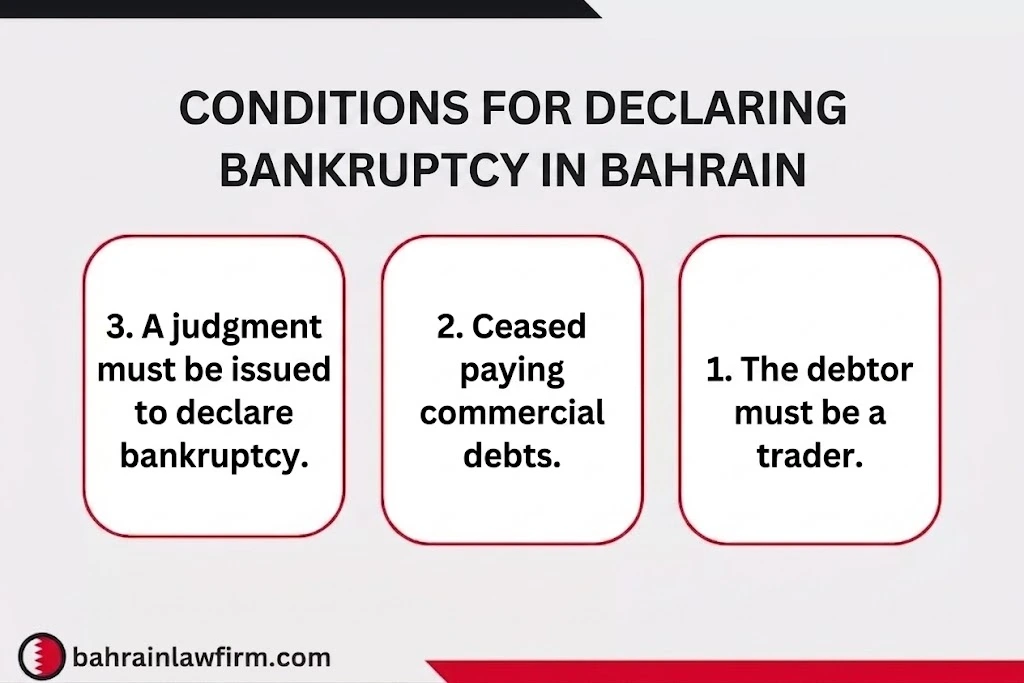
Before that can happen, the debtor must first be a person or entity covered by the Reorganization and Bankruptcy Law, and the application to open proceedings must have followed the process required by law.
The law mainly applies to commercial companies established in Bahrain and to natural persons who carry on commercial activities and have their principal place of business in the Kingdom, subject to statutory exceptions.
One of the main exceptions applies to persons and entities licensed by the Central Bank of Bahrain. These persons and entities are not dealt with under the law in the same way.
Personal, family, and consumer debts of an individual also do not automatically fall within the scope of the Reorganization and Bankruptcy Law merely because that person has difficulty repaying them.
Does Failure to Pay Debts Automatically Lead to Bankruptcy Declaration?
No. Failure or inability to repay debts may provide a basis for starting bankruptcy proceedings if the legal conditions are met, but delayed payment by itself does not automatically make the debtor bankrupt.
The process normally passes through several legal stages. A case must first be filed, the court must review the application, and the appropriate route must then be determined.
In some situations, reorganization may offer a better solution than liquidation. If reorganization can preserve value and allow the business to continue in a realistic way, it may be considered instead of moving directly toward liquidation.
For this reason, the Bankruptcy Declaration Procedures under Bahraini Law distinguish between financial distress and an actual court decision that results in a formal bankruptcy declaration.
How Is the Opening of Bankruptcy Proceedings Announced?
Once the court approves the opening of bankruptcy proceedings, it notifies the debtor, creditors, and any other person or party with an interest in the case.
The announcement should include important information such as:
- Approval of the bankruptcy case and the opening of reorganization or liquidation proceedings, depending on the circumstances.
- The debtor’s name and address.
- The court hearing the bankruptcy case.
- The name of the bankruptcy judge.
- Other details required under the relevant regulatory decisions.
- Any additional information the court considers necessary to publish or announce.
The notice serves an important purpose. It allows creditors and other parties connected to the debtor to know that proceedings have started, follow the case, and participate in accordance with the law.
How Are Bankruptcy Notices Served in Bahrain?
The method of notification depends on the person who must be notified and whether that person’s address is known.
The debtor and other persons whose addresses are known are notified according to the applicable legal rules. The law also deals with cases involving creditors whose addresses are unknown.
If a creditor with an unknown address is a trader, the address recorded in the Commercial Register may be used. In other cases, the notice may be published in a local newspaper or served through another method that the court considers suitable and sufficient to make the person aware of the proceedings.
Bankruptcy notices therefore do not follow one single method in every case. The correct method depends on the circumstances of the person concerned and the relevant legal provisions.
What Is the Bankruptcy Register?
The Reorganization and Bankruptcy Law provides for a bankruptcy register to be created for each bankruptcy case.
The register contains information and details relating to the case. It may also include documents, hearing records, applications, submissions, objections, orders, decisions, judgments, and measures issued throughout the proceedings.
The register helps organize the information connected to the bankruptcy case within a clear legal framework.
The court may also protect certain documents or information where disclosure could harm trade secrets or reveal commercially sensitive information.
What Happens After Bankruptcy Is Declared?
Once the court approves liquidation and the debtor is declared bankrupt, the case moves into the liquidation stage governed by law.
The process remains under the supervision of the court and the bankruptcy judge. The debtor’s assets are dealt with according to the legal rules, while creditors submit and pursue their claims within the bankruptcy proceedings.
Creditors are therefore not simply free to take separate action against the debtor’s assets outside the bankruptcy process. Their rights and claims become subject to the framework governing the bankruptcy and liquidation proceedings.
This stage is especially important for both the debtor and creditors because it affects the handling of assets, the submission of claims, and the determination of legal rights.
Understanding what happens after liquidation is therefore an important part of the Bankruptcy Declaration Procedures under Bahraini Law.
Is Bankruptcy Declaration the Same as Company Liquidation?
The two concepts are closely related, but they do not always mean the same thing.
Under the Reorganization and Bankruptcy Law, a bankruptcy declaration is linked to the court’s approval of liquidation proceedings within a bankruptcy case.
Company liquidation is broader. A company may be liquidated for reasons that have nothing to do with bankruptcy. For example, shareholders or partners may decide to dissolve and liquidate a company where company law allows them to do so.
The reason for liquidation must therefore be identified first. The applicable legal framework can then be determined before deciding which procedures should be followed.
Can a Company Be Reorganized Instead of Being Declared Bankrupt?
Yes, that may be possible in some cases.
One of the purposes of the Reorganization and Bankruptcy Law is to preserve the value of the debtor’s assets and support reorganization where this is reasonably possible.
When considering the opening of proceedings, the court may look at whether reorganization could provide a more suitable outcome than liquidation and whether there are reasonable economic grounds for the business to continue.
Financial distress therefore does not automatically mean that liquidation and bankruptcy declaration are the only available outcomes.
Who Can Be Subject to the Bankruptcy Declaration Procedures under Bahraini Law?
The Bankruptcy Declaration Procedures under Bahraini Law apply only to persons and entities that fall within the scope of Bahrain’s Reorganization and Bankruptcy Law.
The main categories include:
- Commercial companies established in the Kingdom of Bahrain.
- Natural persons carrying on commercial activities whose principal place of business is in Bahrain.
The law also includes certain exceptions. These include persons and entities licensed by the Central Bank of Bahrain and some companies whose establishing legislation provides that the bankruptcy law does not apply to them.
It is therefore important to check the debtor’s legal status before assuming that Bahrain’s bankruptcy rules apply to the case.
Frequently Asked Questions
The following are some of the most common questions raised about bankruptcy declaration and liquidation in Bahrain:
What Does Declaring Bankruptcy Mean?
Declaring bankruptcy means that a debtor is legally considered bankrupt under the Reorganization and Bankruptcy Law once the court approves the commencement of liquidation proceedings.
Does Filing a Bankruptcy Case Mean the Company Has Been Declared Bankrupt?
No. Filing a bankruptcy case only starts the legal process. A bankruptcy declaration is linked to the court issuing a decision approving liquidation proceedings.
Does Commencing Bankruptcy Proceedings Mean Liquidation?
Not necessarily. The proceedings may involve reorganization or liquidation, depending on the court’s decision in the case.
Who Announces the Bankruptcy?
The court is responsible for notifying the debtor, creditors, and other interested parties of the commencement of bankruptcy proceedings in accordance with the rules set out by law.
Is Bankruptcy Announced in Newspapers?
Publication in a local newspaper may be used in certain cases, particularly for creditors whose addresses are unknown. However, the law provides several methods of notification depending on the circumstances of each party.
Is Every Financially Distressed Company Considered Bankrupt?
No. Financial distress or an inability to meet certain obligations does not, by itself, mean that a company is legally bankrupt. The procedures prescribed by law must be followed, and the appropriate court decision must be issued.
Understanding the difference between financial distress, opening bankruptcy proceedings, reorganization, liquidation, and formal bankruptcy declaration is important before taking any step that may affect a company, debtor, or creditor.
At Abdulrahman Khalifa Law Firm, we review the legal and financial position of each case and explain the available options under Bahrain’s Reorganization and Bankruptcy Law. This may include assessing the possibility of reorganization, dealing with liquidation proceedings, or following up on rights and claims in an existing bankruptcy case.
A proper understanding of the Bankruptcy Declaration Procedures under Bahraini Law can help debtors and creditors identify the correct legal route and understand the consequences of each stage before making important decisions.
You may also consult a Corporate Bankruptcy Lawyer in Bahrain to review the company’s position and determine the appropriate legal route before taking further action.
You can also learn more about: Reasons for Company Liquidation in Bahrain and the Lawyer’s Role.

A Bahraini lawyer and the founder of a legal consultancy firm established in February 2019. He holds a Higher Degree in Sharia and Law from Al-Azhar University. He has extensive experience in court representation and providing legal advice in criminal, personal status, civil, and commercial matters. He is known for delivering clear, practical, and effective legal advice aimed at protecting his clients’ rights and interests, and has achieved tangible results in notable cases, including commercial litigation and inheritance matters
