
Women’s Rights in Khula Divorce in Bahrain are considered one of the important topics that concern many women who seek a Sharia-compliant solution that provides them with independence while preserving their basic rights.
Khula Divorce represents an important legal option under Bahraini laws for regulating the marital relationship between spouses and ensuring a balance between rights and obligations.
Have you reached a dead end in your marriage and are you hesitant to request Khula Divorce because you fear giving up too many of your rights or losing custody of your children?
Table of Content
Main Women’s Rights in Khula Divorce in Bahrain
Khula Divorce is the dissolution of a marriage contract based on the wife’s request in exchange for financial compensation or a settlement provided to the husband. Khula Divorce is considered one of the legal solutions recognized under the Bahraini Family Law to prevent lengthy disputes and ensure that the marriage ends fairly for both parties.
Khula Divorce is a regulated legal process that allows Bahraini women to request the termination of the marital relationship in a way that respects their rights and dignity, in accordance with the Family Law applicable in Bahrain.
To provide a complete understanding of these rights, we explain below the main details related to Women’s Rights in Khula Divorce in Bahrain:
The Woman’s Right to End the Marital Relationship
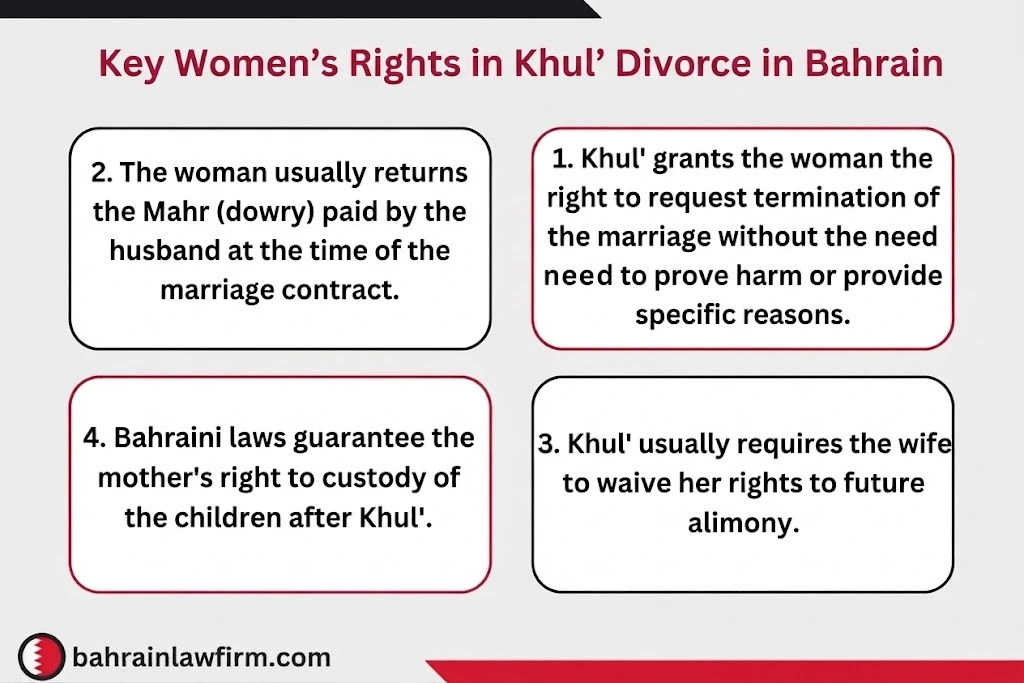
Khula Divorce gives a woman the right to request the termination of her marriage without the need to prove harm or provide specific reasons, making the process faster compared to a divorce lawsuit.
The law protects this right as a means of achieving personal independence and preserving human dignity, especially when a woman believes that continuing the marriage is no longer in her best interest.
Waiving the Dowry (Mahr)
Under the Bahraini Family Law, in most Khula Divorce cases, the wife is required to return the dowry paid by the husband at the time of the marriage contract. The amount of compensation is determined based on the agreement between the spouses or according to the court’s assessment.
In certain cases, the amount of the returned dowry may be reduced if the wife proves that she was subjected to harm, abuse, or mistreatment by the husband.
Waiving Alimony During the Waiting Period (Iddah)
Although Khula Divorce usually requires the wife to waive future alimony claims, she remains entitled to receive alimony during the waiting period (Iddah). The amount and duration of this support vary depending on the circumstances of the case and the court’s decision, while taking into account the husband’s financial situation.
The Right to Child Custody
Bahraini laws guarantee the mother’s right to custody of children after Khula Divorce, especially when the children are young. The best interests of the children are considered when making custody decisions, and in some cases, specific arrangements may be required to regulate visitation rights for the non-custodial parent.
This right is considered one of the most important Women’s Rights in Khula Divorce in Bahrain, as it strengthens the mother’s role as the primary caregiver and guardian responsible for her children.
Waiving Additional Financial Rights of the Wife
In addition to the dowry, the wife may be required to waive certain other financial rights depending on the agreement between both parties. These may include gifts provided by the husband or financial claims that have not been settled during the marriage.
The Right to Psychological and Social Stability After Khula Divorce
Khula Divorce aims to achieve psychological and social balance for women, especially if the marriage has caused emotional or social pressure. Bahraini law provides this option to help women begin a new life away from ongoing disputes while ensuring legal protection for their rights.
The Role of a Lawyer in Khula Divorce Cases
When dealing with a Khula Divorce case, seeking assistance from a specialized best lawyer in Bahrain plays an essential role. The lawyer’s responsibilities include:
- Providing legal advice: A lawyer helps explain the rights and obligations related to Khula Divorce.
- Preparing legal documents and pleadings: The lawyer ensures that all required documents are properly prepared and submitted according to legal procedures.
- Representing the wife before the court: The lawyer works to defend the woman’s rights and help ensure a fair legal process.
Do not hesitate to contact us to receive direct legal advice through the WhatsApp button at the bottom of the screen.
Frequently Asked Questions
Key questions about Women’s Rights in Khula Divorce in Bahrain
Does the Furniture Belong to the Wife After Khula Divorce?
The furniture belongs to the wife after khula divorce if it was purchased with the wife’s own money, as it is considered her property. As for jointly owned furniture, it is settled according to the agreement between the parties or the court’s judgment.
Is the List of Household Items the Wife’s Right in Case of Khula?
Yes, the list of household items is considered the wife’s right in case of khula if it was agreed upon as part of the marriage contract. The wife has the right to retain it unless the judgment provides otherwise.
Women’s Rights in Khula Divorce in Bahrain represent an important legal framework that allows women to seek justice and obtain freedom within the principles of Sharia and the law. If you need specialized legal advice to protect your rights, we can assist you.
Contact us now through the WhatsApp button at the bottom of the screen to receive the necessary legal support.

A Bahraini lawyer and the founder of a legal consultancy firm established in February 2019. He holds a Higher Degree in Sharia and Law from Al-Azhar University. He has extensive experience in court representation and providing legal advice in criminal, personal status, civil, and commercial matters. He is known for delivering clear, practical, and effective legal advice aimed at protecting his clients’ rights and interests, and has achieved tangible results in notable cases, including commercial litigation and inheritance matters
