
Father’s Child Custody Rights After Divorce in Bahrain is the topic we have selected for you to answer based on the provisions of the new Bahraini Family Law.
If you are involved in a child custody dispute and want a clear answer regarding this matter, learn more with the assistance of the best lawyers.
Contact us now through the WhatsApp button at the bottom of the screen.
Table of Content
Father’s Child Custody Rights After Divorce in Bahrain
Custody refers to protecting, caring for, and raising a child in a manner that does not conflict with the guardian’s legal authority over the child. The person entitled to custody is determined based on who is able to provide proper care and meet the child’s needs, unless both parties agree otherwise regarding custody arrangements.
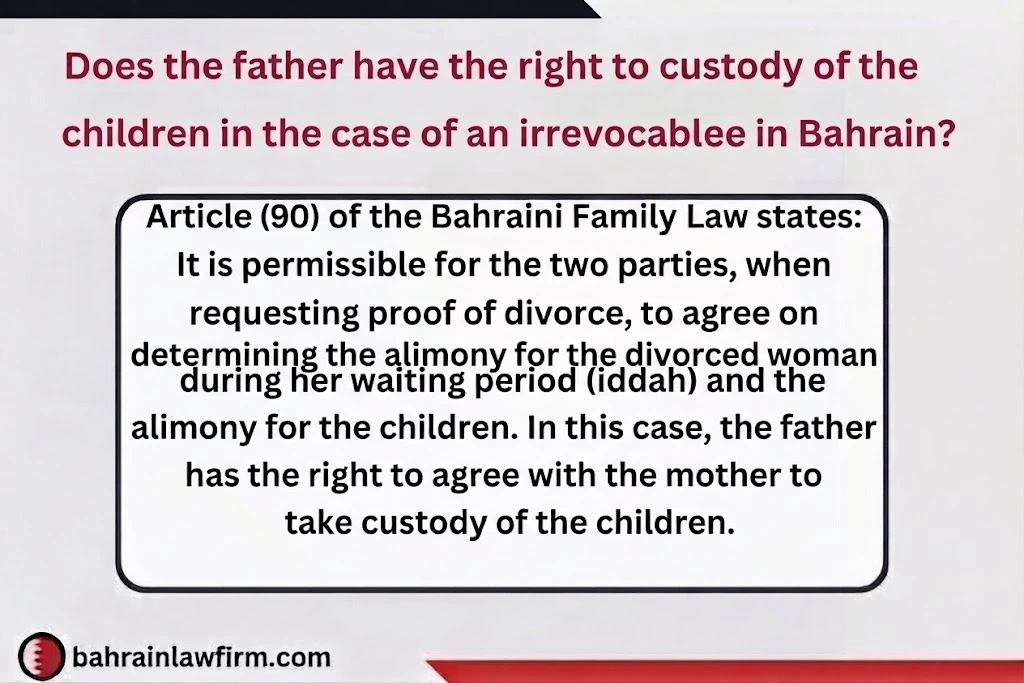
Article (90) of the Bahraini Family Law states that, when requesting the confirmation of divorce, the spouses may agree on determining the divorced wife’s maintenance during her waiting period (Iddah), as well as the children’s maintenance.
They may also agree on who has the right to custody, along with the number, place, and timing of visits with the child. This agreement is recorded in the divorce document and is considered immediately enforceable by operation of law.
Therefore, it is clear that child custody after divorce can be determined through an agreement between the father and the mother.
However, if a dispute arises, either party may resort to the court, which will decide the matter and determine who is more entitled to custody according to the provisions established under Bahraini Family Law.
The law regulates the types of divorce in Bahrain, cases where custody rights may be lost, and the conditions that must be met by the custodian. It also addresses cases where custody may be removed from the father and other matters related to child custody.
The Importance of Hiring a Lawyer in Child Custody Cases
The role of the best lawyer in Bahrain specializing in child custody cases includes several key responsibilities, which can be summarized as follows:
- The lawyer begins by analyzing the case and understanding the surrounding circumstances, such as separation or divorce and their impact on the children.
- The lawyer collects the necessary information and documents, including family records and statements, to assess the child’s situation and requirements.
- The lawyer explains the local and international laws related to custody to the client.
- The lawyer clarifies the legal procedures that must be followed and explains how to submit evidence supporting the client’s position.
- The lawyer prepares legal applications and written submissions accurately, which helps strengthen the chances of achieving a favorable outcome.
- The lawyer ensures that all documents are complete and comply with legal requirements.
- The lawyer represents the client before the court and defends both the client’s rights and the child’s rights.
- The lawyer focuses on presenting evidence that demonstrates the client’s ability to provide a suitable environment for the child.
- The lawyer works to ensure that the child’s best interests remain the primary consideration in any decision made by the court.
- The lawyer seeks to avoid prolonged disputes that may negatively affect the child’s psychological and emotional well-being.
- The lawyer may negotiate with the other party to reach an amicable settlement that reduces conflict and promotes stability for the child.
- The lawyer assists in preparing custody or visitation agreements that serve the child’s best interests.
- After the judgment is issued, the lawyer helps implement it, whether it concerns transferring custody or arranging child visitation.
- The lawyer ensures that enforcement is carried out according to the law while protecting the rights of all parties involved.
- If the judgment is unfair or does not serve the child’s best interests, the lawyer assists in filing an appeal to request a review of the case.
- The lawyer provides legal and family support and helps overcome the difficulties associated with custody disputes.
- The lawyer works to achieve a balance between the parents’ rights and the child’s best interests.
In summary, a lawyer in child custody cases plays a comprehensive role by combining legal representation, consultation, negotiation, and advocacy for the child’s interests, with the aim of achieving justice and family stability.
FAQ Abut Father’s Child Custody Rights After Divorce in Bahrain
Related questions:
If the wife requests divorce, does she have the right to custody of the children?
Yes, if the wife requests divorce, she may have the right to custody of the children, as stated under Article (132) of the Bahraini Child Custody Law.
Leaving the marital home due to a dispute or for another reason does not automatically cancel the mother’s right to custody unless the judge decides otherwise based on valid reasons. The judge may also grant custody to the mother if the child is young and still dependent on the mother, unless the judge determines otherwise.
What are the divorce procedures before the Jaafari Court in Bahrain?
Divorce procedures before the Jaafari Court in Bahrain include submitting the divorce application form along with the required documents via email to the Sharia Procedures Department in PDF format.
After that, a Bahraini phone number must be provided for communication. The applicant then receives a confirmation message through the same email address confirming that the application has been submitted correctly.
This concludes our article on **Father’s Child Custody Rights After Divorce in Bahrain**, where we explained the father’s eligibility for child custody according to Bahrain’s divorce law and the divorce procedures before the Jaafari Court in Bahrain.
Contact a child custody lawyer in Bahrain by reaching out to us through the phone numbers displayed on the website.
Read more about:
When does custody end in Bahrain.
Child Custody Judgment After Divorce in Bahrain.

A Bahraini lawyer and the founder of a legal consultancy firm established in February 2019. He holds a Higher Degree in Sharia and Law from Al-Azhar University. He has extensive experience in court representation and providing legal advice in criminal, personal status, civil, and commercial matters. He is known for delivering clear, practical, and effective legal advice aimed at protecting his clients’ rights and interests, and has achieved tangible results in notable cases, including commercial litigation and inheritance matters
