
Can khula divorce change the balance and cause the person entitled to custody to give up this right? To answer this question, we will explain what the Bahraini Family Law provides regarding Child Custody After Khula Divorce in Bahrain. Welcome and continue reading with us.
Are you hesitant to file for khula because you fear that you may be pressured to give up custody of your children? Do not allow anyone to use your motherhood as a means of pressure or negotiation.
Table of Content
Child Custody After Khula Divorce in Bahrain According to the Law
The Bahraini Family Law No. (19) of 2017 addresses all matters related to child custody, including the circumstances in which custody may be lost after divorce or khula. The law confirms that parents may agree on arrangements related to Child Custody After Khula Divorce Bahrain, including matters concerning communication with the child, the number of visits, their timing, and the place where visits take place.
If the parents cannot reach an agreement regarding these matters, Article (132) of the Family Law confirms that the mother has priority in obtaining custody of her children, even if she leaves the marital home due to a dispute or for another reason.
If the child is still young and cannot be separated from the mother, the mother remains responsible for custody unless the judge decides otherwise based on the circumstances of the case.
The guardian is responsible for the child’s discipline and education. This responsibility is not limited to visitation times only; rather, the guardian must continue following up on the child’s affairs at all times.
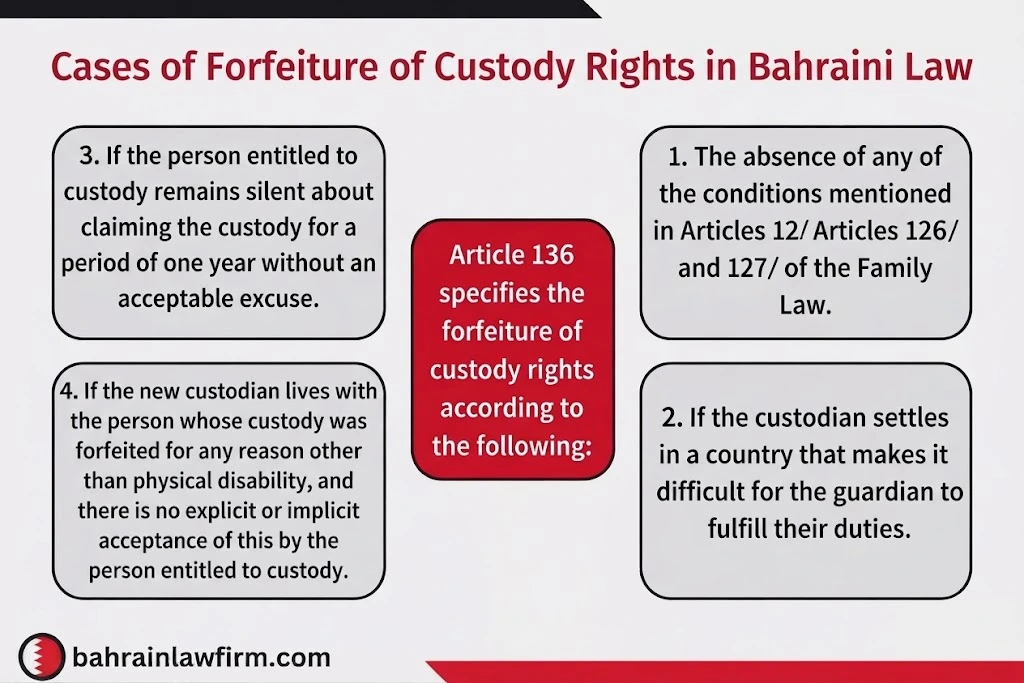
Therefore, it can be concluded that Bahrain’s child custody rules after khula do not consider khula itself a reason for losing custody. Instead, Article (136) sets out the cases in which the right to custody may be forfeited, as follows:
- If any of the conditions required under Articles (126) and (127) of the Family Law are no longer fulfilled.
- If the custodian settles in a country where the guardian’s ability to carry out their duties becomes difficult.
- If the person entitled to custody does not request it for a period of one year without an acceptable excuse.
- If the new female custodian lives with the person whose custody was removed for a reason other than physical incapacity, unless the person entitled to custody has expressly or implicitly accepted this arrangement.
These are the main provisions introduced by the new Bahraini Family Law regarding Child Custody After Khula Divorce. If you need more information or further clarification about custody matters, you can contact us through any of the communication methods available on our website.
FAQ About Child Custody After Khula Divorce Cases
Among the most common related questions:
Does Khula Result in the Loss of the Mother’s Custody Rights?
Khula does not result in the loss of the mother’s custody rights, as the Bahraini Family Law specifies the cases in which custody may be revoked and does not include khula among them.
Who Has Child Custody After Khula Divorce in Bahrain?
Child custody after khula divorce in Bahrain remains with the mother unless one of the circumstances that lead to the loss of her custody rights exists.
This concludes our article about Child Custody After Khula Divorce in Bahrain, where we have highlighted the most important information regarding custody regulations and family law in Bahrain.
You can contact a lawyer in Bahrain at Abdulrahman Khalifa Law Office through WhatsApp to receive professional legal advice and obtain more details about the latest Bahraini Family Law PDF.
Dear reader, you may also find the following articles helpful:
When Can a Wife Request Custody in Bahrain?
Child Custody Lawyer in Bahrain

A Bahraini lawyer and the founder of a legal consultancy firm established in February 2019. He holds a Higher Degree in Sharia and Law from Al-Azhar University. He has extensive experience in court representation and providing legal advice in criminal, personal status, civil, and commercial matters. He is known for delivering clear, practical, and effective legal advice aimed at protecting his clients’ rights and interests, and has achieved tangible results in notable cases, including commercial litigation and inheritance matters
