
Divorce does not end the parents’ responsibility toward their children. Instead, a number of rights continue to exist to protect the child and regulate their affairs after the separation of the father and mother. These rights are also different from the husband’s rights when the wife requests divorce, as children’s rights are independent in their nature from the rights exchanged between spouses after the marital relationship ends.
The Children’s Rights After Divorce in Bahrain include several matters, such as housing, financial support, education, and care, in addition to provisions related to custody, visitation, and communication with the non-custodial parent. These rights must also be distinguished from women’s rights after divorce, because the rights of the former wife and the rights of children are based on different legal rules and considerations.
The Bahraini Family Law regulates these matters while taking into account the best interests of the child and the circumstances of the family. Therefore, it is important to distinguish between the child’s financial rights, the right to custody and care, and the right of each parent to communicate with the child according to the legal regulations.
Are you concerned about securing your children’s rights regarding housing and financial support after divorce, or are you facing difficulties with custody and visitation arrangements?
Consult a Family and Alimony Lawyer NowOr continue reading to understand the legal details related to your children’s rights.
Table of Content
Children’s Rights After Divorce in Bahrain
The Children’s Rights After Divorce in Bahrain are not limited to financial support only. They extend to several obligations and responsibilities that continue despite the end of the marital relationship between the father and mother, regardless of any disputes that may arise between the spouses regarding their personal rights.
The most important of these rights include:
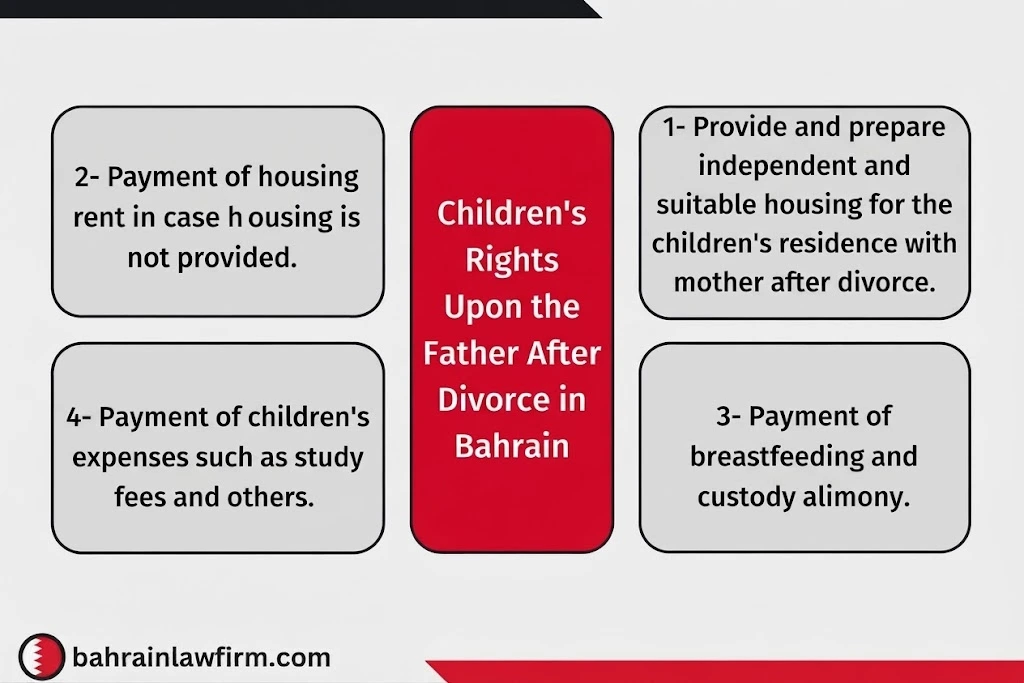
1. Providing Suitable Housing for the Child in Custody
The Family Law regulates custody housing after divorce. It provides that if the custodian does not have a suitable residence, they may remain with the child in the former marital home until the child’s father provides an independent and properly equipped residence suitable for the custodian and the child throughout the custody period, while observing the applicable legal provisions.
The rules related to custody housing expenses may differ in some details depending on the circumstances of each case and the applicable provisions. The child’s right to housing should not be confused with disputes related to marital household belongings or the issue of whether household furniture belongs to the wife after divorce, as each matter has its own legal basis and circumstances.
2. Financial Support and Providing Basic Needs
Financial support remains one of the fundamental financial rights of children after the parents’ separation, and the obligation to provide it does not end simply because divorce has occurred.
The child support in Bahrain is governed by specific provisions that determine the child’s entitlement, the party responsible for payment, and the period during which this obligation continues.
When discussing Children’s Rights After Divorce in Bahrain, it is important to understand that financial support is an independent financial right belonging to the child and should not be confused with custody, visitation, or the personal and financial rights of either parent.
3. Following Up on the Children’s Affairs and Education
The child’s residence with the custodian does not mean that the father’s role in the child’s affairs comes to an end. The Family Law requires the father, or another guardian of the child, to take care of the child’s affairs, discipline, guidance, and education.
Accordingly, the father’s responsibility continues in everything related to the child’s best interests, guidance, and education, even when the child lives with the mother or another custodian.
4. The Child’s Right to Custody and Care
Custody is a responsibility shared by both parents during the marriage. After separation, the Family Law determines the order of those entitled to custody according to the applicable legal provisions, while considering the required conditions for the custodian and the best interests of the child.
Therefore, custody cannot be considered an absolute right of the mother or the father in all cases. Custody may transfer from one person to another if one of the required conditions is no longer met or if there is a legal reason requiring such a change. The child’s best interests also remain an important consideration in cases where the law allows the judge to determine what is most suitable for the child.
5. The Child’s Right to Communicate with the Non-Custodial Parent
The child remaining in the custody of one parent does not mean depriving the other parent of communication with them.
If the child is under the custody of one parent, the other parent has the right to visit, receive, and accompany the child according to what is determined by the judge.
If the parents are unable to arrange visitation through mutual agreement, the judge regulates it in terms of time and place in a manner that does not cause psychological harm to the child.
6. Agreement on Children’s Rights During Divorce
The Family Law allows both parties, when requesting the documentation of divorce, to agree on several matters related to their children, including:
- Children’s financial support.
- The parent who will have custody.
- Child visitation arrangements.
- The number of visits, their times, and locations.
When this agreement is recorded in the divorce document, it produces the legal effects determined by law. These matters may arise alongside discussions regarding women’s rights when requesting divorce. However, agreements concerning children’s affairs must remain separate from the settlement of rights between the spouses.
A clear agreement regarding children’s affairs helps reduce future disputes, but the child’s rights and best interests must remain the main consideration when organizing these matters.
Based on the importance of ensuring proper upbringing for children while maintaining their relationship with both parents, Bahraini law grants the father the right to visit the child, receive them, and accompany them according to the judge’s decision and in a way that serves the child’s best interests.
Does the Father’s Responsibility Toward His Children Continue After Divorce?
Yes. Divorce ends the marital relationship between the father and mother, but it does not end the father’s relationship with his children or the obligations imposed on him by law toward them.
The responsibilities placed on the father may vary depending on the matter involved. They may include financial rights, obligations related to the child’s affairs and education, as well as rules governing visitation and communication.
If a dispute arises regarding these rights or if it becomes difficult to determine the appropriate legal procedure, consulting a divorce lawyer may help evaluate the circumstances and distinguish between children’s rights and the rights arising between the spouses.
At the same time, the child’s residence with the mother or the establishment of her custody does not mean that all responsibilities are transferred to her or that the obligations imposed on the father toward his children are cancelled.
FAQ About Children’s Rights After Divorce in Bahrain
Children’s Rights After Divorce in Bahrain are among the important issues that many parents ask about. Therefore, we answer below the most common questions related to this topic.
What Are the Son’s Rights Against the Father?
Children’s rights after divorce include providing everything necessary for them according to the legal provisions related to maintenance and housing. They also include the father fulfilling his responsibilities regarding the child’s affairs, guidance, and education, while the child maintains the right to have a relationship with both parents according to custody and visitation rules.
Does the Father Have the Right to Custody in Bahrain?
The father may be among those entitled to custody according to the order and conditions established by the Family Law. However, custody cannot be considered automatically granted to him or to any other person in all cases.
When Does Custody Transfer to the Father?
Custody may transfer to the father according to the order of custody entitlement and the family’s legal circumstances if custody is no longer established for the person preceding him in the order or if a reason for transferring custody arises, provided that he meets the required conditions for a custodian.
The details vary depending on the applicable legal provisions and the facts of each case. Therefore, the transfer of custody is not linked to a single reason that applies to all disputes.
Does the Father Have the Right to See the Child During the Custody Period?
Yes. If the child is in the mother’s custody, the father has the right to visit, meet, and accompany the child according to what the judge determines.
The parents may organize visitation through an agreement. If they fail to reach an agreement, the judge determines the visitation arrangements in a way that does not harm the child psychologically.
This concludes our article on Children’s Rights After Divorce in Bahrain, where we reviewed the rights that children are entitled to after divorce and answered the most common questions related to this subject. We also highlighted the importance of seeking assistance from a qualified lawyer who can provide legal advice and help with the necessary legal procedures.

A Bahraini lawyer and the founder of a legal consultancy firm established in February 2019. He holds a Higher Degree in Sharia and Law from Al-Azhar University. He has extensive experience in court representation and providing legal advice in criminal, personal status, civil, and commercial matters. He is known for delivering clear, practical, and effective legal advice aimed at protecting his clients’ rights and interests, and has achieved tangible results in notable cases, including commercial litigation and inheritance matters
