

There is no doubt that the law protects Women’s Rights After Divorce in Bahrain, both during marriage and after separation.
In this article, we provide a clear overview of women’s rights and explain the key entitlements granted to women in different divorce cases under the Ja’fari school of Islamic jurisprudence.
Are you concerned about securing your financial future and ensuring financial support for your children after divorce? Do not let the pressure of this difficult stage prevent you from claiming your legal entitlements.
Table of Content
Women’s Rights After Divorce in Bahrain
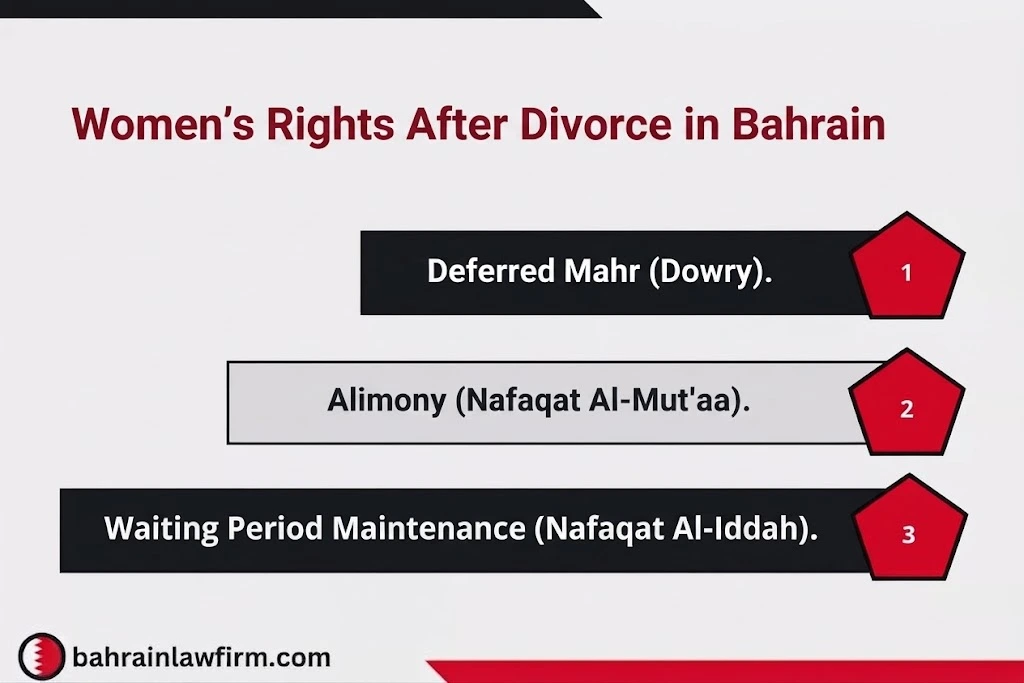
Bahraini law protects women’s rights during marriage and after separation. These protections aim to preserve a woman’s dignity, provide financial security, and reduce the need to depend on others. Accordingly, a divorced woman may be entitled to the following rights:
- Deferred dowry (Mahr).
- Mut’ah compensation.
- Maintenance during the waiting period (Iddah).
- Child maintenance when the children remain in her custody, within the periods and conditions set by law.
It is also important to note that Article 84 of the Bahraini Family Law sets several conditions relating to the divorced woman, including legal age, mental capacity, free choice, and discernment.
When these conditions are met and the divorce takes place, the wife may receive the financial entitlements mentioned above. These rights help secure a dignified standard of living for her and her children and contribute to maintaining stability after divorce.
Wife’s Rights After Divorce Under the Ja’fari School
The Ja’fari school gives particular consideration to a woman’s rights, including her right to suitable accommodation when she has custody of a child. If suitable housing is not provided for the custodial mother and the child, she may be entitled to housing costs.
If she rents a home, she may be entitled to a housing allowance. The amount may be determined by agreement or judicial assessment, taking into account the financial ability of the person responsible for maintenance, the circumstances of the person receiving maintenance, as well as the time, location, and prevailing customs.
On the other hand, if divorce takes place before consummation of the marriage, a divorced woman under the Ja’fari school is generally entitled to half of the specified dowry. If no dowry was specified, she may be entitled to Mut’ah according to the husband’s financial and economic circumstances.
In this context, it should also be noted that, under Ja’fari jurisprudence, divorce is generally pronounced using clear and explicit wording. If the husband is unable to pronounce it verbally, divorce may be carried out in writing or through a clear and understandable gesture. The husband may also appoint another person to carry out the divorce under a special power of attorney specifying the type of divorce.
The Role of a Lawyer in Divorce Cases
The experience and role of a skilled lawyer in Bahrain may include the following:
- Providing initial legal guidance: Explains the woman’s legal rights from the moment she begins considering divorce and clarifies the available options based on the circumstances of her case.
- Preparing and filing the claim or response: Drafts legal documents professionally, whether filing a divorce claim or responding to claims made by the husband.
- Claiming Sharia-based legal rights: Seeks maintenance and financial entitlements, including Iddah maintenance, Mut’ah, and housing, as well as custody, custody-related expenses, education, and medical costs, based on Bahrain Family Law No. 19 of 2017.
- Collecting evidence and assessing maintenance: Helps document the husband’s actual income and submit evidence that supports a fair assessment of maintenance before the court.
- Proving harm in cases of wrongful divorce: Where harm has occurred, gathers the necessary evidence to establish it and seek compensation in accordance with Sharia principles and applicable law.
- Negotiating an amicable settlement: Helps the parties reach practical solutions that protect the woman’s dignity and serve the children’s best interests while avoiding prolonged court disputes whenever possible.
- Following up on the enforcement of judgments: Monitors the enforcement of court decisions relating to maintenance or custody to ensure that the judgments are effectively implemented.
Frequently Asked Questions
Many questions arise about Women’s Rights After Divorce in Bahrain under the new law. Below, we provide clear and reliable answers to some of the most common questions.
Does Bahraini Law Protect the Rights of Divorced Women?
Yes. The Bahraini Family Law protects the rights of divorced women through various provisions, including the following: maintenance during the waiting period (Iddah), Mut’ah compensation, and the deferred dowry (Mahr).
How Is Divorce Proven in Bahrain?
A divorce that takes place outside the court in Bahrain may be proven through:
1. Acknowledgment.
2. Evidence.
This brings us to the end of our article on Women’s Rights After Divorce in Bahrain, where we reviewed the main rights available to divorced women.
We also discussed the rights granted to divorced women under the Ja’fari school and highlighted the importance of consulting a qualified lawyer who can help you understand your case.
A lawyer can also assist in presenting evidence that strengthens your legal position and helps you claim the rights granted to you under Bahraini law.
If you face any legal issue, remember that you can use the WhatsApp button at the bottom of the screen to book a consultation with one of our experienced lawyers.
For more related information, read: Best divorce lawyer in Bahrain.

A Bahraini lawyer and the founder of a legal consultancy firm established in February 2019. He holds a Higher Degree in Sharia and Law from Al-Azhar University. He has extensive experience in court representation and providing legal advice in criminal, personal status, civil, and commercial matters. He is known for delivering clear, practical, and effective legal advice aimed at protecting his clients’ rights and interests, and has achieved tangible results in notable cases, including commercial litigation and inheritance matters
