

In a Khula case, Husband’s Defenses in a Khula Case can be used to protect the husband’s financial and legal rights. A lawyer experienced in Khula cases can advise the husband properly and prepare the appropriate defenses in line with Bahraini law.
In this article, we will explain the main defenses available to a husband in a Khula case and how he can present an effective defense before the court.
For immediate contact, use the WhatsApp button at the bottom of the screen.
Table of Content
Husband’s Defenses in a Khula Case
Khula is a legal right that allows a wife to end the marriage contract in return for compensation paid to the husband. Under the law, Khula seeks to balance the wife’s right to end the marital relationship with the husband’s right to receive appropriate compensation.
In a Khula case, the husband may rely on several legal defenses to protect his rights effectively. These defenses may play an important role in the court’s decision, especially when they are supported by clear and reliable evidence in accordance with Bahraini law.
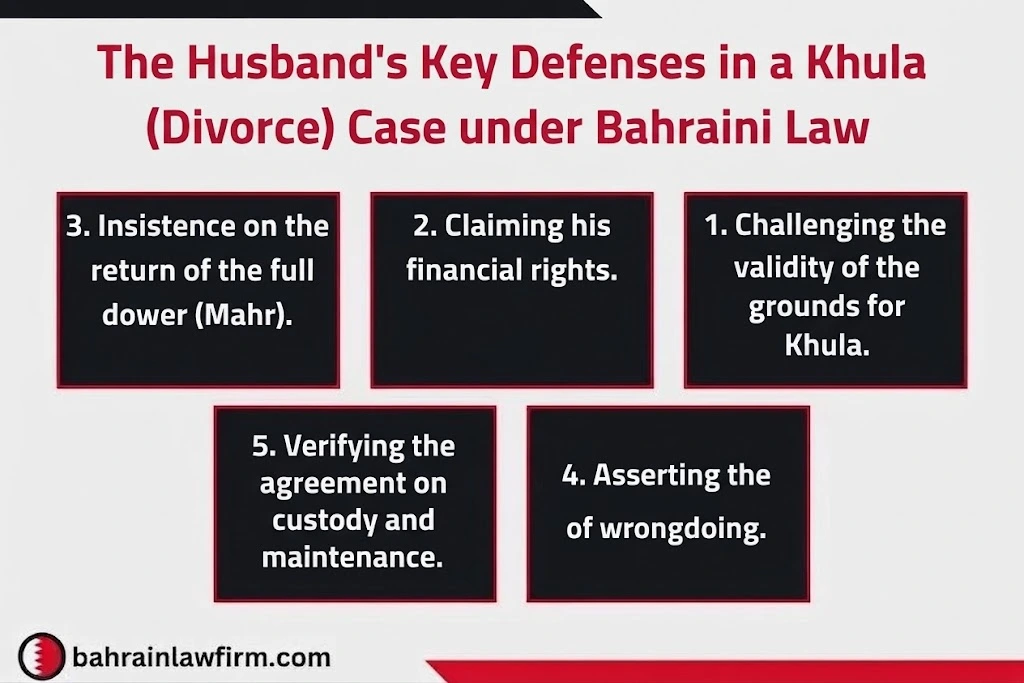
Below is a detailed explanation of the main Husband’s Defenses in a Khula Case:
Challenging the Grounds for Khula
When the wife claims certain grounds for ending the marriage, such as mistreatment or lack of compatibility, the husband has the right to challenge the accuracy of those claims. For example:
- If the wife alleges violence or neglect without clear evidence, the husband may submit documents or call witnesses to challenge those allegations.
- If the stated reasons do not match the actual circumstances, the husband may argue that the marital relationship was normal and that he did not commit any act that would justify the Khula request.
This defense highlights the need to maintain a fair balance between the rights of both parties and to prevent the Khula procedure from being based on unsupported claims.
Claiming His Financial Rights
The husband may claim financial compensation related to the costs he incurred in connection with the marriage. These claims may include:
- The paid dowry, which forms an essential financial part of the marriage and may need to be returned by the wife.
- Other expenses paid by the husband during the marriage where those expenses are directly connected to the marital relationship.
This defense helps protect the husband from suffering unjustified financial losses as a result of the Khula case.
Requesting the Full Return of the Dowry
Under Bahraini law, the dowry is one of the financial rights connected to the marriage. When a Khula case is filed, the wife may be required to return the dowry paid by the husband.
If the wife returns only part of the dowry, the husband may object and claim the remaining amount. He may also raise defenses concerning the exact value of the dowry where the parties disagree about the amount.
This defense focuses on fulfilling the legal requirement relating to the return of the dowry as part of the Khula process.
Denying Allegations of Mistreatment
If the wife claims that the husband committed mistreatment and relies on this as a reason for Khula, the husband may deny those allegations by presenting evidence such as:
- Witness testimony: witnesses may be called to confirm the husband’s good conduct.
- Messages or documents: where correspondence or documents show that no mistreatment occurred, they may be submitted to support the husband’s position.
This defense helps prevent unsupported allegations from affecting the court’s decision.
Addressing Custody and Maintenance Arrangements
Where the spouses have children, disputes may arise over child custody or maintenance. The husband may:
- Argue that the Khula should not affect any custody rights available to him under the law.
- Request that maintenance obligations be determined fairly and that no additional financial obligations be imposed on him simply because of the Khula.
This defense reflects the importance of protecting parental rights while ensuring a fair distribution of financial responsibilities.
The Role of a Khula Lawyer in Husband’s Defenses Cases
The best lawyer in Bahrain can play an important role in protecting the husband’s rights during a Khula case. A lawyer’s responsibilities may include:
- Preparing legal defenses professionally: the lawyer develops strong defenses based on relevant evidence and applicable laws.
- Representing the husband before the court: the lawyer presents legal arguments, handles negotiations where appropriate, and supports the husband’s position.
- Explaining the legal procedures: the lawyer helps the husband understand the legal aspects and procedures connected with the Khula case.
Frequently Asked Questions
Can the Husband Object to a Khula Case?
Yes, the husband may object to a Khula case if it is based on incorrect grounds or if the wife has not fulfilled the requirement to return the dowry (mahr) or provide the appropriate compensation.
Can the Husband Retain Custody of the Children in a Khula Case?
The husband may retain custody of the children in a Khula case, depending on the best interests of the children and the custody circumstances determined by the court. The husband may assert his right to custody if the applicable legal requirements are met.
What Can Happen If the Wife Does Not Return the Dowry in Full?
If the wife does not return the dowry in full, the husband may challenge the Khula case or request that this requirement be fulfilled before the court accepts the claim.
Husband’s Defenses in a Khula Case are important legal tools for protecting the husband’s financial and legal rights. They may include defending his rights concerning the dowry, claiming appropriate compensation,
and challenging any unsupported allegations. To prepare effective legal defenses, it is advisable to appoint a lawyer experienced in Khula cases to properly protect the husband’s legal position.
To contact a specialized lawyer and use our legal services, click the WhatsApp button at the bottom of the screen.
Read more about:
Conditions for Khula Before Consummation in Bahrain.
Child Custody After Khula in Bahrain.

A Bahraini lawyer and the founder of a legal consultancy firm established in February 2019. He holds a Higher Degree in Sharia and Law from Al-Azhar University. He has extensive experience in court representation and providing legal advice in criminal, personal status, civil, and commercial matters. He is known for delivering clear, practical, and effective legal advice aimed at protecting his clients’ rights and interests, and has achieved tangible results in notable cases, including commercial litigation and inheritance matters
