
Khula is one of the most important family law topics that concerns many husbands and wives in Bahrain, particularly when discussing Does Khula Constitute a Major Irrevocable Divorce?
Khula is a legal procedure recognized under Islamic law that allows a wife to end her marriage in return for financial compensation agreed upon by the parties. It also carries specific legal consequences concerning irrevocable divorce and the effects that follow the termination of the marriage.
In this article, we explain the key details under Bahraini law and the applicable principles of Islamic Sharia.
Contact us now by clicking the WhatsApp button at the bottom of the screen.
Table of Content
Does Khula Constitute a Major Irrevocable Divorce? in Bahrain
Under Islamic Sharia and Bahraini law, Khula is an arrangement between spouses through which the marriage is terminated at the wife’s request in return for financial compensation paid to the husband.
Khula is regulated by Bahrain Family Law No. (19) of 2017, which is based on Islamic Sharia principles. The applicable divorce procedures or separation procedures may differ depending on the circumstances of each case.
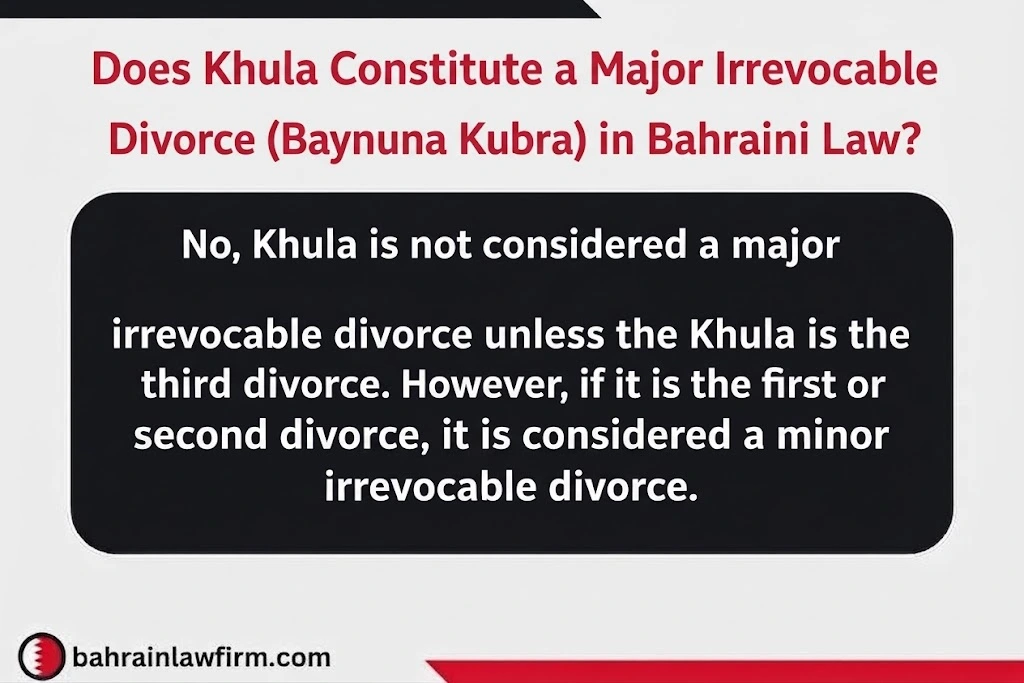
From a legal perspective, Khula is generally treated as an irrevocable divorce. However, it does not amount to a major irrevocable divorce unless it represents the third divorce between the spouses. Once Khula is completed, the husband cannot take his former wife back unless they enter into a new marriage contract with a new dowry, subject to the rules governing the type and number of previous divorces.
Does Khula Always Constitute a Major Irrevocable Divorce?
Khula does not always constitute a major irrevocable divorce. Its legal effect depends mainly on the number of previous divorces between the spouses:
- Minor irrevocable divorce: If Khula constitutes the first or second divorce, it is considered a minor irrevocable divorce. The former spouses may marry each other again by entering into a new marriage contract and agreeing on a new dowry.
- Major irrevocable divorce: If Khula constitutes the third divorce, it becomes a major irrevocable divorce. In that situation, the former spouses cannot remarry unless the woman first enters into a valid marriage with another husband and that marriage subsequently ends in accordance with the applicable Sharia rules.
When Is Khula Used?
A wife may seek Khula when serious disagreements arise between the spouses and continuing the marital relationship becomes difficult. Common reasons may include:
- A lack of compatibility between the spouses.
- The wife’s wish to end the marriage because she believes she can no longer fulfil her marital obligations toward her husband.
- Psychological or physical harm suffered by the wife.
The Role of a Lawyer and the Importance of Legal Representation in Khula Cases
Family disputes such as Khula cases require specialized legal knowledge to help protect the rights of both parties. A lawyer’s role may include:
- Providing legal advice and explaining the rights and obligations of both the wife and the husband.
- Preparing the required legal documents, submissions, and pleadings to help the proceedings move forward properly.
- Assisting with negotiations concerning the financial compensation payable in Khula.
- Representing the wife or husband before the court and presenting their legal position and claims.
Appointing an experienced lawyer in Bahrain who specializes in family matters can help simplify the procedures and protect your legal rights, particularly given the legal and practical complexities that may arise in family disputes.
Frequently Asked Questions
Here are some of the most common questions about Does Khula Constitute a Major Irrevocable Divorce?
Can Khula Take Place Without the Husband’s Consent?
No. In Bahrain, Khula generally cannot take place without the husband’s consent, as it is based on an agreement between both spouses. However, where serious harm is established, the court may intervene through the appropriate judicial procedures.
What Is the Difference Between Khula and Regular Divorce?
The main differences between Khula and regular divorce are:
1. Khula is initiated at the wife’s request, usually in return for financial compensation.
2. Regular divorce may be initiated by the husband without requiring such compensation.
Can the Spouses Reconcile After Khula?
The spouses may remarry after Khula under a new marriage contract and with a new dowry if the Khula results in a minor irrevocable divorce. However, in the case of a major irrevocable divorce, they cannot remarry unless the woman has lawfully married another husband and that marriage has subsequently ended.
Under Bahraini law, Khula may be treated as either a minor or major irrevocable divorce depending on the number of previous divorces between the spouses. To understand your legal position and protect your rights, it is important to consult a specialized divorce lawyer.
Contact us through the WhatsApp button at the bottom of the screen to request a legal consultation.
Learn more about:
What Are the Husband’s Rights in Khula? in Bahrain. What Are the Khula Procedures? under Bahraini law.

A Bahraini lawyer and the founder of a legal consultancy firm established in February 2019. He holds a Higher Degree in Sharia and Law from Al-Azhar University. He has extensive experience in court representation and providing legal advice in criminal, personal status, civil, and commercial matters. He is known for delivering clear, practical, and effective legal advice aimed at protecting his clients’ rights and interests, and has achieved tangible results in notable cases, including commercial litigation and inheritance matters
