

Some people may wonder about the rights related to Paternal half-brother inheritance under Bahrain’s inheritance law, especially when other heirs are present, such as full siblings or children.
In this article, we explain in detail how inheritance is distributed in accordance with Islamic Sharia principles and Bahrain’s Family Law.
For immediate contact, use the WhatsApp button at the bottom of the screen.
Table of Content
Paternal half-brother inheritance rights under Bahraini law
Inheritance distribution in Bahrain is based on Islamic Sharia and the Family Law, Parts One and Two. A paternal half-brother may be entitled to a share of the estate if there is no heir who legally excludes him, such as a full brother or the deceased’s children.
When is a paternal half-brother entitled to inherit?
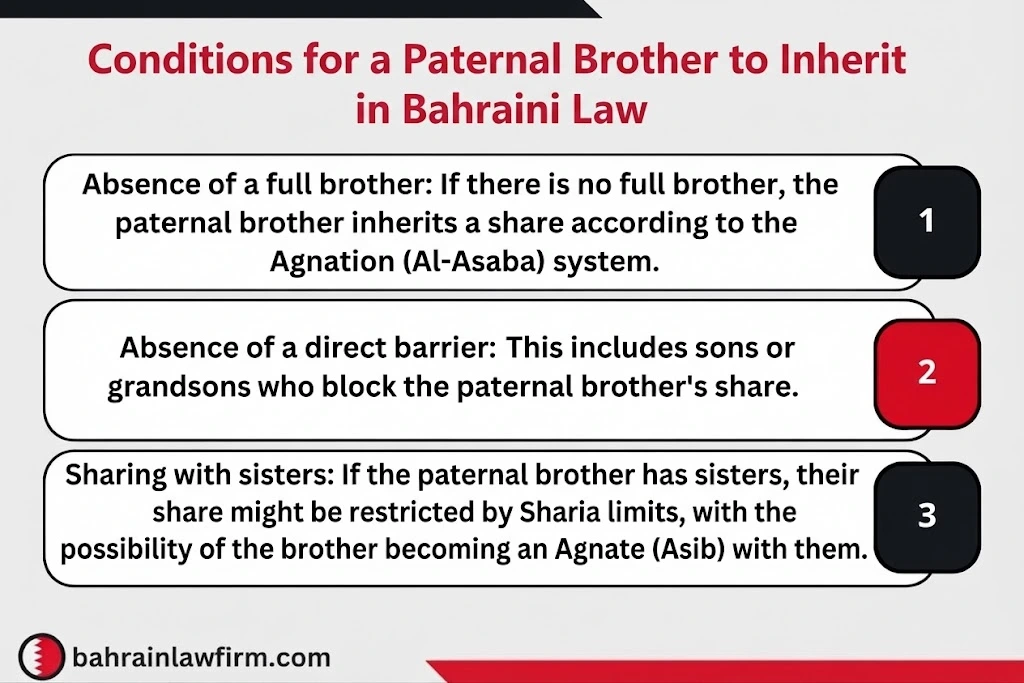
A paternal half-brother may receive a share of the inheritance in the following cases:
- No full brother exists: If there is no full brother, the paternal half-brother may inherit under the residuary inheritance rules.
- No direct heir excludes him: This may include children or certain descendants whose presence can prevent the paternal half-brother from inheriting.
- He inherits alongside paternal half-sisters: If the paternal half-brother has paternal half-sisters, their shares are determined according to Sharia rules, and he may become a residuary heir together with them.
How is the paternal half-brother’s share calculated?
The paternal half-brother’s share is calculated as follows:
- As a residuary heir, he receives the remainder of the estate after the fixed-share heirs have received their prescribed shares.
- If he is the only legal heir, he may receive the entire estate.
Estate distribution procedures and protection of a paternal half-brother’s rights
To protect the rights of all heirs, Bahraini law requires specific legal procedures to be followed when distributing an estate. These procedures include:
- Obtaining the death certificate: This is one of the first official documents required to begin the inheritance process and identify the heirs.
- Establishing the legal heirs: An application is submitted to the competent court to identify the heirs and determine each person’s entitlement.
- Distributing the estate: The estate is distributed in accordance with Sharia rules after debts and other financial obligations have been settled.
The role of a lawyer in inheritance cases
Seeking assistance from an experienced inheritance lawyer at a law firm in Bahrain is an important step toward ensuring that the applicable legal rules are followed correctly and that the heirs’ rights are protected.
A lawyer can provide the following services:
- Provide legal advice on the inheritance rights of the heirs.
- Prepare the documents required for estate distribution.
- Represent the client before the court to help secure the share they are legally entitled to under Sharia.
Working with a law firm experienced in inheritance matters can save time and effort and may also help prevent disputes that could arise between the heirs.
Frequently Asked Questions
Can a paternal half-brother inherit if the deceased has children?
No. A paternal half-brother generally does not inherit if the deceased has children who legally exclude him from the inheritance under the applicable Sharia rules.
How is a paternal half-brother’s share determined if he has sisters?
If the paternal half-brother inherits together with paternal half-sisters, he may become a residuary heir with them, and their shares are determined in accordance with the applicable Sharia rules.
In matters involving Paternal half-brother inheritance, Bahraini law applies Islamic Sharia principles to ensure that the estate is distributed according to the legal rights of the heirs.
To protect your inheritance rights and avoid unnecessary legal complications, you can contact our office for legal advice and the assistance required to complete the inheritance procedures. For direct contact, use the WhatsApp button at the bottom of the screen.

A Bahraini lawyer and the founder of a legal consultancy firm established in February 2019. He holds a Higher Degree in Sharia and Law from Al-Azhar University. He has extensive experience in court representation and providing legal advice in criminal, personal status, civil, and commercial matters. He is known for delivering clear, practical, and effective legal advice aimed at protecting his clients’ rights and interests, and has achieved tangible results in notable cases, including commercial litigation and inheritance matters
