
The topic of Inheritance distribution for someone with no children raises many questions among heirs, especially when the deceased leaves no direct descendants.
In Bahrain, these cases are governed by clear rules under the Personal Status Law, while taking into account the factors that affect Inheritance distribution for someone with no children, such as the presence of a husband or wife, parents, or siblings.
An inheritance distribution table is often used to show the legally prescribed shares for each category of heirs. This is where the role of an inheritance lawyer becomes important, as they help ensure that both Sharia principles and legal rules are applied accurately and fairly.
Has one of your relatives passed away without leaving children, and are you concerned about relatives becoming involved or the estate becoming difficult to divide because of inheritance complications? Do not let personal opinions create family disputes.
Table of Content
Inheritance Distribution for Someone With No Children in Bahrain
Inheritance distribution where there are no children is governed in detail by Islamic Sharia. The estate is divided according to how closely each heir is related to the deceased.
The shares are distributed based on the rules set out in the Quran and Sunnah, while also taking the provisions of Bahrain’s family law into account.
Heirs When There Are No Children
When the deceased leaves no children, the estate is divided among the lawful heirs according to their degree of kinship, as follows:
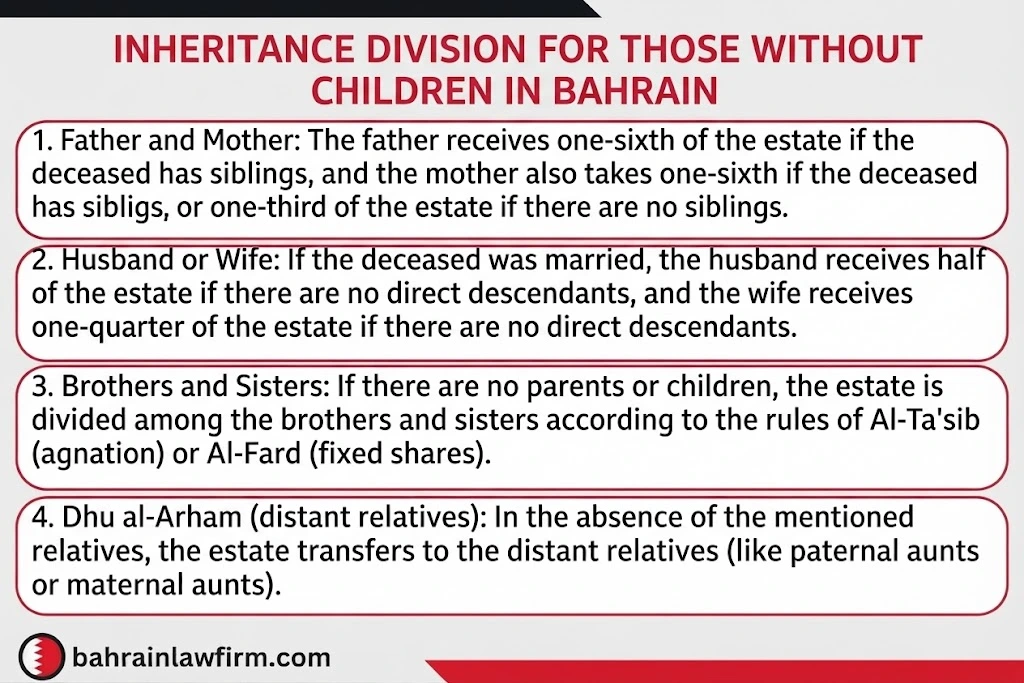
- Father and mother: The father may inherit the residue as a residuary heir after the fixed-share heirs when there is no descendant. The mother receives one-sixth if the deceased has siblings, or one-third of the estate if there are no siblings, subject to the circumstances of the case.
- Husband or wife: If the deceased was married, the husband receives one-half of the estate when there is no descendant. The wife receives one-quarter when there is no descendant.
- Brothers and sisters: If there are no parents or children, the estate may pass to brothers and sisters according to the applicable rules of fixed shares and residuary inheritance.
- Distant kindred: If none of the closer relatives mentioned above exist, the estate may pass to distant relatives such as paternal or maternal aunts, depending on the applicable rules.
Factors Affecting Inheritance Distribution for Someone With No Children
To identify the lawful heirs accurately when the deceased has no children, several factors must be considered:
- The number of heirs and the presence of close relatives.
- Whether there is a valid Sharia-compliant will.
- Any outstanding debts owed by the deceased.
Inheritance Distribution Table
Below is a simplified inheritance distribution table in Bahrain based on the Islamic inheritance rules applied by the Bahraini Sharia courts. The exact shares may vary depending on the number of heirs and their degree of kinship:
| Category of Heir | Share When There Are No Children | Sharia Notes Under Bahraini Law |
| Wife | One-quarter (¼) | If there is no descendant, meaning no children or grandchildren |
| Husband | One-half (½) | If there is no descendant |
| Father | One-sixth (⅙) + possible residuary share | His share depends on whether descendants exist and on the composition of the remaining heirs |
| Mother | One-third (⅓) | If there is no descendant and no qualifying number of siblings that would reduce her share |
| Full brothers | Residue as residuary heirs, where applicable | Generally applies in the absence of descendants and the father |
| Full sisters | One-half for one sister, two-thirds for two or more | Where the relevant legal conditions are met and no brother makes them residuary heirs |
| Paternal or maternal half-siblings | Depends on the case | The share varies depending on the presence of full siblings, the father, the mother, and other heirs |
| Grandfather / grandmother | The grandfather may inherit in place of the father in some cases, while a qualifying grandmother may receive one-sixth | The rules apply when the closer parent is absent and the legal conditions are satisfied |
| Distant kindred | May inherit where no closer lawful heirs exist | May include certain nephews, uncles, maternal relatives, and other extended family members depending on the legal classification |
| State Treasury | May receive the estate only where no lawful heirs exist | Subject to Article 1 of Law No. 11 of 1971 |
The Role of an Inheritance Distribution Lawyer in Bahrain
Hiring a lawyer in Bahrain who specializes in inheritance cases is important for preventing disputes and ensuring that the estate is divided in accordance with the law.
An inheritance distribution lawyer in Bahrain plays a central role in making sure the estate is divided fairly and in line with both Bahraini Personal Status Law and Islamic Sharia principles.
Their work is not limited to procedural matters. It also includes providing full legal and Sharia support, especially in complex cases involving no children or heirs from different degrees of kinship. Their responsibilities may include:
- Preparing the official inheritance certificate that identifies the lawful heirs and determines each person’s exact share.
- Identifying and listing all estate assets, including movable and immovable property, shares, and bank balances.
- Reviewing debts and wills and ensuring they are settled or implemented before distribution in accordance with Sharia requirements.
- Representing heirs before the Sharia court where a dispute or objection to the distribution arises.
- Drafting amicable settlement agreements between heirs to avoid lengthy court proceedings.
- Providing Sharia and legal advice to ensure that all distribution procedures comply with Bahraini law.
For this reason, seeking the assistance of an experienced inheritance lawyer who specializes in estate matters and Inheritance distribution for someone with no children is an essential step toward protecting legal rights and making the process easier.
Our law firm provides professional legal advice to resolve inheritance cases with accuracy and transparency.
Frequently Asked Questions About Inheritance Distribution for Someone With No Children
Here are some of the most common questions about inheritance distribution:
How is the inheritance divided between the wife and siblings if there are no children?
If the deceased leaves no children, the wife receives one-quarter of the estate. The remaining portion is distributed among the siblings according to the applicable rules of residuary inheritance.
What is the mother’s share if the deceased has no children?
The mother’s share, if the deceased has no children, is as follows:
1. If the deceased leaves neither children nor siblings,
2. the mother receives one-third of the estate
Can the distribution of inheritance be changed by a will?
Yes, the distribution of inheritance may be affected by a will. A will is generally enforceable up to one-third of the estate, while any amount exceeding that limit requires the approval of the heirs.
In conclusion, Inheritance distribution for someone with no children in Bahrain is subject to detailed Sharia and legal rules that vary according to the type of heirs and how closely they are related to the deceased.
The inheritance distribution table provides a useful way to understand the basic entitlements. However, some cases require legal assistance to interpret the applicable rules or resolve disputes.
This is where an experienced inheritance lawyer can help ensure that the estate is distributed correctly and fairly. For advice on your specific case, contact us through the WhatsApp button at the bottom of the page.

A Bahraini lawyer and the founder of a legal consultancy firm established in February 2019. He holds a Higher Degree in Sharia and Law from Al-Azhar University. He has extensive experience in court representation and providing legal advice in criminal, personal status, civil, and commercial matters. He is known for delivering clear, practical, and effective legal advice aimed at protecting his clients’ rights and interests, and has achieved tangible results in notable cases, including commercial litigation and inheritance matters
