
The Inheritance Law in Bahrain governs the distribution of a deceased person’s estate in accordance with Islamic Sharia principles and forms part of the legal framework governing personal status matters in the Kingdom of Bahrain.
The law raises several practical questions, including: What is the Inheritance Law in Bahrain? How is an estate distributed under Bahraini law? These questions become particularly important because inheritance rights vary according to the heirs involved and their degree of relationship to the deceased.
The legal process involves several procedures for dividing an estate in Bahrain. It begins with confirming the death and obtaining the Sharia inheritance document and continues until ownership of inherited assets is formally transferred.
Understanding when to consult an inheritance lawyer in Bahrain can help heirs protect their rights and deal properly with potential Sharia or legal disputes.
Are you facing a dispute between heirs, delays in distributing an estate, or uncertainty about your inheritance rights under the Inheritance Law in Bahrain?
Consult an Inheritance Lawyer Now
Or continue reading to understand estate distribution and inheritance shares in Bahrain.
Table of Content
What Is the Inheritance Law in Bahrain?
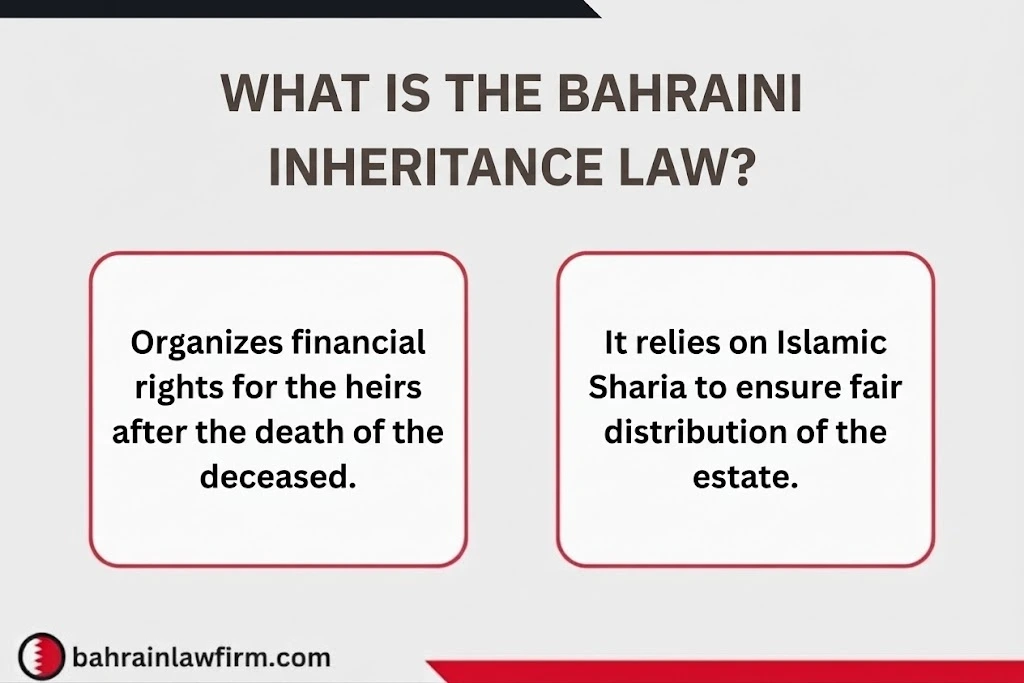
The Inheritance Law in Bahrain is based on Islamic Sharia principles and governs how a deceased person’s estate is distributed among the lawful heirs. The applicable inheritance shares depend on the heirs who survive the deceased and their relationship to them. In relevant cases, the Sharia rule under which a male may receive the share of two females applies alongside the other inheritance rules governing spouses, parents, descendants, and other heirs.
Conditions for Entitlement to Inheritance
To qualify as an heir under the applicable inheritance rules in Bahrain, the following conditions must generally be met:
- Death of the deceased: The death of the person whose estate is being inherited must be established.
- The heir must be alive at the time of death: The heir must generally be living when the deceased dies.
- No legal or Sharia impediment to inheritance: An impediment such as unlawful killing or a difference in religion may affect inheritance entitlement according to the applicable rules.
How Is an Estate Distributed Under Bahraini Law?
After the deceased’s death, the estate is distributed according to the applicable Sharia inheritance shares. These may include the following:
- Rights of the Husband or Wife
- If the deceased has children, the wife generally inherits one-eighth, while the husband generally inherits one-quarter.
- If the deceased has no children, the wife generally inherits one-quarter, while the husband generally inherits one-half.
- Rights of Children
- Where the applicable Sharia rules provide for sons and daughters to inherit together, a son may receive twice the share of a daughter under the rule that a male receives the share of two females.
- Rights of the Parents
- The father and mother may each receive one-sixth when the deceased leaves children, subject to the applicable inheritance rules.
- If the deceased has no children, the mother may receive one-third in the relevant circumstances, while the remaining estate is distributed to the father or other heirs according to the applicable Sharia rules.
Procedures for Dividing an Estate in Bahrain
To obtain their lawful shares, heirs generally need to complete the following procedures:
- Obtain the death certificate from the competent authorities.
- Obtain the Sharia inheritance document identifying the heirs and the share of each heir.
- Identify and inventory the deceased’s estate, including money, real estate, debts owed to the deceased, and other property.
- Settle debts and liabilities that must be paid before the estate is distributed.
- Distribute the remaining estate according to the shares stated in the Sharia inheritance document.
The Sharia Inheritance Document in Bahrain
The Sharia inheritance document in Bahrain is an official document issued through the Sharia Court. It identifies the deceased’s heirs and determines the share of the estate to which each heir is entitled under Islamic Sharia rules.
This document is important before dealing with the deceased’s money, real estate, bank accounts, or other assets because it establishes for government bodies and other institutions who the lawful heirs are and the share belonging to each of them.
Bahrain’s National Portal explains that the service for issuing a Sharia inheritance document determines the heirs and the share of each person in accordance with Islamic Sharia.
When Do Heirs Need a Sharia Inheritance Document?
Heirs generally need to obtain the Sharia inheritance document when the deceased leaves an estate, whether it consists of cash, real estate, vehicles, shares, or financial rights held by third parties.
Its purpose goes beyond identifying the heirs. It also provides an official basis for dealing with the estate and helps prevent individual dealings with inherited property before the lawful heirs and their respective shares have been established.
It is commonly required in situations such as:
- Dealing with banks to identify or release the deceased’s account balances.
- Transferring ownership of inherited real estate or selling it after completing the required procedures.
- Determining each heir’s share when dividing the estate.
- Protecting the rights of minors or absent heirs.
- Completing government transactions relating to the deceased’s money or property.
Legal Basis of the Sharia Inheritance Document
Inheritance matters in Bahrain are governed by the applicable Sharia rules according to the circumstances of the deceased.
Bahrain’s Family Law No. 19 of 2017 provides that matters relating to inheritance, gifts, wills, and endowments are governed by the school of Islamic jurisprudence followed by the deceased. This means that the inheritance shares recorded in the Sharia inheritance document are determined according to applicable Sharia and legal rules rather than through an arbitrary calculation.
Why Accurate Information Matters When Applying for the Document
Accurate information about the heirs is essential when applying for a Sharia inheritance document. An incorrect name or the omission of a person who is entitled to inherit may later lead to disputes between family members.
Minister of Justice, Islamic Affairs and Endowments Decision No. 3 of 2017 concerning the procedures for issuing documents falling within the jurisdiction of the Sharia Procedures Judge also stresses the importance of ensuring that a person who is not an heir is not included and that no lawful heir is omitted. Providing incorrect information may expose the applicant to legal responsibility.
Before submitting the application, it is therefore advisable to check:
- The full names of all heirs as stated in their official documents.
- Each heir’s degree of relationship to the deceased.
- Whether a husband or wife was alive at the time of death.
- Whether there are minors, an unborn child, or absent heirs.
- Whether there is a Sharia-compliant will or other documents that may affect the estate.
Does the Sharia Inheritance Document Complete the Distribution of the Estate?
Issuing the Sharia inheritance document does not necessarily mean that the estate has actually been divided among the heirs. The document identifies the heirs and their respective shares. Further procedures may still be required, such as selling inherited real estate, transferring title, filing an estate division claim when the heirs cannot agree, or obtaining a Sharia succession document if one of the heirs dies after an earlier inheritance document has been issued.
Bahrain’s National Portal explains that the Sharia succession procedure is used to include the heirs of an heir who subsequently dies and to determine the final shares of the surviving heirs.
When Should You Consult an Inheritance Lawyer in Bahrain?
It may be appropriate to consult an inheritance lawyer in Bahrain when legal or procedural issues arise during the administration or division of an estate. Common situations include:
- When a person dies and leaves an undistributed estate: a lawyer can assist with identifying the heirs, inventorying the estate, and obtaining the Sharia inheritance document.
- When there are no children or other direct heirs: legal advice can clarify who is entitled to inherit and how the relevant inheritance rules apply.
- When a dispute arises between heirs: this may involve inheritance shares, ownership of specific property, or the implementation of a will.
- When an heir is absent, a minor, or unable to represent themselves: appropriate legal procedures may be required to protect that heir’s rights.
- Before selling or dividing inherited property: reviewing the required procedures can help avoid an invalid or legally defective transaction.
- When a will or gift exists: legal advice can help determine its validity and its effect on the distribution of the estate.
- When the estate includes property outside Bahrain: legal advice may be required regarding cross-border inheritance procedures and court jurisdiction.
Legal assistance may help heirs complete the required procedures correctly and address disputes that could otherwise delay the distribution of the estate or affect inheritance rights.
How Can Our Law Firm Help?
Our law firm assists clients with inheritance matters in Bahrain through services that include:
- Providing legal advice regarding inheritance rights and applicable Sharia rules.
- Assisting with the procedures for obtaining the required official documents.
- Providing legal representation in inheritance disputes before the competent courts when necessary.
- Assisting with the legal procedures involved in administering and distributing an estate.
Contact us through the WhatsApp button at the bottom of the page to speak with a lawyer in Bahrain and obtain legal advice concerning inheritance and estate distribution.
Frequently Asked Questions About the Inheritance Law in Bahrain
Can the Heirs’ Shares Be Changed by Agreement?
No. As a general rule, the share of an heir cannot be increased or reduced contrary to the legally prescribed inheritance shares, even if the heirs agree among themselves, because inheritance shares are determined under the applicable rules of Islamic Sharia and Bahraini personal status law.
Can the Heirs’ Shares Be Changed by Agreement?
No. As a general rule, the share of an heir cannot be increased or reduced contrary to the legally prescribed inheritance shares, even if the heirs agree among themselves, because inheritance shares are determined under the applicable rules of Islamic Sharia and Bahraini personal status law.
However, after receiving their lawful shares, heirs may voluntarily waive or transfer their shares to another person, provided that the waiver or transfer is properly documented in writing and registered with the competent authorities where required.
What Happens if One of the Heirs Is a Minor?
If one of the heirs is a minor who has not reached the legal age of majority, a legal guardian may be appointed to manage the minor’s share of the estate in accordance with the applicable guardianship rules.
The minor’s share generally cannot be sold or otherwise disposed of without court approval. The competent court supervises the management of the minor’s property to protect their financial rights until they reach the age of majority.
Can the Heirs Sell the Estate Before Distribution?
It is generally preferable not to sell estate assets before obtaining the official inheritance document and determining each heir’s share, unless all heirs agree and the applicable legal requirements are satisfied.
How Can Disputes Between Heirs Be Resolved?
Heirs may refer inheritance disputes to the competent Sharia courts or seek assistance from a lawyer experienced in inheritance matters to resolve the dispute through the appropriate legal procedures.
Does the Estate Include Debts?
Yes. Debts owed by the deceased must be settled from the estate before the remaining assets are distributed among the heirs.
The Inheritance Law in Bahrain determines how inheritance rights and estate shares are handled according to the applicable legal and Sharia rules.
Understanding the relevant procedures and obtaining legal advice when a dispute or complex estate issue arises can help heirs deal with the estate on a proper legal basis.
For advice concerning your inheritance rights, contact our law firm in Bahrain through the WhatsApp button at the bottom of the page.

A Bahraini lawyer and the founder of a legal consultancy firm established in February 2019. He holds a Higher Degree in Sharia and Law from Al-Azhar University. He has extensive experience in court representation and providing legal advice in criminal, personal status, civil, and commercial matters. He is known for delivering clear, practical, and effective legal advice aimed at protecting his clients’ rights and interests, and has achieved tangible results in notable cases, including commercial litigation and inheritance matters
