
The Mother and father’s share of their son’s inheritance changes depending on which heirs are alive at the time of death and the school of Islamic jurisprudence followed by the deceased in Bahrain. For this reason, simply knowing that both parents are alive is not enough to calculate the estate accurately. The presence of a son, daughter, wife, or siblings may change the final distribution.
Start the distribution process by identifying all heirs, assets, and debts. Then obtain the Sharia inheritance certificate and determine each heir’s legal share. If you are dealing with an actual estate or an existing inheritance dispute, review the case carefully before signing any distribution agreement or giving up any right.
Are you facing a dispute over the distribution of a son’s estate and the parents’ shares, and finding the inheritance rules confusing?
Contact an inheritance lawyer to review the estate now
You can also read the article first to understand how a son’s estate is distributed and how the parents’ shares are determined under Bahraini law before contacting us.
Table of Content
How much do the mother and father inherit from their son?
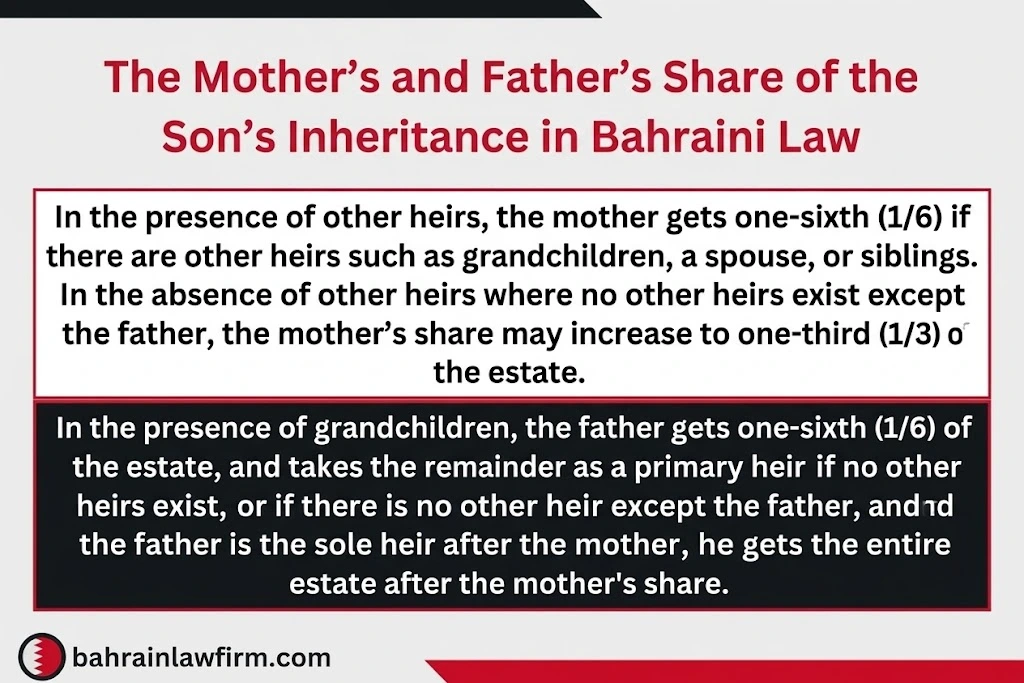
In short, the Mother and father’s share of their son’s inheritance depends on the composition of the heirs. In common Sunni inheritance cases, the mother receives one-third when the father and mother are the only heirs, while the father receives the remainder.
The mother’s share may fall to one-sixth if the deceased leaves a direct descendant or a qualifying group of siblings. In certain cases, she may instead receive one-third of the remainder when she inherits together with the father and one of the spouses.
The father may receive one-sixth, one-sixth plus the remainder, or the remainder after the fixed shares have been distributed, depending on whether the deceased left descendants and on the type of those descendants.
Before relying on any percentage, confirm which school of Islamic jurisprudence applies to the estate, because Bahraini family law applies the jurisprudential school followed by the deceased in inheritance matters.
What is the legal basis for determining the parents’ shares in Bahrain?
Article 909 of the Bahraini Civil Code provides that the identification of heirs, determination of their shares, and transfer of estate assets to them are governed by the rules of Islamic Sharia.
This forms the legal framework for Bahraini inheritance law when identifying heirs and determining their shares. Family Law No. 19 of 2017 also provides that inheritance matters are governed by the school of jurisprudence followed by the deceased.
For that reason, you should not take one inheritance table and apply it automatically to every estate in Bahrain without first determining whether the case falls under Sunni or Jaafari jurisprudence.
This distinction becomes particularly important when the deceased leaves only daughters, siblings, several fixed-share heirs, or cases in which the remaining estate changes after the fixed shares are distributed.
Table of the Mother and father’s share of their son’s inheritance in common Sunni cases
The following table gives a general overview of several common situations. However, it does not replace a full estate calculation after all heirs have been identified:
| Situation of the deceased son | Mother’s share | Father’s share | Note |
|---|---|---|---|
| He leaves only his father and mother | One-third | The remainder, which is two-thirds | There are no other heirs |
| He leaves a wife, father, and mother with no direct descendant | One-third of the remainder after the wife’s share | The remainder | A well-known case in Sunni jurisprudence |
| He leaves a son or sons | One-sixth | One-sixth | The remainder is distributed among the sons according to their legal shares |
| He leaves a daughter or daughters but no son | One-sixth | One-sixth and may also receive the remainder | The case requires a full inheritance calculation |
| There is no direct descendant, but there is a qualifying group of siblings | The mother may receive one-sixth | The father’s share depends on the other heirs | The siblings may affect the mother’s fixed share |
The table explains common Sunni inheritance situations only. When dealing with an actual estate in Bahrain, determine the school of jurisprudence followed by the deceased and identify all heirs before relying on any percentage.
When does the mother receive one-sixth, and when does she receive one-third?
The mother’s share changes according to the heirs who are present. If the deceased son leaves a direct descendant in a typical Sunni case, the mother’s share of the inheritance is one-sixth.
This usually applies when the deceased leaves sons or daughters. Siblings may also affect her share in certain cases, depending on their degree of kinship, including matters related to maternal half-sister inheritance, depending on the full group of heirs.
If there is no direct descendant and no qualifying group of siblings that reduces her fixed share, the mother may receive one-third.
In some cases, the mother receives one-third of the remainder when she inherits together with the father and one of the spouses. Therefore, the presence of a wife alone does not automatically reduce the mother’s share to one-sixth.
Anyone looking specifically for information about a mother’s inheritance from her son and the situations in which she is entitled to inherit can refer to the dedicated article on this topic instead of repeating all the details here.
When does the father inherit one-sixth, and when does he receive the remainder?
The father’s share changes depending on whether the deceased leaves a direct descendant.
In a typical Sunni case, the father receives one-sixth when the deceased leaves a son. The rest of the estate is then distributed among the other entitled heirs.
If the deceased leaves a daughter or daughters but no son, the father may receive one-sixth and then also inherit what remains after the fixed shares are distributed, depending on the composition of the estate.
If there is no direct descendant at all, the father may receive the remainder after the fixed-share heirs have received their shares.
Understanding these situations prevents a common mistake: assuming that the father always receives one-sixth or always receives the remainder in every inheritance case.
How is the Mother and father’s share of their son’s inheritance calculated if he had no children?
The situation is relatively straightforward when the father and mother are the only heirs. In a typical Sunni case, the mother receives one-third, while the father receives the remaining two-thirds.
Suppose the net estate is BHD 60,000 and the deceased leaves no wife, children, or other heirs.
The distribution would be:
- Mother: BHD 20,000.
- Father: BHD 40,000.
This example explains the Mother and father’s share of their son’s inheritance when the parents are the only heirs. It should not be applied directly to cases involving a wife, siblings, or other heirs.
The net estate must also be calculated first, because debts, liabilities, and other estate-related obligations affect the amount that can actually be distributed.
What happens if the son leaves a wife, father, and mother?
The method used to calculate the Mother and father’s share of their son’s inheritance changes when the deceased leaves a wife. This scenario requires particular care because calculation mistakes are common.
The reverse situation, where the wife dies, is different because a husband’s inheritance from his wife is determined independently according to whether she leaves descendants and who the other heirs are.
If the net estate is BHD 100,000:
- The wife receives BHD 25,000.
- BHD 75,000 remains.
- The mother receives BHD 25,000, which is one-third of the remainder.
- The father receives BHD 50,000.
This example corrects the common belief that the presence of a wife by itself automatically reduces the mother’s share to one-sixth.
How does the calculation change if the son has children?
The presence of children directly affects the Mother and father’s share of their son’s inheritance.
For example, if the deceased leaves a wife, father, mother, and two sons, both the father and mother receive one-sixth in a typical Sunni case.
The wife receives one-eighth because the deceased left direct descendants, and the remainder goes to the two sons. If the mother herself dies, however, the direction of inheritance changes, and the children’s share of their mother’s inheritance depends on the other heirs who are alive.
Suppose the net estate is BHD 120,000:
- Wife: BHD 15,000.
- Mother: BHD 20,000.
- Father: BHD 20,000.
- The remaining BHD 65,000 goes to the two sons.
This example is for illustration only, because changing any heir may alter the way the estate is distributed.
What if the son leaves only daughters?
A case involving only daughters differs from one involving a male child.
Under Sunni jurisprudence, the father may receive one-sixth in addition to what remains after the fixed shares have been distributed, while the mother generally receives one-sixth because a direct descendant exists.
For this reason, determine the number of daughters, whether there is a wife, and who the other heirs are before calculating the final result.
Mistakes become more likely when someone takes an example involving sons and applies it to a situation involving daughters only. Each estate should therefore be calculated according to its own facts instead of copying shares from a different case.
Does the distribution differ between Sunni and Jaafari jurisprudence?
Yes. The result may differ in some situations.
Bahraini Family Law provides that inheritance matters are governed by the jurisprudential school followed by the deceased. A correct calculation therefore starts by identifying the applicable school of jurisprudence, then identifying the heirs, and only then determining their shares.
Listing many general jurisprudential rules without linking them to a specific estate is not always useful, because a rule that applies to one estate may not apply to another.
A detailed review becomes especially important when the deceased leaves daughters but no sons, siblings, heirs from several degrees of kinship, or when the case involves exclusion or redistribution of the remaining estate.
What must happen before the estate is actually distributed?
Start with the Sharia inheritance certificate before moving on to the actual distribution of assets.
Bahrain’s National Portal describes the Sharia inheritance certificate as an official document issued by the Sharia courts that identifies each heir’s share in the deceased’s estate in accordance with Islamic Sharia. The process may require documents such as the death certificate, heirs’ identification documents, and any official will, where applicable.
After identifying the heirs, move on to determining the actual components of the estate.
These may include:
- Real estate.
- Bank accounts.
- Shares or interests in companies.
- Vehicles.
- Money held by third parties.
- Outstanding financial rights.
- Debts and liabilities owed by the deceased.
Then review estate inventory in Bahrain to understand which assets form part of the estate and which documents may be required before distribution.
Knowing that an heir is entitled to one-third, for example, is not enough if you do not know the value from which that one-third will be calculated.
What is the difference between a Sharia inheritance certificate and an estate inventory?
The Sharia inheritance certificate identifies the heirs and determines each heir’s share.
The estate inventory, by contrast, identifies what the deceased actually left behind, including money, real estate, rights, and liabilities.
The inheritance certificate may therefore be complete while the distribution remains delayed because a property was not included in the estate inventory, or because a bank account or debt has not yet been dealt with.
Understanding the difference between these two procedures helps identify where the problem lies instead of starting a process that the case may not require.
When should you seek legal advice before dividing an inheritance?
Seek a legal assessment when the issue goes beyond simply calculating a percentage.
Legal advice is often useful when the list of heirs is unclear, some assets have not been identified, one heir objects to a sale, or the estate involves a will, debts, or a minor heir.
A consultation becomes especially important if:
- The heirs disagree about the mother’s or father’s share.
- The estate contains property that is difficult to divide in practice.
- One heir refuses to sell or sign.
- Assets are discovered that were not included in the estate inventory.
- The Sharia inheritance certificate has been issued but the estate has not been distributed.
- One of the heirs lives outside Bahrain.
- The heirs want to arrange a clear amicable distribution.
- A dispute arises over a previous transaction involving the deceased’s property.
Has the estate process stopped at one of these stages?
Review the inheritance certificate and the asset list first. An inheritance lawyer can then identify the source of the delay and determine whether the appropriate next step is an agreement between the heirs, completion of an official procedure, or court action.
What role does an inheritance lawyer play before the case reaches court?
A lawyer should begin by identifying the problem rather than immediately filing a lawsuit.
The delay may be caused by a missing document, an asset that has not been included in the estate inventory, or disagreement over a property valuation that can be addressed before the matter develops into court proceedings.
Depending on the case, a lawyer may:
- Review the Sharia inheritance certificate.
- Examine the list of heirs and supporting documents.
- Explain how each heir affects the calculation.
- Review the estate’s assets and liabilities.
- Help organize an agreement between the heirs.
- Assess objections to the distribution or dealings involving inherited property.
- Represent the interested party before the relevant court when necessary.
This review is especially useful when a question about the Mother and father’s share of their son’s inheritance involves property, large sums of money, or several heirs, because a mistake at the beginning of the case can affect every later step.
Can the heirs divide the estate by agreement?
The heirs may agree on the distribution as long as their rights are clear and the required procedures are completed.
Start by identifying the heirs, their shares, and the estate assets. Then discuss how the distribution will be carried out.
If the estate includes one property, for example, the heirs may agree to sell it and divide the proceeds. They may also agree for one heir to take ownership while settling the other heirs’ rights, depending on the agreement and the procedures required in the case.
If no agreement can be reached, the judicial route may be considered rather than leaving the estate unresolved for a long period.
If the problem relates specifically to real estate, it is better to refer to the dedicated article on procedures for selling inherited property in Bahrain instead of expanding this article with property-related details that do not serve its main search intent.
What should you do if one heir refuses to divide the estate?
Identify the reason for the objection first.
An heir may refuse because of a disagreement over the property valuation, because an asset has been left out of the estate, because the heir disputes the calculation, or because they do not agree to the sale.
Gather the Sharia inheritance certificate, ownership documents, valuations, and any correspondence related to the dispute. Then assess whether a settlement is possible before going to court.
Do not deal with jointly owned inherited property or bypass another heir’s rights before confirming the legal position. Trying to resolve one issue too quickly may create a more complicated dispute.
How should you prepare for a useful inheritance consultation?
Prepare the information that directly affects the legal assessment.
Where possible, start with:
- The deceased’s death certificate.
- The Sharia inheritance certificate, if already issued.
- The names of the heirs who were alive at the time of death.
- Documents relating to known properties and assets.
- Any official will.
- Information about debts and liabilities.
- Details of the current dispute between the heirs.
You do not need to have every document ready before seeking advice.
Start with what you have and identify the issue you want to resolve. Do you want to know the Mother and father’s share of their son’s inheritance, obtain the Sharia inheritance certificate, identify estate assets, or deal with an heir who refuses to divide the estate?
This makes the consultation more focused on the actual issue instead of starting with a general explanation that does not change the legal position.
Frequently Asked Questions
Key questions about the Mother and father’s share of their son’s inheritance.
How much does a mother inherit from her deceased son?
The mother’s share depends on the other heirs and the applicable school of Islamic jurisprudence. Under Sunni inheritance rules, she may inherit one-sixth if the deceased has descendants, one-third in other cases, or one-third of the remainder in certain situations where she inherits alongside the father and one of the spouses.
What is the mother’s share of the inheritance if the son has children?
Under the usual Sunni inheritance rules, the mother receives one-sixth if the deceased has descendants. The rest of the estate is then distributed among the other eligible heirs according to each heir’s legal share.
What is the mother’s share of the inheritance if the son has no children?
The mother may inherit one-third if there are no descendants and no group of siblings that reduces her prescribed share. However, if one of the spouses and the father are also heirs, the way her share is calculated may differ in certain cases.
Does the son’s wife make the mother’s share one-sixth?
No. The presence of the son’s wife alone does not make the mother’s share one-sixth. The existence of descendants, siblings, and other heirs must be considered before determining her exact share.
How much does a father inherit from his son?
The father may receive one-sixth, one-sixth plus the remainder, or the remainder after the prescribed shares are distributed, depending on whether the deceased has descendants, their type, and the other eligible heirs.
The Mother and father’s share of their son’s inheritance must be determined in line with the applicable Sharia and legal rules to ensure a fair distribution of the estate. Our lawyers provide the legal support needed to handle inheritance matters.
Whether you need legal advice or representation before the court, use the WhatsApp button at the bottom of the screen to contact our office directly and request legal assistance.
Also read: Inheritance Distribution Lawyer.

A Bahraini lawyer and the founder of a legal consultancy firm established in February 2019. He holds a Higher Degree in Sharia and Law from Al-Azhar University. He has extensive experience in court representation and providing legal advice in criminal, personal status, civil, and commercial matters. He is known for delivering clear, practical, and effective legal advice aimed at protecting his clients’ rights and interests, and has achieved tangible results in notable cases, including commercial litigation and inheritance matters
