
Legal Review: This content was written and reviewed by the legal team at the office of Lawyer Abdulrahman Khalifa.
Last Updated: 29/08/2026.
Category: Bahraini Contract Law.
A company may stop supplying what it owes, or a key obligation may drag on until the contract loses its whole point. Simply saying the other side broke the deal isn’t enough — termination doesn’t happen just because there’s a dispute or a short delay.
Everything starts with checking whether the Conditions for Contract Termination in Bahrain are actually met, whether the breach is serious, whether you’ve carried out your own obligations, and whether the other party got formal notice the right way.
Bahrain’s Civil Code regulates termination in contracts that bind both sides, and gives the judge room to weigh the dispute. So this guide walks you through your situation step by step: when it’s better to demand performance, when you can ask for termination and compensation, and what documents you need before filing a case.
Has the other party broken their obligations, and you’re worried about the wrong legal step? Don’t leave it hanging.
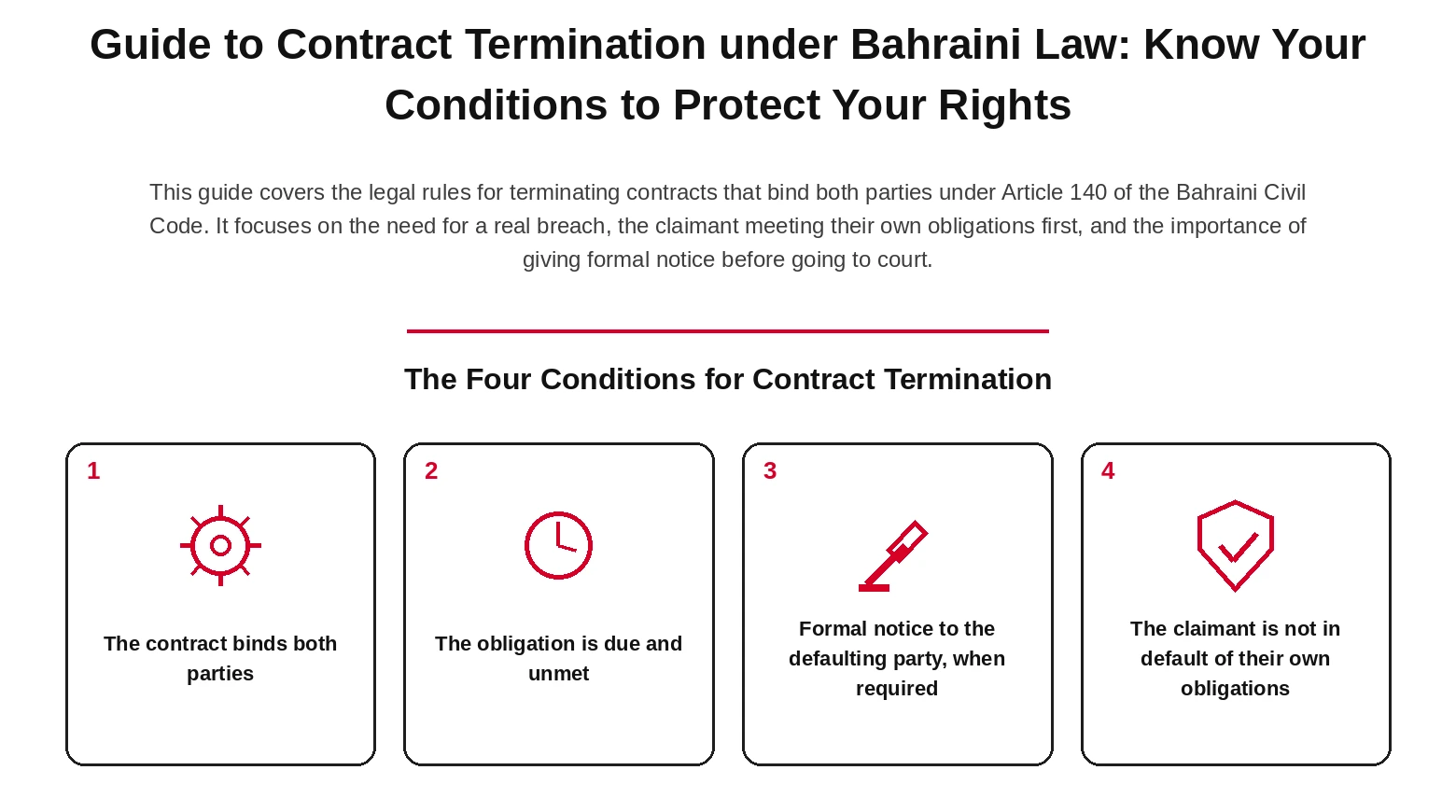
In short, Conditions for Contract Termination in Bahrain rest on a contract that binds both parties, an obligation that’s fallen due and gone unmet, formal notice where it’s required, and the party asking for termination not being at fault themselves.
The judge still has the final say on how serious the unmet part is — they can give the debtor more time, or refuse termination if what’s left undone is minor next to the contract as a whole.
Table of Content
What Does Contract Termination Mean?
Termination assumes there’s a valid, binding contract to start with, and that something happens afterward that affects it going forward — like one party not carrying out an obligation that’s already due. The other party can then, under the legal rules, ask the court to enforce the contract or terminate it, with compensation where that applies.
This distinction matters because it separates termination from issues that only look similar. If the problem is with the contract’s validity from the very start, the real dispute may be the difference between contract nullity and contract termination. And if the contract’s term simply ended, or someone used an independent right to end it, that’s the separate question of termination versus the expiry of a contract.
Conditions for Contract Termination in Bahrain Under Article 140 of the Civil Code
Article 140 of Bahrain’s Civil Code focuses on non-performance in contracts that bind both parties. It doesn’t turn every breach into an automatic reason to end the contract — instead, it ties a termination request to a set of elements that all need to be checked together.
1. The Contract Must Bind Both Parties
Start with the nature of the contract. It has to create matching obligations that each side carries a part of — like a seller’s duty to deliver against a buyer’s duty to pay, or a service provider’s duty to do the work against a client’s duty to pay the fee.
This condition matters because termination here is built on the link between obligations. If one party doesn’t carry out their share, it affects what the other side owes in return.
The details of these obligations differ depending on the type of contract. In commercial deals, it helps to pin down the types of commercial contracts in Bahrain before you assess the obligation.
2. The Obligation Must Be Due and Still Unmet
Check the due date before you even start thinking about termination. It’s not enough to expect the other side won’t perform, and a past disagreement doesn’t count either if the obligation hasn’t fallen due yet — unless some special legal situation changes that.
Pin down exactly which obligation was breached: is it a payment? A delivery? Finishing a stage of a project? Handing over a document? Then establish the date it was due, and what happened after that date.
This distinction helps separate a simple delay from non-performance that actually damages the whole point of the contract.
3. Giving Formal Notice to the Defaulting Party, When Notice Is Required
Don’t treat formal notice as a box-ticking step. Notice gives the other party clear warning that an obligation is due, and that failing to perform it could lead to legal action.
Check the contract first — it might set a specific way to notify the other side, an official address, or a grace period to fix the breach. Then keep proof that the notice was sent and received, since disputes can later shift to the date of the notice or how it was delivered.
Some rules change if the contract contains an explicit termination clause, which is why agreed (consensual) termination of a contract in Bahrain is handled on its own, so it doesn’t get mixed up with court-ordered termination.
4. The Party Seeking Termination Must Not Be at Fault
Review your own position before pointing the finger at the other side. Proving their breach isn’t enough if you’re also behind on an obligation that affects the dispute.
Gather proof of payment, delivery, or genuine readiness to perform, depending on the contract. A termination claim is much stronger when you can show the court what you carried out, what’s left, and why the contract stalled because of the other party.
This is where it genuinely pays to have a contracts lawyer review the contract and the correspondence before taking a step that can be hard to reverse.
Does Every Breach Lead to Termination?
No. And this is one of the most important points when weighing up the Conditions for Contract Termination in Bahrain — under Article 140, the judge can give the debtor more time, or refuse termination if the unmet part is minor compared to the obligations as a whole.
So ask how serious the breach is, not just whether it happened. A supplier running a few days late on something that didn’t affect the project is different from a delay that makes the delivery worthless after the selling season ends. And failing to pay a small part of a large sum while still performing the rest of the contract looks different from refusing to pay altogether.
There’s no fixed percentage that makes a breach material in every contract. It depends on the nature of the obligation, the purpose of the contract, what’s actually been carried out, the resulting harm, and how the parties behaved.
Do the Termination Conditions Apply to Your Case?
Use the table below as an initial check, not a substitute for reviewing the actual contract:
| Question | What You’re Looking For |
|---|---|
| Is the contract binding on both parties? | Clear, matching obligations |
| Has the obligation’s due date arrived? | A due date you can prove |
| Did an actual failure to perform happen? | A document, message, or event proving the breach |
| Was notice given when it was needed? | A clear notice with proof it was delivered |
| Did you carry out your own obligation? | Payment, delivery, or genuine readiness to perform |
| Is the breach material? | A real effect on the contract’s purpose, not a minor issue |
| Is there a special termination clause? | Clear wording that may change how termination is handled |
If most answers are clear and backed by evidence, your claim is easier to assess. If a key point is still unresolved, sort that out before filing.
What’s the Difference Between Non-Performance, Impossibility, and Exceptional Circumstances?
Don’t lump these situations under one label — each one has a different legal effect.
| Situation | General Legal Direction |
|---|---|
| The other party didn’t perform a due obligation despite being able to | Termination is considered under Article 140 |
| Performance became impossible for a reason beyond the debtor’s control | Automatic dissolution may be considered under Article 145 |
| Performance became excessively burdensome due to unforeseen, general exceptional events | The rules on exceptional circumstances apply, reducing the burdensome obligation to a reasonable level |
| The problem was with the contract’s validity from the moment it was formed | Nullity or voidability is considered |
| The contract’s term ended, or an independent right to end it was used | Expiry/ending is considered, based on the type of contract |
This prevents a common mistake — asking for termination every time performing the contract gets difficult. Difficulty, impossibility, and a genuine failure to perform aren’t the same thing.
How Do You Prove the Conditions for Contract Termination in Bahrain?
Start with the whole contract, not just the page with the termination clause, and arrange your documents in chronological order so it’s clear when the obligation arose, when it fell due, and what each side did after. What usually helps most:
- The contract, its annexes, and any amendments.
- Invoices and payment receipts.
- Purchase or delivery orders.
- Receipt records, or records of refusal to receive.
- Relevant emails and correspondence.
- The notice, plus proof it was sent or received.
- Technical reports, if the breach relates to quality or a defect in performance.
- Proof that the party seeking termination carried out their own obligations.
- Proof of the harm, if you’re also claiming compensation.
Don’t just dump every piece of correspondence on the table. Pick what proves a clear point and tie each document to the event it supports — that turns a vague claim like “the contract wasn’t performed” into specific facts the court can actually assess, ideally with a contracts lawyer reviewing it with you first.
How Do You File a Termination Lawsuit in Bahrain?
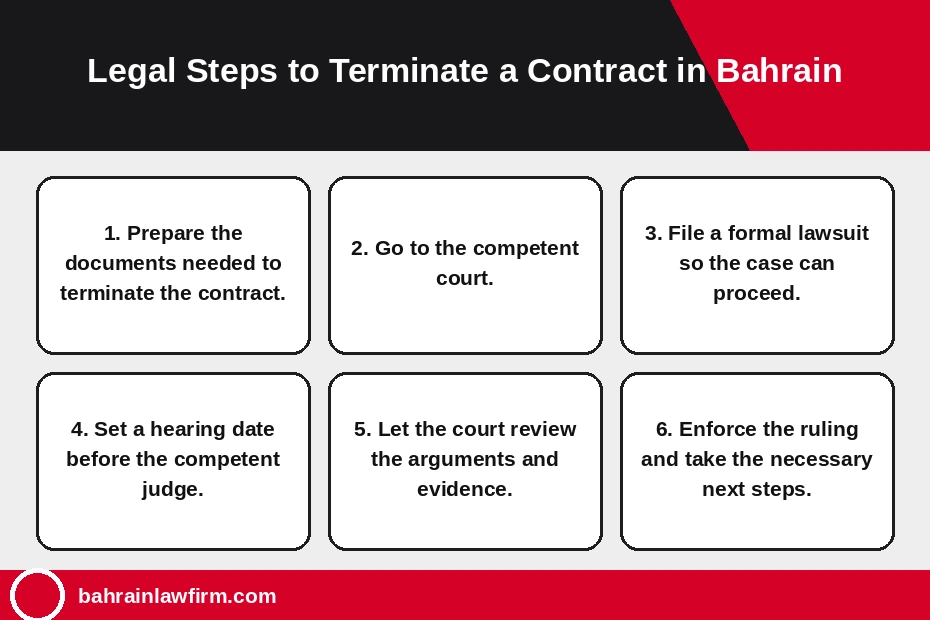
Once you’ve confirmed the Conditions for Contract Termination in Bahrain are met, identify the nature of the dispute, the competent court, and the requests you want to make, then prepare the statement of claim and its supporting documents.
Bahrain’s e-Judicial services let you file civil and commercial lawsuits online: enter the applicant’s and the parties’ details, the subject of the case, attach documents, and pay the fees. In practice, that means:
- Review the contract and identify the obligation that was breached.
- Send formal notice where it’s required, and keep proof it was delivered.
- Decide what you’re asking for: enforcing the contract, terminating it, or termination plus compensation.
- Prepare the statement of claim and the supporting documents.
- File the case through the channel set for the competent judicial body.
- Present the evidence and arguments relating to performance, the breach, and the harm caused.
- Wait for the court to assess whether the grounds for termination are met, along with the related requests.
- Follow the enforcement procedures once the ruling becomes enforceable.
Don’t start the case assuming termination is always the best option. In some cases, enforcing the contract makes more commercial sense, and a well-thought-out settlement can get your rights back faster.
What Can the Judge Decide When Termination Is Requested?
The court’s role isn’t limited to accepting or rejecting termination. Enforcing the contract may actually fit the dispute better, termination can be granted if its conditions are met (with compensation once its basis is proven), or the judge can give the debtor more time, or refuse termination if the unmet portion is minor.
Build your case on precise facts and connected requests. That matters even more in commercial disputes, where termination might involve large sums or ongoing supply — which is where a commercial lawyer in Bahrain can help you judge the effect on the whole business relationship.
What Are the Effects of Contract Termination Under Bahrain’s Civil Code?
These effects only come up once termination is actually established, and they aren’t themselves Conditions for Contract Termination in Bahrain — they’re what happens afterward.
Article 142 sets the basic rule: put both parties back where they were before the contract, or, if that’s not possible for one of them, order an equivalent payment instead. That can mean returning money or property, or valuing whatever can’t be returned — though the outcome isn’t the same for every type of contract.
What Happens With Continuing Contracts?
Article 143 says that in continuing contracts, termination only takes effect from the moment it actually happens. So a service already carried out over several months is treated differently from a sale of property that can simply be handed back — the contract isn’t treated as if it never existed.
Does Termination Affect Third Parties’ Rights?
It’s not accurate to say termination always wipes out every right that passed to someone else. Article 144 protects a third party who acquired a right for value and acted in good faith. So check any third party’s position if the contract transferred a right or property before you move to terminate it.
When Do the Conditions for Contract Termination in Bahrain Change Based on the Type of Contract?
The general rules work alongside special provisions for certain types of contracts, so don’t apply the steps for an ordinary commercial contract to an employment or lease relationship without checking its own rules first.
If the dispute is a labor one, terminating an employment contract in Bahrain falls under labor law and its own rules on notice and compensation. If it’s a lease dispute, real-estate rental law shapes the relevant situations and procedures — which comes up with a landlord terminating a lease contract. Identify the type of contract first, then apply the general rule together with whatever special rule governs it.
What Should You Do Before Sending a Termination Notice?
After going through the Conditions for Contract Termination in Bahrain in theory, go back to the contract and write down, next to each obligation: who’s responsible, when it’s due, was it performed, and what’s the evidence. Then check four points:
- The goal: do you actually want to end the relationship, or force the other party to perform?
- The risk: could stopping your own performance end up making you the party at fault?
- Notice: did the contract set a specific method or deadline?
- The financial outcome: what sums or property will you need to recover or hand back?
These steps help you apply the legal rule to the actual facts, instead of treating it as a theoretical checklist.
Do you have a contract where a breach has happened? Review the contract, the notices, and the documents before you stop performing or file a case. An early review helps you work out whether it’s better to demand performance, seek termination, or negotiate a settlement that protects your rights.
Mistakes That Can Weaken a Contract Termination Claim
Don’t act fast just because the other side made a mistake. Your position might be strong on the substance, but how you handle the dispute can still weaken your evidence or open you up to a counterclaim. Some of the most common mistakes:
- Terminating the contract verbally despite a written notice procedure being in place.
- Treating every delay as a material breach.
- Stopping your own performance without weighing the effect of doing that.
- Sending a notice that doesn’t specify the obligation or its due date.
- Relying on partial correspondence and ignoring the contract or its annexes.
- Mixing up termination with nullity, automatic dissolution, and expiry.
- Claiming compensation without documents proving the harm and its value.
- Ignoring a clause on dispute resolution or arbitration.
And if the contract includes an arbitration clause, check its effect before heading straight to court, since the route for resolving the dispute may already be set out in the contract.
Frequently Asked Questions About Contract Termination
Common questions about the Conditions for Contract Termination in Bahrain.
What are the conditions for contract termination in Bahrain?
Is there a valid contract binding both parties? Has a clear obligation fallen due without being performed? And has the party seeking termination taken the steps the law and the contract require, without being at fault themselves?
Does every breach of contract lead to termination?
No. Under Article 140, the judge can give the debtor more time, or refuse termination if what’s left unperformed is minor compared to the contract as a whole.
How is non-performance different from impossibility or exceptional circumstances?
Non-performance is assessed under Article 140 when the other party could have performed but didn’t. Impossibility beyond the debtor’s control may lead to automatic dissolution under Article 145, while unforeseen events that make performance excessively burdensome fall under the rules on exceptional circumstances instead.
How do you prove the conditions for contract termination in Bahrain?
Gather the contract and its annexes, invoices and payment proof, delivery or purchase orders, correspondence, and proof that notice was sent and received, then arrange it all in chronological order before filing.
What happens after a contract is terminated in Bahrain?
Article 142 puts both parties back where they were before the contract, with an equivalent payment where restitution isn’t possible. Continuing contracts (Article 143) are only affected from the moment termination happens, and Article 144 protects a third party who acquired a right in good faith for value.
Gather the contract, your notices, and proof of performance and harm before deciding. The clearer your timeline, the easier it is to pick the right path, and the lower your risk of an avoidable mistake.
Read more about: the wording for a legal notice to terminate a lease contract in Bahrain.

A Bahraini lawyer and the founder of a legal consultancy firm established in February 2019. He holds a Higher Degree in Sharia and Law from Al-Azhar University. He has extensive experience in court representation and providing legal advice in criminal, personal status, civil, and commercial matters. He is known for delivering clear, practical, and effective legal advice aimed at protecting his clients’ rights and interests, and has achieved tangible results in notable cases, including commercial litigation and inheritance matters
